Analysis Defines Four Development Opportunities for Global Labour Markets and Industries
Artificial intelligence (AI) is changing the world of work at an unprecedented pace and is already having an impact on the workforce planning of many companies. However, this does not mean that AI will uniformly reduce the area of commercial real estate. This is the result of a recent study by JLL in collaboration with the Sloan School of Management and the Center for Real Estate at the Massachusetts Institute of Technology (MIT).
Rather, the study “Where AI is changing jobs and what it means for real estate” shows that AI creates profound differences between markets, industries and asset classes, separating those with adaptability from those without. Although the long-term study focuses on the US office market, it also takes into account global metropolises, including the seven German metropolises of Berlin, Düsseldorf, Frankfurt, Hamburg, Cologne, Munich and Stuttgart.
“For corporates and real estate investors, it is not the theoretical risk posed by AI that is decisive, but the adaptability of a location,” emphasizes Helge Scheunemann, Head of Research at JLL Germany. The winning markets of the future are those that can quickly absorb disruption and redirect freed-up workers into newly emerging, technology-driven roles. “A pure focus on employee numbers does not go far enough here and static personnel planning is no longer suitable as the sole basis for long-term real estate decisions.”
Disruption and growth can run in parallel
Looking at the U.S. real estate market, the study shows that demand for office space in the U.S. technology sector continues to rise despite a 1.5 percent decline in employment overall at the beginning of this year. This demonstrates a clear decoupling of AI growth from the broader trends in the tech industry and other office-using industries.
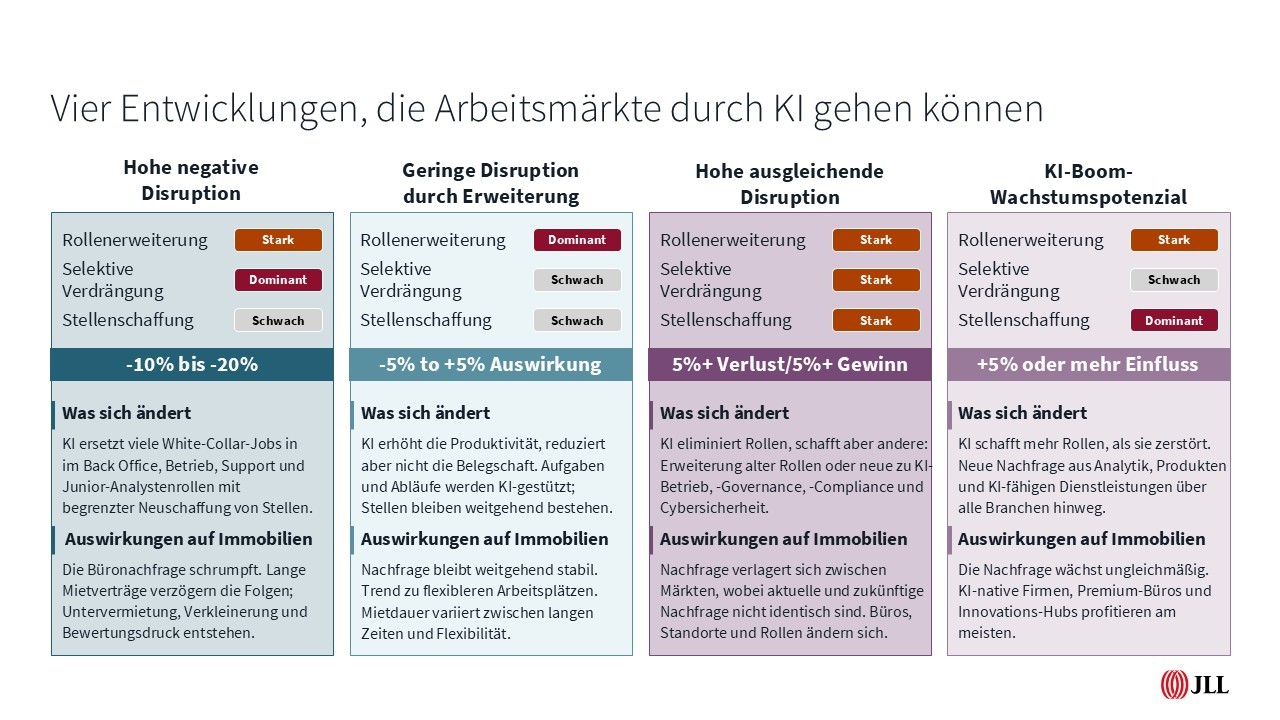
This is partly due to the fact that AI affects the labor market through three forces acting simultaneously: It expands existing areas of responsibility without reducing the number of employees, displaces certain occupational fields in a targeted manner and creates completely new fields of activity. While AI was cited as the main reason for five percent of job cuts in 2025, more than one million AI-related jobs were created between 2023 and 2025. The ratio of these forces varies greatly depending on the region and industry and leads to different developments in the respective real estate markets.
In San Francisco, for example, nearly 30 percent of all leases have come from AI companies since 2025, even though the city is one of the centers in the U.S. with the highest risk of AI-related job losses. “This trend shows that a market’s ability to adapt, seize new opportunities and redeploy the workforce is more important to real estate performance than pure exposure risk,” says Scheunemann.
The three forces described are already changing the demand on the various markets and define four characteristic directions of development:
- High negative disruption in markets where the automation of back-office and administrative tasks leads to smaller teams, thus reducing the need for traditional office space.
- Low disruption through expansion in markets where AI supports skilled knowledge workers and encourages companies to move to higher-value, collaborative offices.
- High compensatory disruption due to the restructuring of industries and the relocation of jobs to companies, creating a geographical redistribution of space demand without reducing overall demand.
- The AI boom offers growth potential in innovation hubs and AI-native sectors, leading to competition for premium buildings.
The seven German metropolises are taking different paths in this regard. Munich continues to be Germany’s preeminent city for AI-related innovations, ranking first in Europe and eleventh in the world for AI research publications. At the same time, Stuttgart benefits from an extremely robust funding environment for research and development, which corresponds to 5.9 percent of the region’s gross domestic product.
Berlin’s tech ecosystem, meanwhile, has produced as many unicorns (23) as Toronto in the past five years, surpassing competitors such as Singapore, Stockholm, Miami and Shenzhen – only Seoul recorded one more unicorn.
With nearly $54 billion in venture capital funding across Germany over the past five years, German cities are well-positioned to benefit from AI-driven economic growth and real estate investment, according to the JLL analysis.