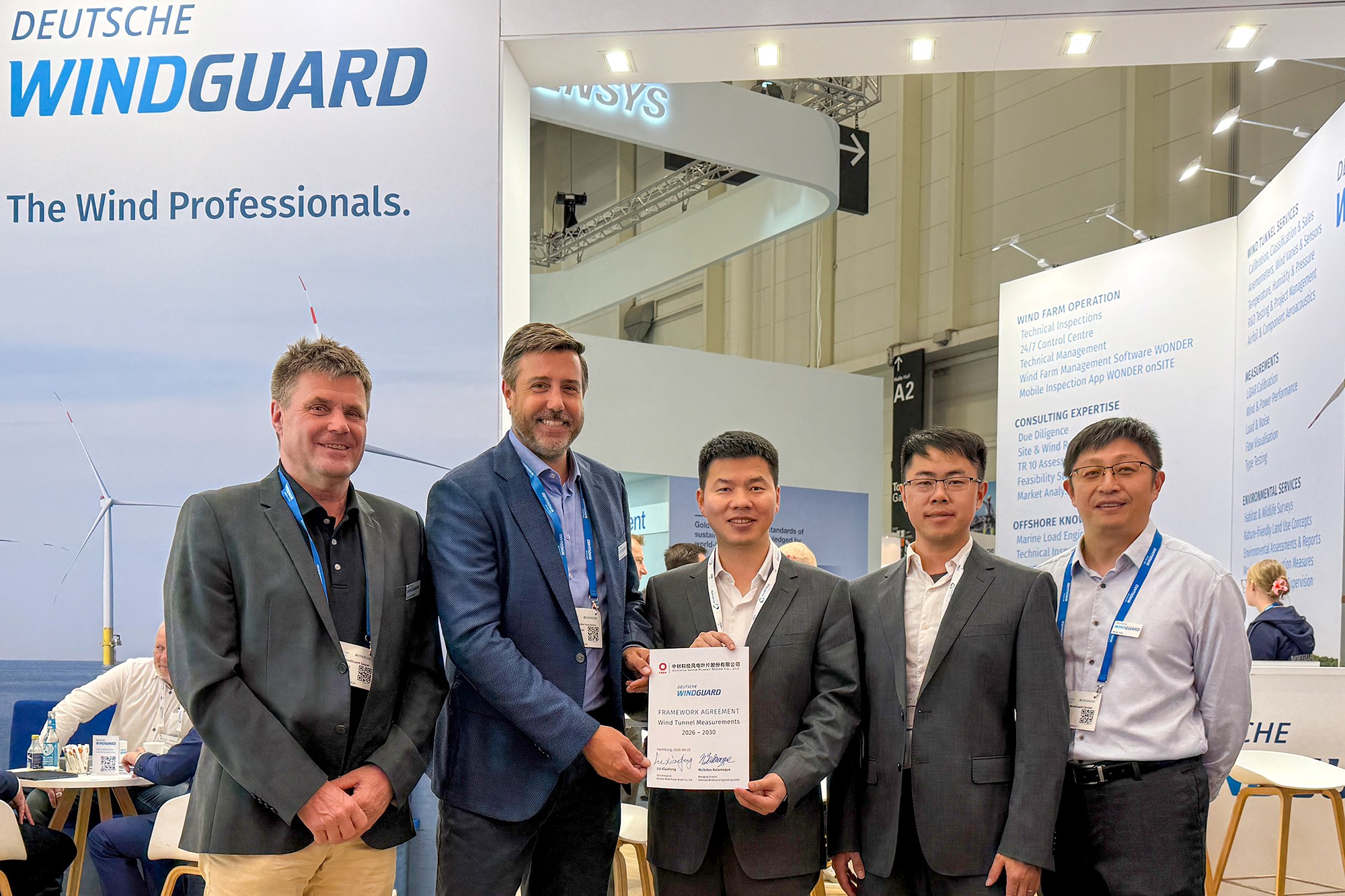
Deutsche WindGuard Engineering GmbH and Sinoma Wind Power Blade Co., Ltd. signed a long-term framework agreement yesterday at WindEnergy Hamburg. It includes tests in the large wind tunnel of Deutsche WindGuard in Bremerhaven for the period from 2026 to 2030.
The contract secures Sinoma a contingent of flexibly callable wind tunnel days at fixed conditions – on average several test weeks per year. Sinoma, one of China’s largest rotor blade manufacturers, benefits from maximum flexibility, less administrative effort and simpler campaign planning. The measurement data obtained provides Sinoma’s own rotor blade design team with a reliable basis for well-founded decisions and reliable development planning.
Lu XiaoFeng, Vice President Sinoma, explains: “With its wind tunnel expertise, Deutsche WindGuard is a valued partner for Sinoma. The framework agreement offers us flexible access to high-quality tests and reliable data. This helps us to accelerate innovation and drive the development of the next generation of rotor blades.”
The agreed services include planning, design, installation and measurement of the wind tunnel models. Based on geometry data from Sinoma’s engineers, Deutsche WindGuard Engineering manufactures profile models with a length of 1.25 m as well as add-ons such as serrations and vortex generators. The team combines comprehensive model building expertise with its own additive manufacturing for tailor-made add-on parts.
The acoustically optimised wind tunnel with its 2.75 m × 1.25 m × 5 m measuring section enables measurements at wind speeds of up to 100 m/s and Reynolds figures of up to six million. “We specialise in aerodynamic and acoustic measurements. Standardised processes ensure consistently high quality and fast, reliable implementation,” says Nicholas Balaresque, Managing Director Deutsche WindGuard Engineering. “We provide our customers with comprehensive and personal support from planning to data handover, so that they can use their wind tunnel time as efficiently as possible.”
Rotor blade manufacturers typically investigate the aerodynamic properties of profiles, the influence of surface contamination and flow noise in the wind tunnel. Further tests evaluate the noise reduction caused by trailing edge serrations as well as the influence of vortex generators or flaps on lift, resistance and stall behaviour. In the wind tunnel, optimal sizes and positions of the attachments can be determined in order to adapt a basic rotor blade design for low or strong wind locations, for example, or to reduce dynamic loads. Thermographic free-field measurements on wind turbines in operation complement the wind tunnel campaign.
Wang Yang, Managing Director Deutsche WindGuard (Beijing) Technology Co., Ltd., made a significant contribution to bringing the partners together and simplifying processes: “Our presence in Beijing gives customers in China direct access to Deutsche WindGuard’s comprehensive service portfolio along the entire wind energy value chain. Sinoma particularly benefits from our close, direct exchange, which helped us to tailor the contract to the customer’s requirements.”