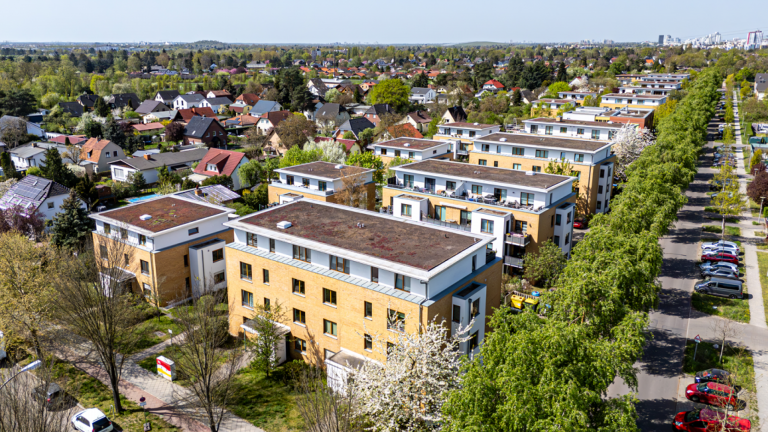
Student housing is increasingly developing into an institutional asset class in Germany. The new report “Student Housing in Germany” by Newmark shows which demand and supply drivers are shaping the PBSA market and where investment opportunities are emerging in the country. The attractiveness of the asset class for investors can be seen directly in the rents: In the top 7 markets, the median inclusive rent for furnished student housing is between 26 and 35 euros per square metre. This price enforcement makes PBSA a profitable residential asset class for investors.
Of the approximately 2.86 million students in Germany, the number of international enrolments in particular has developed dynamically. In the winter semester 2024/2025, there were 492,000 international students nationwide – twice as many as 20 years ago and 4.6 percent more than in the previous year. This group in particular is dependent on furnished, short-term and professionally operated housing offers.
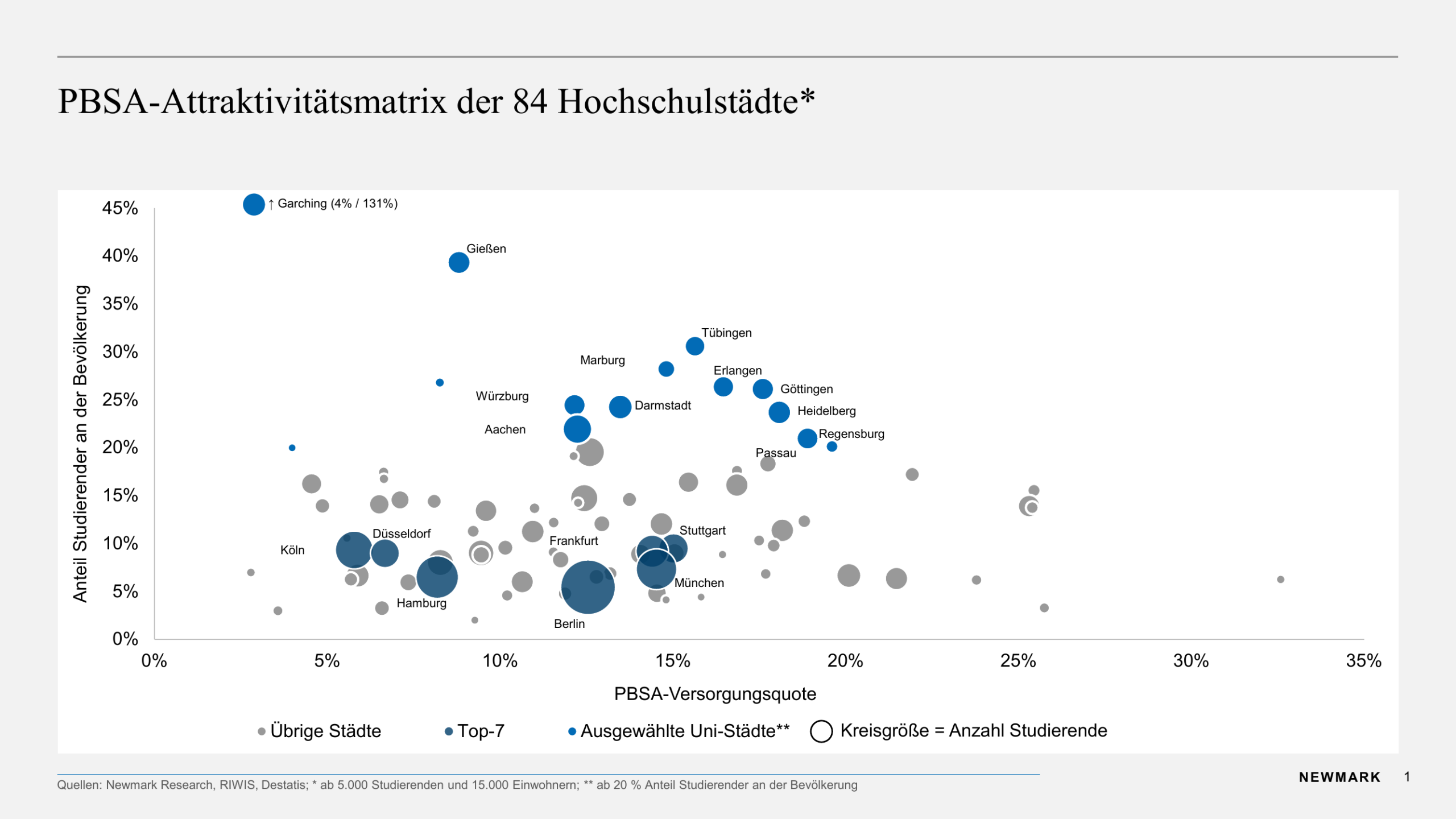
In 84 German university cities with at least 5,000 students and 15,000 inhabitants, a total of 295,000 dormitory places are available. This means that the PBSA accommodation rate, defined as the ratio of dormitory places to the number of students, is just under 13 percent.
With around 197,000 places, the student unions continue to provide the largest part of the supply. Although the number of professional operators has almost tripled within the past ten years, private operators still account for less than a third of the dormitory places in the 84 university cities surveyed.
Investment interest meets scarce product supply
Limited product availability is also a key factor in the investment market. National and international investors’ interest in PBSA has increased significantly in recent years, while institutionally investable individual properties and larger portfolios remain rare.
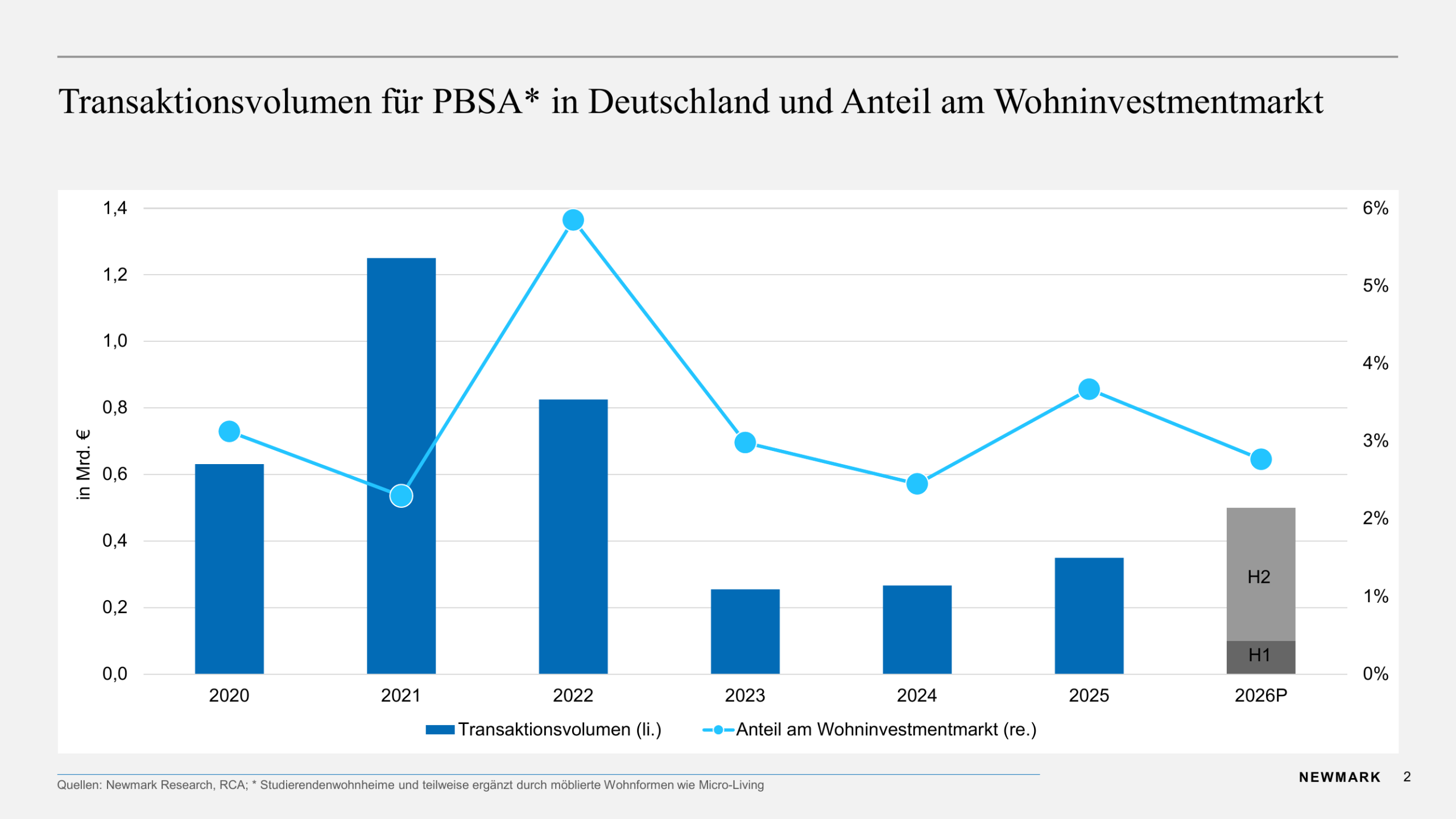
In 2025, PBSA properties worth around 350 million euros were traded in Germany, 30 percent more than in the previous year. For 2026, Newmark expects a transaction volume of more than 500 million euros. Several transactions that are currently in the closing phase as well as increasingly clear pricing contribute to this. A significant part of the volume is also driven by foreign capital: International investors accounted for 33 percent of the transaction volume in 2025.
“The market still has a lot of room for further institutionalization: Only 13 private operators in Germany each have more than 1,000 beds, together they have around 33,000. For investors, demand is therefore less of a problem than access to scalable products. As further developments and platforms come onto the market, liquidity is likely to increase noticeably,” says Helge Zahrnt MRICS, Head of Research Germany at Newmark.
Investment opportunities do not only exist in Germany’s top 7 markets. Of the 84 university cities surveyed, 14 have a student share of at least 20 percent of the total population. These include Heidelberg, Tübingen, Regensburg, Göttingen and Giessen.
“The greatest opportunities do not automatically lie in the seven largest German real estate markets. Medium-sized university cities in particular can offer very attractive risk-return profiles due to high student numbers, low housing supply and comparatively low professional competition,” says Jan Kiskemper, Head of PBSA & Micro Living Germany at Newmark.
PBSA offers yield premium compared to classic living
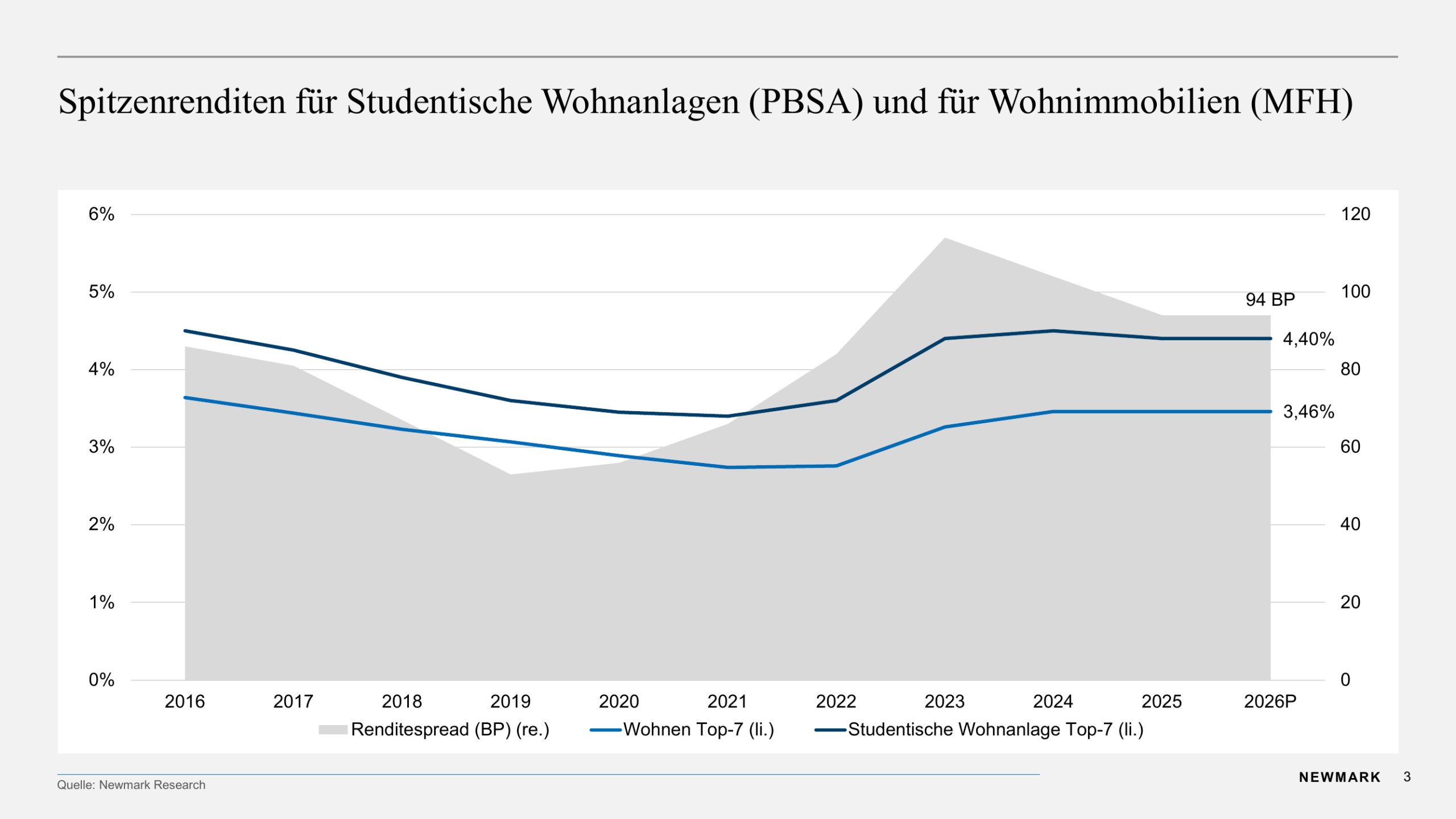
The prime yield for PBSA products in Germany’s top 7 markets currently averages 4.40 percent. This means that the yield premium compared to classic apartment buildings, whose prime yield is 3.46 percent, is 94 basis points.
Newmark expects PBSA prime yields to remain stable by the end of 2026. With increasing institutionalisation of the asset class and further growing investor demand, the gap to traditional residential investments could narrow in the future. However, due to the higher operating share of the asset class, a significant yield spread is likely to remain. Operations remain decisive for investment performance: management quality, building quality, operating costs and economies of scale have a direct impact on profitability.
The complete PBSA report “Student Housing in Germany” offers an in-depth analysis of 84 university cities and examines operator structures, rents, purchase prices, yields and regulation.