Investing in affordable housing* is once again becoming a serious investment option for investors. Public funding programmes and tax incentives are noticeably improving the economic environment. This is shown by a recent analysis by CBRE, which is available here. As a result, affordable housing can generate attractive risk-adjusted returns, especially for buy-and-hold investors, which can also be convincing in comparison to other defensive investments in the current market environment.
“When it comes to the question of affordability today, the main question is whether there is access to corresponding rental supply at all,” says Dr. Jan Linsin, Head of Research Germany at CBRE. “The sharp decline in available apartments reinforces the structural asymmetry between existing and new contract rents on the German housing market. However, since the decline in new construction activity affects all segments, there is increasingly hardly any freely available supply even in regulated and price-controlled segments.”
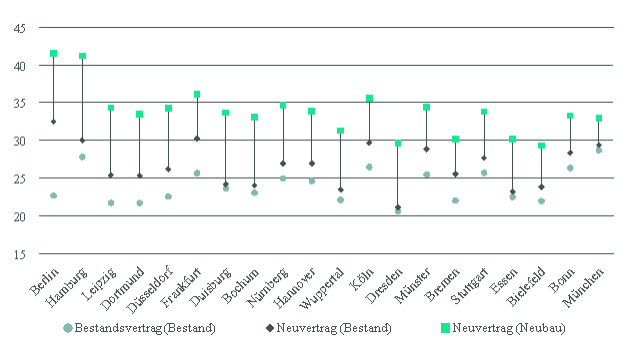
The New Contract Premium illustrates how much the real stress situation changes when changing residence. This results in a central asymmetry: while the burden ratios for existing tenants remain moderate thanks to tenant protection, new tenants encounter current market rents with significantly higher burdens directly. In tight markets, this inhibits relocation mobility and increases barriers to entry. If you look at German cities and regions, the asymmetry becomes spatially visible. While new contracts in new buildings in larger cities such as Berlin and Hamburg sometimes cost more than 40 percent of net household income, the burden in other regions such as Leipzig, Dresden or Dortmund is sometimes less than 25 percent for existing tenants.
Affordable housing pays off again, especially for long-term investors
In addition to classic social housing, investors now have numerous subsidy programs at their disposal that combine public financing assistance with market-based elements. In practice, this results in so-called mixed approach models, in which subsidized and privately financed apartments are combined within a project. The viability of these models is shown by existing programmes in individual federal states. In Berlin, for example, long-term public loans with maturities of up to 30 years can cover a significant part of project financing and can sometimes be provided on very favourable terms. Additional impetus comes from the tax side. The introduction of degressive depreciation for new residential buildings enables increased depreciation volumes in the first few years and thus improves profitability, especially in the early project phase. Together with straight-line depreciation, additional financial leeway is created, which makes investments in price-controlled residential projects more attractive.
At the same time, the investment focus in this segment is increasingly shifting from short-term exit scenarios to long-term stable income profiles. Whereas in the past the focus was often on an investment of around ten years followed by a sale, today strategies that focus on sustainable cash flows, low volatility and long-term portfolio orientation are gaining in importance. Price-controlled and partially controlled housing models in particular fit this approach because they combine predictable revenue streams with permanently high structural demand.
“For investors, this creates a functional interface between regulation and the market,” explains Jirka Stachen, Head of Research Consulting Continental Europe at CBRE. “Today, price-subdued and partially restricted housing models are less a classic exit product and more a long-term cash flow investment. They enable stable current income, a secured risk-return profile and at the same time address the structural demand for affordable housing.”
“The current challenges on the housing market can no longer be solved by the public sector alone,” says Dr. Steffen Heinig, Senior Analyst at CBRE. “Resilient housing structures are created where public funding and private capital work together. Only through close cooperation between the state and private investors can sufficient affordable and at the same time economically viable housing be created in the long term.”
*Definition of affordable housing: On the basis of international empiricism, affordable housing can be defined up to a rent burden ratio of less than 40%.
Rent burden* (in %) in the top 20 markets – Differences between existing and new contract rents