Artificial intelligence has arrived in the real estate industry. 86 percent of the companies that took part in a joint survey by aedifion and Rueckerconsult are already using AI. Among AI users, 90 percent use generative applications such as ChatGPT, Claude, Gemini or Perplexity. However, the step from individual applications to the systematic integration of AI into corporate and building processes is still pending in many places: Only 27 percent use integrated AI platforms that can access their own data sources, for example.
The results of the trend survey of 35 companies in the real estate industry were presented and discussed at the online press conference “AI in a reality check – How far has the real estate industry come?”. Participants in the discussion were Dr.-Ing. Johannes Fütterer, CEO of aedifion, Prof. Dr. Kunibert Lennerts, Professor of Facility Management at the Karlsruhe Institute of Technology (KIT), and Thomas Wiese, Technical Property Manager at B&L Property Management.
AI has so far focused on the “low-hanging fruits”
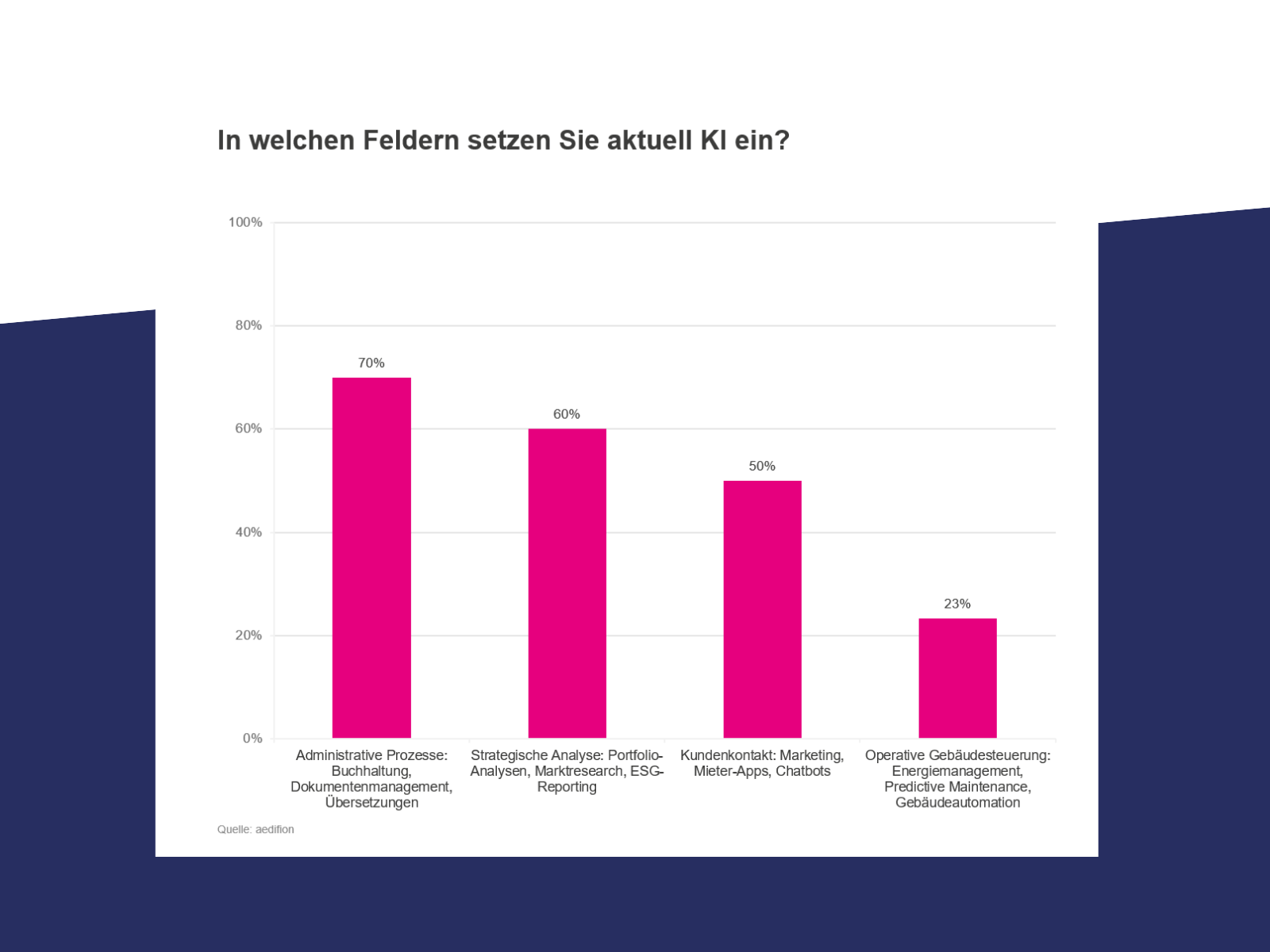
The results show a clear discrepancy between the spread of AI and its integration into real estate value creation. 70 percent of AI users use the technology in administrative processes such as accounting, document management or translations. 60 percent use it for strategic analyses, for example in portfolio analyses, market research or ESG reporting. In contrast, AI is only used in operational building control, for example for energy management, predictive maintenance or system control, in only 23 percent.
“The current readiness is still very different. At the same time, awareness in the industry has grown enormously, so processes and business models have to change,” says Dr.-Ing. Johannes Fütterer, CEO of aedifion. “Especially in asset and property management, a significant part of the daily work consists of passing on information and data between different stakeholders. If we structure this data and intelligently connect systems with each other, enormous efficiency potential is created.”
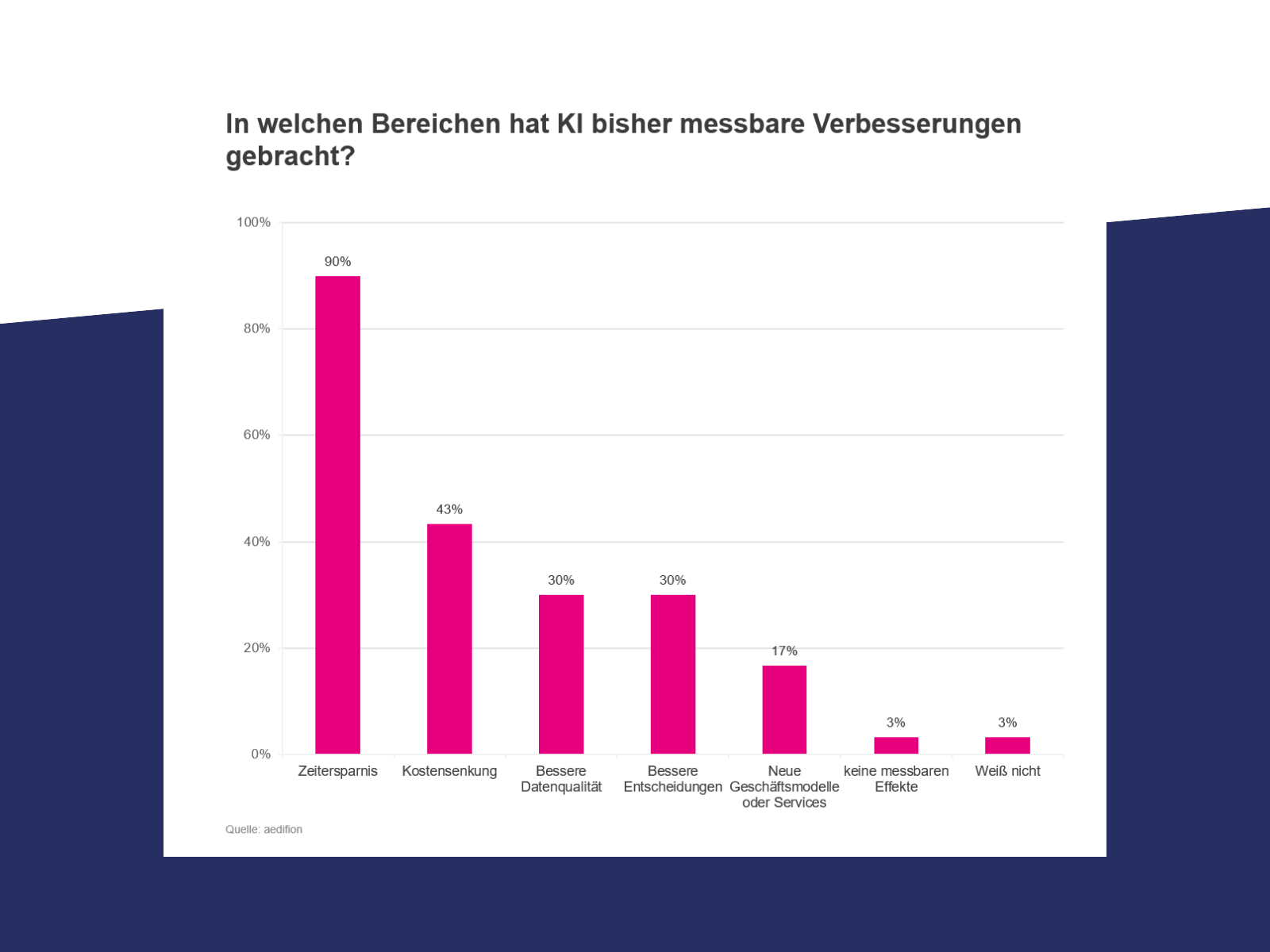
The respondents confirm that AI is already bringing concrete benefits today: 90 percent report measurable time savings. 43 percent were able to reduce costs, and 30 percent each cite better data quality and better decisions. New business models or services, on the other hand, have only been created by 17 percent.
From personal efficiency to process optimization
According to Prof. Dr. Kunibert Lennerts, this highlights a central challenge: The individual time savings through AI have not yet automatically translated into more efficient business processes.
“Many people have been using ChatGPT, Perplexity or other applications for a long time, thus simplifying their daily work. But the big step is still to come,” says Prof. Dr. Kunibert Lennerts, Professor of Facility Management at Karlsruhe Institute of Technology (KIT). “We have to make the necessary data available and change organizations in such a way that AI makes not only individual employees more efficient, but entire processes. Only then, for example, can AI agents take over structured tasks independently.”
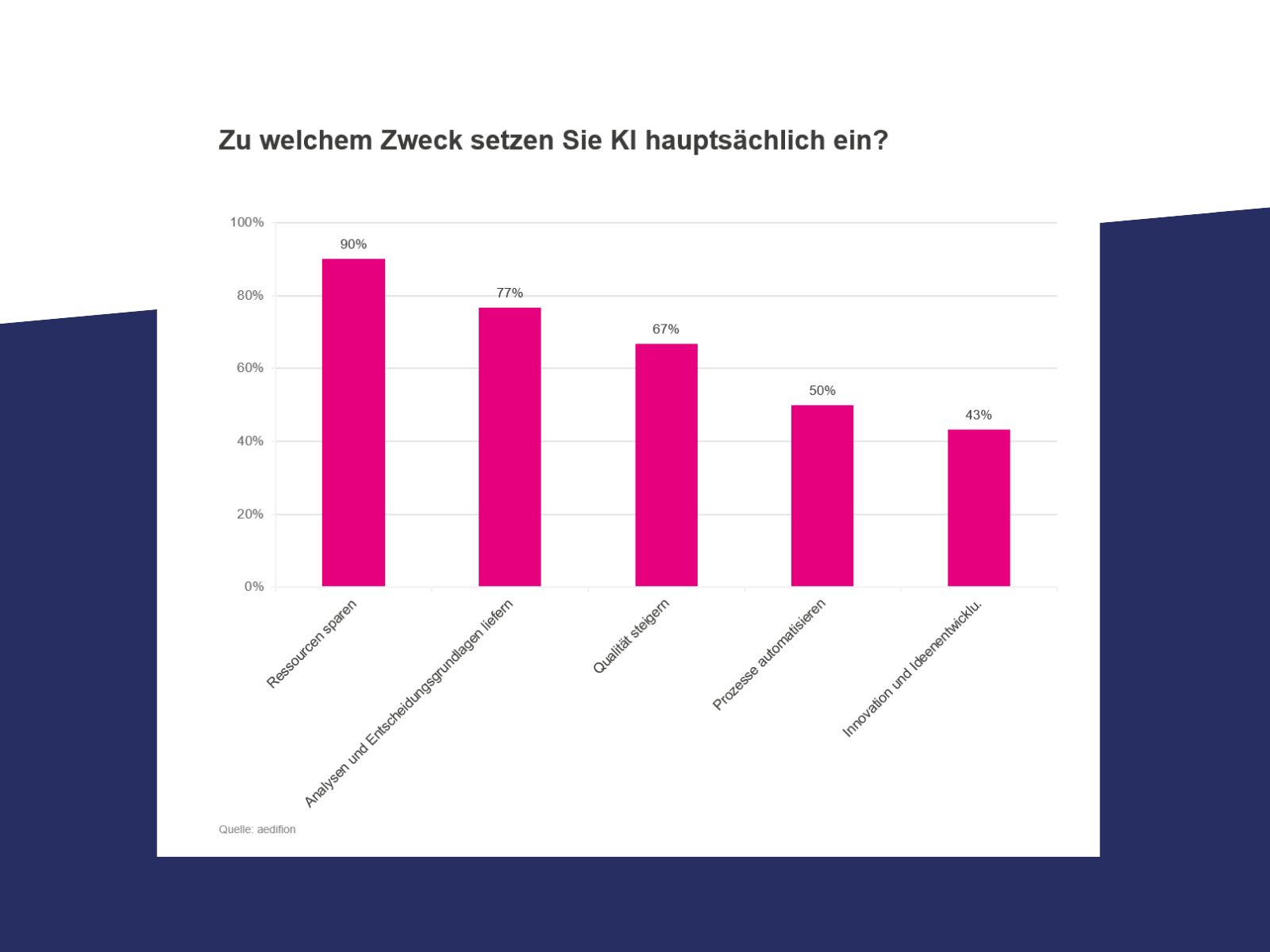
The objectives of the companies also underline the current focus on efficiency. 90 percent of AI users want to use the technology to save resources, 77 percent want to create better analyses and decision-making bases, and 67 percent want to increase the quality of their services. 50 percent cite automating processes as a goal, innovation and idea development 43 percent.
Building data: relevance recognized, usage lags behind
A particular challenge is the data basis. Currently, companies rely primarily on market and transaction data (57 percent), public sources and web data (53 percent) and internal company data (50 percent) for AI-supported processes. Building-related data is used much less frequently: Technical operating data is used by 20 percent, sensor and ESG and sustainability data by 17 percent each.
At the same time, companies recognize its importance. 63 percent consider real-time building data to be important or very important for AI-supported decisions. Especially for building operations, this has a largely untapped potential. 63 percent expect the use of AI to reduce operating costs, 60 percent to improve rentability, 37 percent to increase the life of technical systems and 33 percent to increase in value.
Thomas Wiese, Technical Property Manager at B&L Property Management, still sees a considerable need for development in practice: “On the technical side, we need live data from the properties. A lot of information from maintenance, testing or operation is still collected with a great deal of manual effort. AI can make a major contribution, especially in the subsequent evaluation of this data: We can more quickly see the condition of a property, how energy consumption is developing and where there is a need for action.”
AI strategies and budgets are lagging behind usage
In addition to data availability, governance is becoming a crucial prerequisite for the next step in development. Although 40 percent of the companies surveyed already have an AI policy, and a further 30 percent are currently developing corresponding rules. However, only 27 percent have a dedicated budget for AI.
This can also become a problem because the use of AI is by no means exclusively via officially introduced corporate solutions. If employees are not provided with suitable and secure tools, the risk increases that publicly accessible applications will be used independently and that sensitive company data may be processed in the process.
“The efficiency gains through AI are so great that companies must assume that employees want to use such tools,” says Fütterer. “That’s why they should evaluate suitable tools as quickly as possible, provide secure solutions, and create clear rules for data storage and data processing. Governance does not mean preventing AI, but transferring its use into a secure and productive framework.”
Wiese confirms the importance of these framework conditions from the user’s point of view: “Data security is a crucial point for us. Companies must give their employees opportunities to use AI officially and securely. This includes secure tools as well as training and a common understanding of which data may be processed in which systems.”
90 percent want to expand the use of AI
Despite the hurdles that still exist, the survey shows a high level of dynamism: 90 percent of AI users want to further expand the use of artificial intelligence. Its importance for competitiveness is also rated highly. On a scale of one to ten, AI achieves an average score of 7.5. The willingness of employees to actively use AI is 7.1 points on average.
As a result, the challenge for real estate companies is increasingly shifting from the question of whether to use AI to the question of how to scale the technology and integrate it into their value creation. It will be crucial to systematically combine internal company data with real estate, operational and real-time data, to further develop processes accordingly and to create clear organizational framework conditions.
“AI is no longer a topic of the future in the real estate industry. The next stage of development is to turn selective efficiency gains into an operational transformation,” Fütterer sums up. “If we succeed in combining business processes with structured building data, AI can not only save time, but also pay directly into operating costs, asset performance and ultimately the value of a property.”
To the survey
Companies from different areas of the real estate industry took part in the joint survey conducted by aedifion and Rueckerconsult. The largest share is made up of companies from the investment and asset management sector. In addition, investors and family offices as well as companies from facility management, project development and property management took part. The survey is not representative. Detailed questions on the use of AI refer to the 30 companies that are already using AI.