Two-day conference “Stimmann’s City – Work and Impact” takes stock and asks about the lessons for tomorrow’s urban development
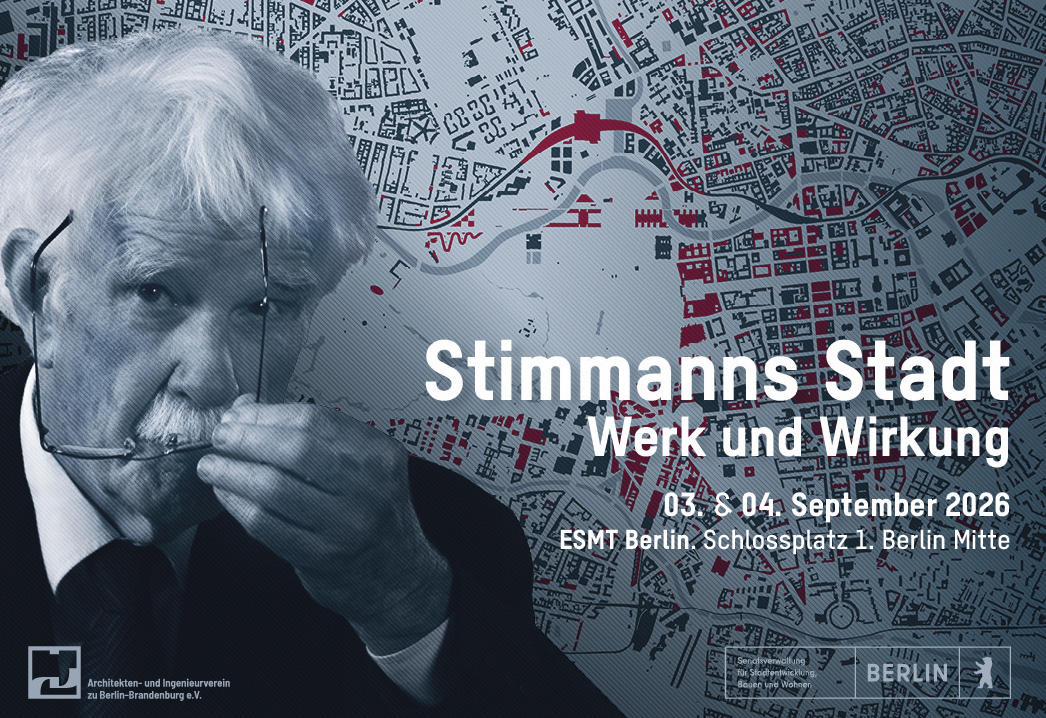
What remains of Hans Stimmann’s urban planning thinking and what can Berlin learn from it for the future? For two days, architects, urban planners, politicians, scientists, and companions of the former Berlin Senate Building Director discussed the work and impact of one of the most influential personalities in Berlin’s urban development after reunification at the invitation of the Berlin-Brandenburg Association of Architects and Engineers (AIV) and the Senate Department for Urban Development, Building and Housing. The conference “Stimmann’s City. Work and Impact” on September 3 and 4 at ESMT Berlin on Schlossplatz explicitly saw itself not only as a retrospective, but also as a contribution to the current debate about the future of the city. Stimmann, who died on August 30, 2025, had a significant influence on Berlin’s urban development for many years as Senate Building Director and State Secretary.
The focus of the conference was therefore not only on Stimmann’s “Critical Reconstruction”, the planning of the inner city or the major architectural debates of the post-reunification period. There was also a discussion about the prerequisites a city needs today in order to steer its spatial development again in a long-term and quality-oriented manner. In doing so, the view deliberately went beyond Berlin: examples and experiences from Hamburg, Osnabrück, Vienna as well as the international discourse on the European city broadened the Berlin perspective.
“Hans Stimmann did not shape Berlin because all his positions were undisputed. On the contrary. He forced the city to deal with its own future. He had an idea of what Berlin should look like and function, and was prepared to argue about it publicly. It is precisely this combination of a professional attitude, a long-term perspective and the courage to debate that we need more strongly today,” says Christian Müller, AIV CEO.
Urban development needs attitude and decisions
A common thread of the conference was the question of the responsibility of the public sector. Stimmann understood urban development not as the sum of individual building projects, but as a public task. For him, block edges, parcels, mixed uses, public space and orientation towards the historic urban layout were components of an overarching understanding of the city. His positions triggered fierce controversy, but at the same time made architecture and urban planning the subject of a broad public debate.
In doing so, the conference also showed the ambivalences of his work. For political culture, according to one of the theses discussed, is not exhausted in participation and discussion. Democratically legitimized politics must also pursue goals, take responsibility and be able to make decisions.
For Tobias Nöfer, board member of the AIV and initiator of the conference, this is a central lesson: “The fact that the Stimmann era is still polarizing was already evident when this event was announced. But good urban development needs public institutions and responsible personalities who not only approve individual projects, but also formulate goals, design procedures and use the power of the power given to them to enforce what is technically appropriate and socially necessary.”
The European city remains relevant, its tasks have changed
A special focus of the second day of the conference was on the question of the future of the European city. Stimmann associated it with density, mixing, plots, short distances, a clearly defined public space and a design standard for the city. At the same time, the contributions made it clear that the challenges are different today: climate adaptation and resource scarcity, the transformation of the building stock, affordable housing and new requirements for mobility and open space are fundamentally changing the conditions of urban development.
This also shifts the task. It is less about reproducing a historical city model and more about developing the existing city. Building culture, climate protection, social participation and economic development must be thought of more closely together.
This is precisely why the idea of the European city continues to be relevant. It stands for a city of mixing, proximity and public space, and thus also for a social space in which encounters, exchange and confrontation are possible.
What do we take with us for the future?
From the AIV’s point of view, three tasks in particular can be derived from the two days of the conference for future urban development: Berlin needs long-term spatial models, strong public responsibility for urban development and building culture, and a new, serious culture of debate about the shape of the city.
It is expressly not a matter of continuing the planning instruments or aesthetic ideas of the Stimmann era unchanged. The international perspective of the conference already showed that Stimmann’s significance lies less in the transferability of a finished “Berlin model” than in having initiated a fundamental discussion about the form, history, urbanity and political governance of the city.
“The decisive demand after these two days is therefore: do we ourselves have the courage to formulate an idea of the city again that goes beyond the individual project and the next legislative period! Berlin is facing enormous tasks. To do this, we need a new urban planning will for the 21st century,” said Müller.
For the AIV, the conference is therefore a mandate to continue the discussion. For a central quality of the Votun years – despite all the harshness of the disputes at the time – was the public preoccupation with architecture and urban planning. The question of how Berlin should be built was part of the social and political discourse. The conference also reminded us that this culture of debate is much weaker today.
Nöfer concludes: “The city is created over generations. This makes it all the more important that decisions are not made solely from the perspective of the moment, but with knowledge of its origins. Hans Stimmann’s perhaps most important legacy is therefore not the height of the eaves or individual urban planning rules. It is the claim to think of the city as a whole. We should reformulate this claim for Berlin, open to the demands of our time, but with the same seriousness towards the built space.”
High-profile conference
At “Stimmann’s City – Work and Impact”, numerous renowned personalities from architecture, urban planning, politics, science and journalism discussed Hans Stimmann’s work and the future of the European city. The speakers and discussion partners included Petra Kahlfeldt, Senate Building Director Berlin, Eberhard Diepgen, former Governing Mayor of Berlin, Peter Strieder, former Senator for Urban Development, Volker Hassemer, former Berlin Senator, Ephraim Gothe, District Councillor for Urban Development in Berlin-Mitte, and Franz-Josef Höing, Chief Planning Director of the Free and Hanseatic City of Hamburg. From architecture, urban planning and science, Hans Kollhoff, Harald Bodenschatz, Dieter Hoffmann-Axthelm, Philipp Meuser, Hilmar von Lojewski, Thimo Weitemeier, Silvia Malcovati and Birgit Rapp were represented, among others. They were joined by Hannes Swoboda, former Vienna City Councillor for Urban Planning and Urban Design and President of the Architekturzentrum Wien, as well as the publicists and authors Jens Bisky and Simon Strauss.