The German industrial and logistics real estate market continued its recovery in the first half of 2026. With take-up of 3.8 million square metres in the first half of 2026, the market exceeded the previous year’s result by 28 per cent. Rental revenue developed particularly dynamically, with earnings up 41 percent compared to the first half of 2025. One of the main drivers of this development was the return of large-volume leases: After no corresponding agreements in the previous year, 13 leases for 50,000 square metres were already registered in the first six months of 2026.
Germany is asserting its role as one of Europe’s leading logistics markets. Global supply chain shifts and geopolitical developments are increasingly influencing demand developments. Asian companies in particular and industries with security-relevant logistics requirements are providing new impetus. However, this additional demand continues to meet a limited supply: Above all, the weak new construction pipeline and a lack of modern logistics space are slowing down market activity.
The largest deals in the first half of the year include two leases by Asian users – a new construction project with 58,000 square metres in Rieste and an existing property with 52,000 square metres in Oelde. In addition, there is the new BTS development for the clothing management of the German Armed Forces in the Nuremberg region with around 65,250 square meters.
The share of Asian companies in take-up rose to 11 per cent in the first half of the year, which is still significantly higher than the previous year’s figure. Modern logistics spaces are particularly in demand in regions with good connections to international flows of goods, such as Frankfurt, Hamburg or the Ruhr area. At the same time, short planning horizons and the sometimes limited creditworthiness of Asian users continue to pose challenges for owners and investors. For example, not every land application can be met, as suitable areas are often lacking. In addition, investment processes are longer due to the limited creditworthiness of the user.
Demand in the top 8 markets remains stable
At the end of the first half of 2026, the top 8 logistics markets achieved take-up of 1.2 million square metres, only 3 per cent below the previous year’s figure. In five of the eight locations, a noticeable recovery in demand is already evident.
Despite some significant regional differences, there is a uniform trend: the number of deals is increasing, while the average area size is decreasing. Around 63 percent of all deals were in the segment below 3,000 square meters. This is mainly due to a change in the demand structure due to new user groups, such as padel providers, as well as an increased focus on central locations.
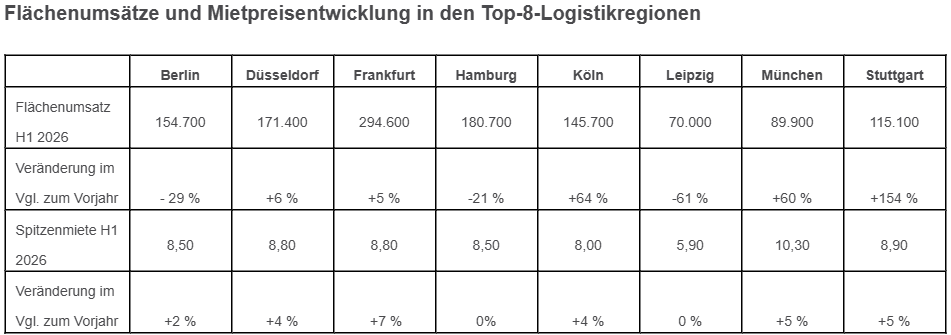
Within the top 8 markets, Frankfurt achieved the highest take-up with 294,600 square metres, followed by Hamburg with 180,700 square metres – two markets with direct connections to global supply chains, but which develop differently in a long-term comparison. While Frankfurt grew by 6 per cent compared to the same period last year and even exceeded the five-year average by 35 per cent, Hamburg fell short of the previous year’s figure by 21 per cent due to the limited supply of space. However, this decline is largely due to the limited supply of space. The Leipzig region recorded the lowest take-up of space at 70,000 square metres. Despite good space availability, economic uncertainty there continues to cause a pronounced reluctance on the part of users to make decisions.
With the exception of Düsseldorf, Frankfurt and Hamburg, more trades were registered in all other markets than in the same period last year – a clear indicator of increasing market activity. A total of 26 major deals were recorded in the first half of the year, 16 of them in the second quarter alone. The largest leases include Siemens with more than 30,000 square meters in Offenbach, H&G AG with around 27,800 square meters in Hamburg and a new BTS building from Wisag AG in Krefeld with around 20,000 square meters.
In the first half of the year, there was an increased presence of Asian users in Frankfurt (share of 4 percent), Hamburg (9 percent), Düsseldorf (11 percent) and especially Cologne (24 percent). In Berlin, on the other hand, demand was largely driven by European retail and e-commerce companies. In Munich, companies from the defense sector were more active than average and, with a share of 18 percent of take-up, represented a significant demand impulse. The development in Stuttgart is different: The economic challenges of the industrial region are leading to job cuts and plant closures, while new impulses are coming from the leisure and sports segment – especially from padel suppliers.
Christian Kah, Head of Industrial & Logistics Germany at Colliers, says: “The current key figures point to a continued moderate, but at the same time clearly recognisable recovery in demand for space. Nevertheless, the interpretation requires a differentiated view. A key limiting factor remains the shortage of space in conjunction with a weak new construction pipeline, which affects almost all top 8 logistics markets. The only exceptions are currently Berlin and Leipzig. International users in particular are encountering space bottlenecks that they are often unfamiliar with in other markets. As a result, many large-scale searches cannot be realised in the core markets and are either postponed or shifted to space offers in the periphery.”
Rental growth: focus on existing space, while new construction remains empty
Both prime and average rents in the top 8 logistics markets are recording moderate year-on-year growth. With an increase of 5 percent, average rents developed more dynamically than prime rents (+3 percent). As in the first quarter, Frankfurt has the highest rental dynamics: the prime rent for new-build properties rose by 7 percent, while existing rents rose by as much as 10 percent. In Berlin and Leipzig, on the other hand, where there is still comparatively high space availability, rents were more subdued. The most expensive locations remain Munich (10.30 euros/square metre) and Stuttgart (8.90 euros/square metre). Both locations recorded an increase of 5 percent each.
Kah clarifies: “Three central factors are decisive for further rental growth: increasing demand dynamics, a suitable, but at the same time scarce supply of space and users willing to pay. This constellation is currently particularly evident in Frankfurt, Düsseldorf and Cologne. Munich and Stuttgart occupy a special position due to their high share of existing properties, the limited supply of development space and their user structure geared towards light industrial properties. Accordingly, they develop their own market dynamics.”
On the basis of the currently available land applications, Colliers expects demand to pick up in the second half of the year. However, this is unlikely to provide additional impetus for rental growth until the medium term.