BERLIN OFFICE MARKET. CITY REPORT REGION BERLIN 2026/2027, No. 36.
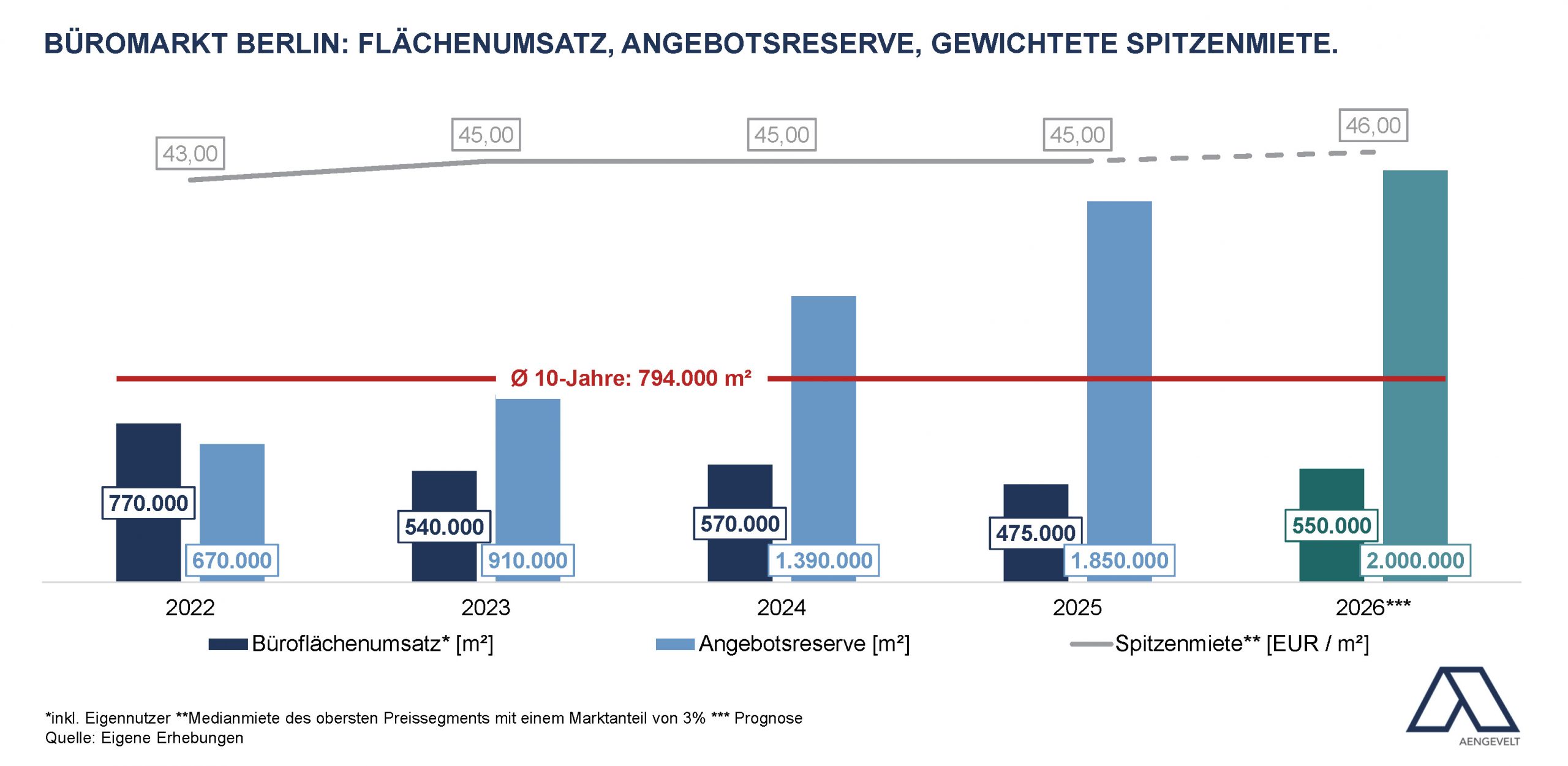
According to analyses by Aengevelt Research, the Berlin office market achieved office space take-up of around 475,000 m² in 2025, which is around 17% below the previous year’s figure (2024: 570,000 m²), while remaining around 40% below the decade average (Ø 2015-2024: 794,000 m² p.a.).
With this result, Berlin ranks third nationwide behind Frankfurt (approx. 564,000 m²) and Munich (approx. 550,000).
For 2026 , Aengevelt Research forecasts an increase in office space take-up of 550,000 m² and thus a gradual recovery of the Berlin office market.
This is also confirmed by take-up in the first quarter of 2026 , with office space take-up of around 151,000 m², which is around 51% higher than in the same period of the previous year (Q1 2025: approx. 100,000 m²), but still remains around 10% below the Dakaden average (Ø 1st Q 2015-2024: approx. 168,400 m²).
Supply reserve increases significantly.
In 2019, the short-term supply reserve (available within three months) fell to a completely inadequate 280,000 m². Since then, it has risen again and stands at around 1,850,000 m² at the beginning of 2026 (beginning of 2025: around 1,390,000 m²). The vacancy rate has thus increased to around 8.4% (beginning of 2025: 6.4%) with a total office space stock of around 22 million m².
If one subtracts from this the fluctuation reserve of around 900,000 m² required for the smooth functioning of the market as well as the latent and structural vacancy rate (185,000 m² and 170,000 m² respectively), the surplus of around 600,000 m² is rising again after years of supply deficit.
By the end of 2026 , Aengevelt Research expects the supply reserve to increase further to around 2 million m² .
Office space completion falls below decade average.
Since 2020, the volume of new or extensively renovated office space has grown significantly and significantly exceeded the 500,000 m² mark between 2021 and 2023 (2021: approx. 580,000 m², 2022: approx. 750,000 m²; 2023: approx. 617,000 m²). In 2024, there was significantly less new construction space at around 495,000 m².
For 2025 , Aengevelt Research analyses a further decline in completion volume of around 400,000 m² , which is moderately below the decade average (Ø 2015-2024: approx. 422,000 m²).
According to the current state of registration, a completion volume of around 400,000 m² of new office space is expected for 2026.
This means that the supply of sustainable, ESG-compliant office space continues to grow – a positive development, as this space is also the focus of demand for broad, especially international user groups. On the other hand, older, energy-suboptimal properties are losing their attractiveness and are becoming increasingly difficult to market.
Rental price level unchanged.
The weighted prime rent is stable compared to the previous year at currently around EUR 45/m². This puts Berlin in third place behind Munich (EUR 58/m²) and Frankfurt (EUR 54/m²). The median rent in central locations is also unchanged at around EUR 29/m².
In the course of 2026 , Aengevelt Research forecasts a slight increase in prime rents of around EUR 46/m².