
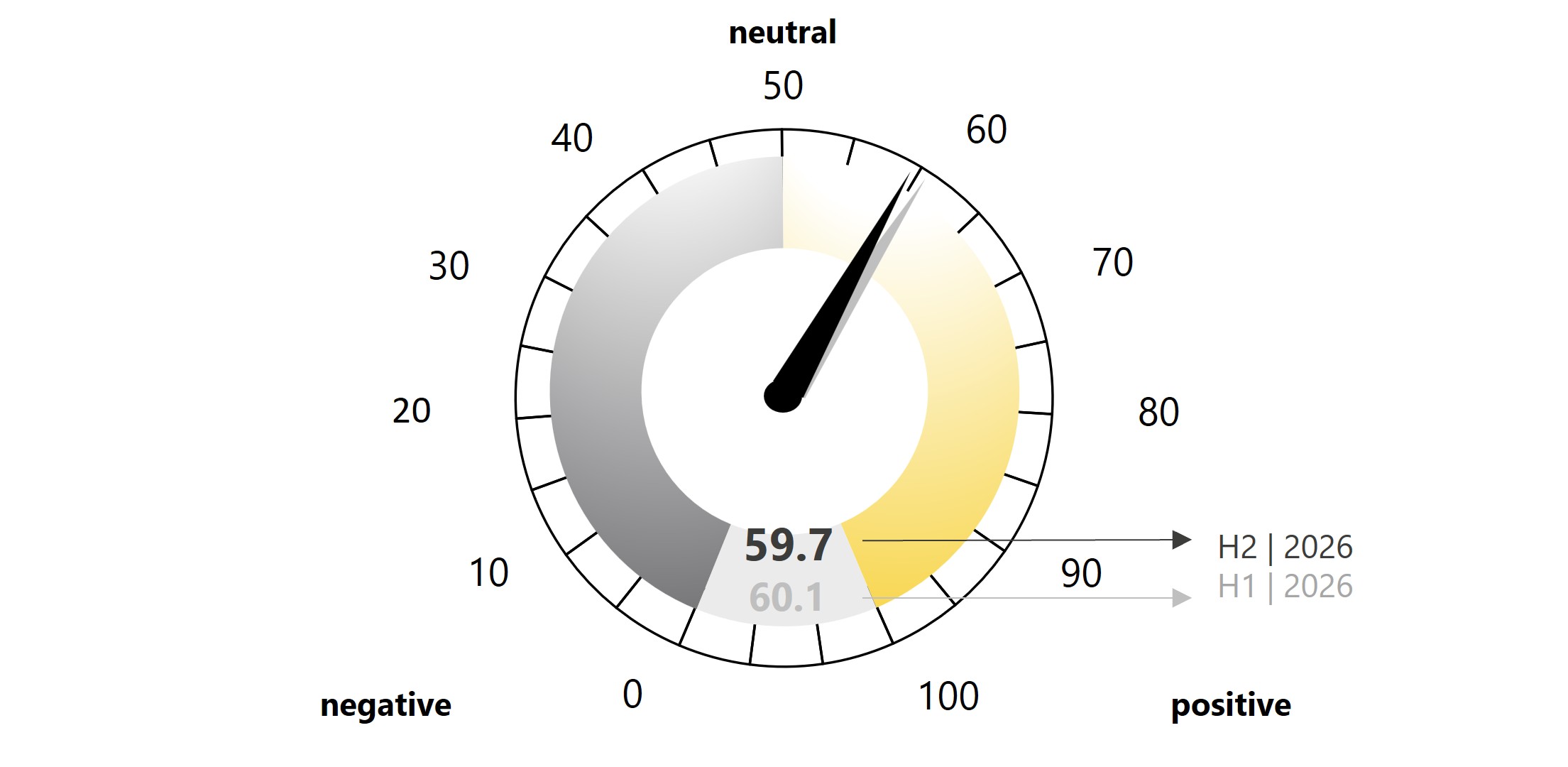
The BF.Private Debt Market Sentiment Index stands at 59.7 points during the second half of 2026 and thus remains well above the neutral score of 50. This means that sentiment on the international private debt market has barely shifted since the survey for the first half-year, which returned a score of 60.1 points. The so-called expectation gap, meaning the difference between the forward-looking component and the retrospective component of the survey, signals a cautiously positive outlook.
The results reveal a gradual improvement of the financing conditions in favour of lenders, whereas the first half-year had still been defined by tendencies that were tentatively borrower-friendly. The general partners surveyed expect this trend to continue for another six months. The leverage profiles reported for the corporate direct lending, real estate debt and infrastructure debt sub-segments represents mostly moderate levels. This means that the risk-return profile has generally stayed attractive from the lenders’ point of view.
Fundraising, While Still Robust, Is Normalising
Fundraising remains a key pillar of the positive market sentiment. Although the fundraising dynamic has somewhat slowed in the months since the first survey, the environment remained generally constructive. A growing share of the respondents reporting stable fundraising conditions while responses reporting significant deterioration are still the exception.
In a parallel development, the trend in capital commitments by institutional investors has proven to be resilient, albeit on a lower level. An increase in commitments by limited partners was reported by 59 percent of the respondents (H1: 64 percent). For the next six months, a majority of 62 percent also anticipates a further increase in capital commitments (H1: 71 percent). Re-ups of existing commitments remain an important stabilising anchor. Close to 87 percent of the survey participants reported re-up rates of over 40 percent in the corporate direct lending segment. This compares to re-up rates of 80 percent in real estate debt and of 78 percent in infrastructure debt.
Credit Quality Remains Sound – Risks Being Sector-Specific
The credit quality of the portfolios remains largely stable despite persistent macroeconomic and geopolitical uncertainty. For 75 percent (H1: 85 percent) of the respondents, the ratios of non-performing or underperforming loans have not changed over the last six months. Significant deteriorations are cited only by very few respondents. During the next six months, a clear majority expects default and non-accrual rates to remain stable, although it should be added that the percentage of respondents who predict a surge here increased from 1.6 to 6.6 percent. Stress factors within the portfolios generally continue to affect specific sectors and property types rather than pointing to structural financing problems.
Growth and Acquisitions Define Transaction Activity
This second edition’s special feature examines the evolution of transaction targets within the private debt market. Eugenio Sangermano, Managing Director of BF.capital, said: “The evidence suggests that acquisition financing continues to play a key role across segments. At the same time, financing solutions to boost growth, expansion and strategic capital allocation keep gaining in significance. By contrast, restructuring situations or distressed situations remain the exception.”
Prof. Dr. Michael Flad, tenured chair for finance & entrepreneurship at the Esslingen University and scientific adviser of the BF.Private Debt Market Compass, added: “The survey findings emphasise that demand for private debt financing arrangements continues to be largely defined by entrepreneurial growth and investment activities, and not by growing financial stress on the borrower side.”
About the survey:
The BF.Private Debt Market Compass is compiled semi-annually by BF.capital GmbH. Its scientific adviser is Prof. Dr. Michael Flad, who holds the chair for finance & entrepreneurship at the Esslingen University. Twice a year, the panel survey captures the assessments of around 200 private debt fund managers worldwide, the focus being on the private debt sector in Europe. It covers the sub-segments of corporate direct lending, real estate debt, and infrastructure debt.
For this latest edition, a total of 63 market players were interviewed in June 2026. Together, the participating companies handle a weighted average of c. 80 billion euros in assets under management.
You may download the full-length survey as a PDF: www.bf.capital/news