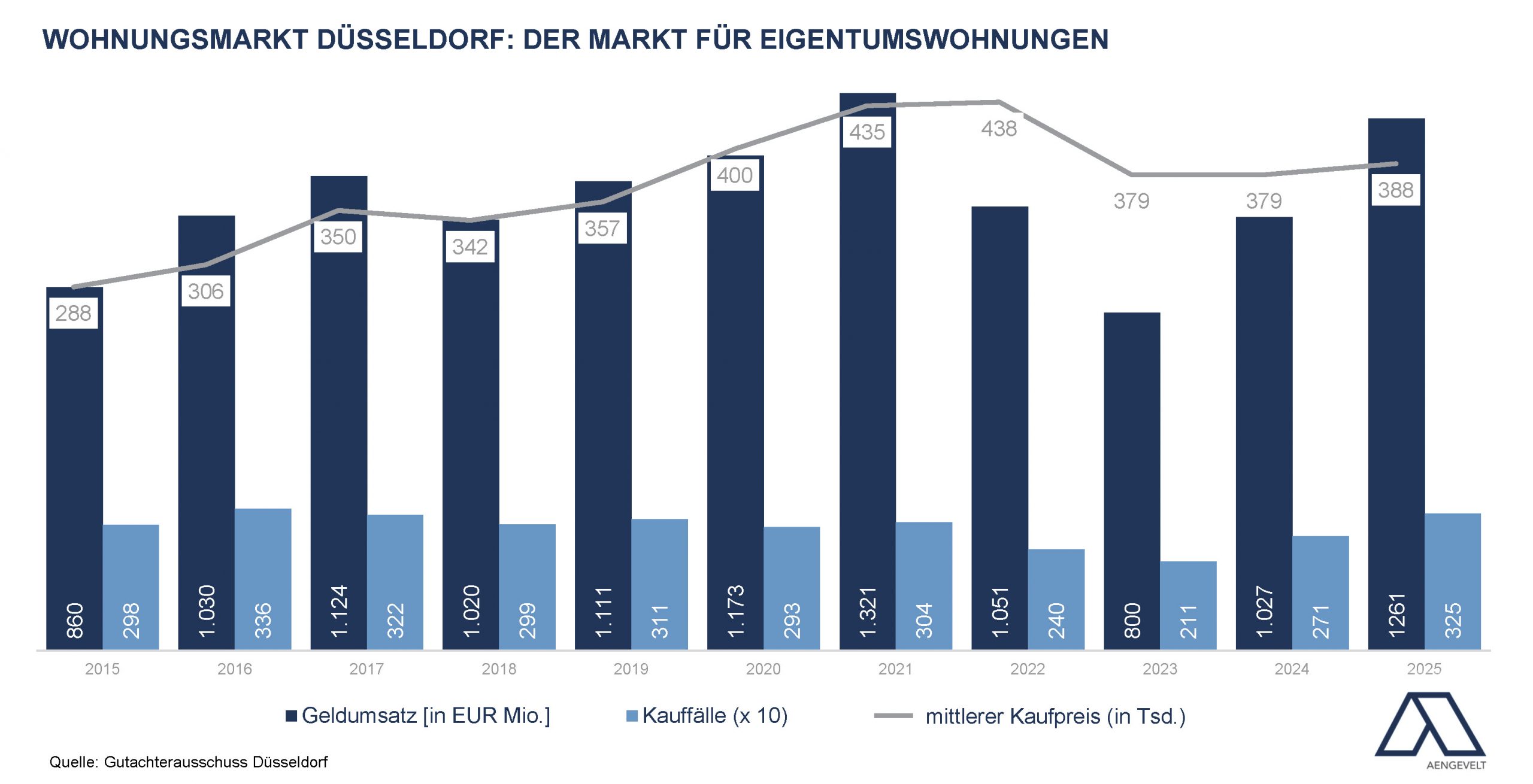
According to analyses by Aengevelt Research, a cash turnover of around EUR 1.71 billion was achieved in 2025 on the Düsseldorf market for private real estate (condominiums, detached and semi-detached houses). This figure is around 16% above both the previous year’s figure (2024: EUR 1.48 billion) and the decade average (Ø 2015-2024: EUR 1.47 billion).
- In the condominium segment, the transaction volume in 2025 increased by around EUR 234 million or 23% to EUR 1.03 billion compared to the previous year (2024: approx. EUR 1.03 billion). In addition, the level of the decade average (Ø 2015-2024: EUR 1.05 billion) will be exceeded by 20%.
In the case of detached and semi-detached houses (single-family homes/single-family homes), cash turnover in 2025 reached the previous year’s level of around EUR 451 million (2024: approx. EUR 458 million) and is also around 7% above the ten-year average (Ø 2015-2024: EUR 422 million).
There were different developments in the average purchase prices: While they rose slightly year-on-year to around EUR 388,000 (2024: EUR 379,000), they fell by around 11% to EUR 866,000 (2024: EUR 974,000) for single-family homes/holiday homes.
- For 2026 , Aengevelt Research forecasts that demand on the private real estate market will generally continue, but this may be slowed down and limited by possible further increases in loan interest rates, rising inflation and global economic developments and the associated uncertainty of many prospective buyers.
Declining new residential construction exacerbates shortage in Düsseldorf.
The generally high demand for apartments to buy or rent is generated by the population and household growth in Düsseldorf that has been going on for years. Since 2014, Düsseldorf has grown by more than 30,000 people to around 635,000 inhabitants at the end of 2025. This also increased the number of private households – as housing buyers – to around 356,850.
- According to forecasts by the state database NRW, IT NRW, the population in Düsseldorf could “crack” the mark of 700,000 inhabitants by 2040. This means an increase in private households (as housing demanders) of up to 40,000.
- If one adds the new construction demand derived from this with the current (nominal) housing deficit of approx. 10,700 dwellings and the minimum maintenance requirement “new versus old” amounting to approx. 0.5% p.a. of the total housing stock (approx. 356,900 residential units = approx. 1,785 residential units p.a.), this results in a total new construction requirement of approx. 5,500 dwellings that would have to be built in Düsseldorf every year until 2030.
In 2024, however, only around 1,800 apartments were completed and in 2025 , according to projections, there were only around 1,750 apartments, i.e. less than the minimum maintenance requirement. Building permits have also fallen compared to 2019, when 3,743 new apartments were approved, to only 2,047 permits in 2025 .
- In addition to a further shortage of supply, the consequences are in particular further increases in residential rents.
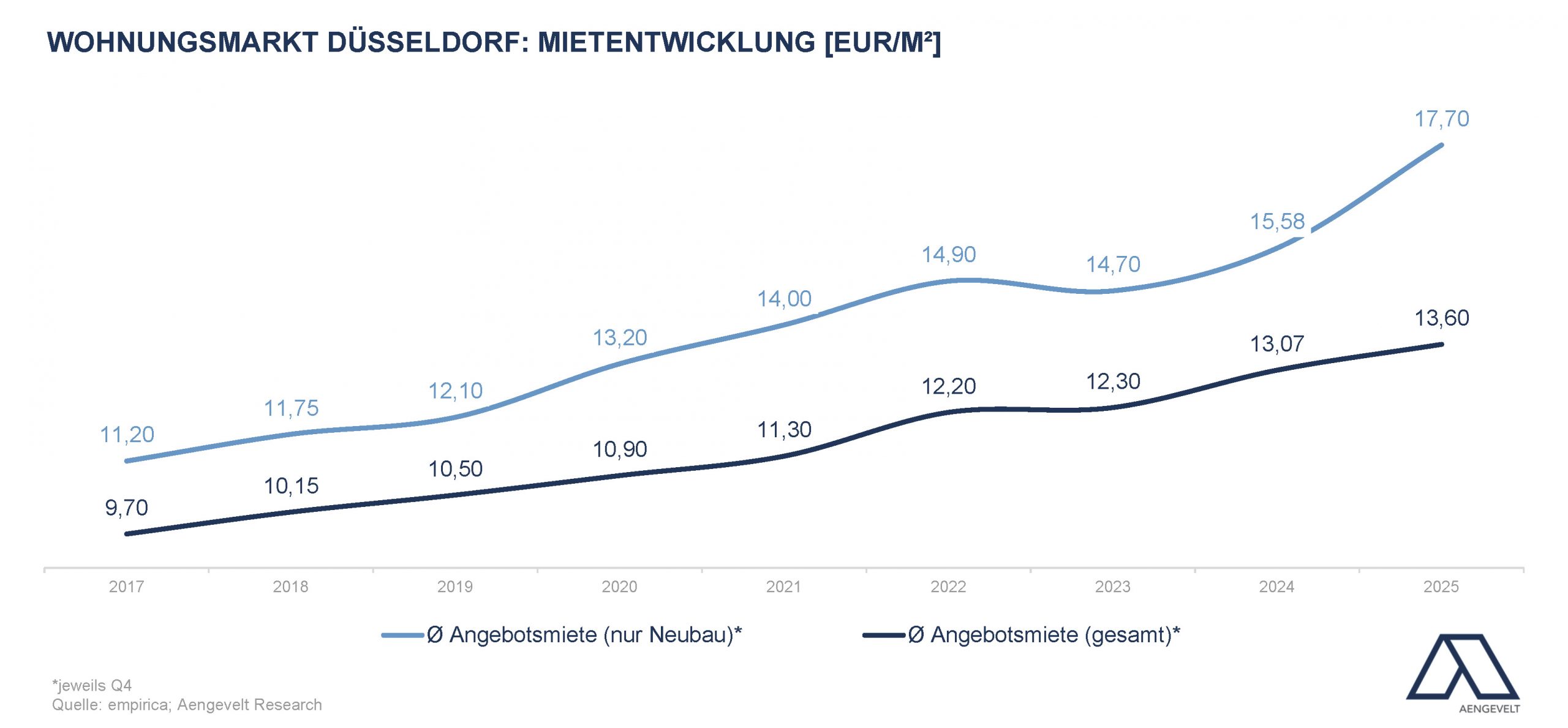
According to Empirica, asking rents for new-build apartments have risen by 58% since the fourth quarter of 2017 from EUR 11.20/m² to EUR 17.70/m² in the fourth quarter of 2025 , by around 2024 alone (EUR 15.60/m²). 13,5 %.
Asking rents across all years of construction have also risen significantly since 2017 by 40% to EUR 13.60/m².
• Conclusion: Without a targeted expansion of supply, especially in the lower-priced apartment segments, the price trends shown will continue, at least in the medium term.