

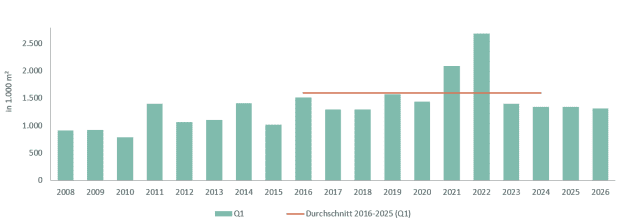
The German industrial and logistics real estate market achieved take-up of 1.3 million square metres in the first quarter of 2026, two per cent below the same quarter of the previous year. Take-up was in line with the level of the first quarters of the past three years. In terms of take-up, Hamburg was the strongest market, followed by the Ruhr region. Both stores exceeded the 100,000 square metre mark in the first quarter. This is the result of an analysis by the global real estate service provider CBRE.
“While the macroeconomic environment is challenging, this was not reflected in the same clarity in the German industrial and logistics real estate market,” says Sarina Schekahn, Head of Industrial & Logistics Leasing Germany. For example, the big-box vacancy rate has fallen by 0.3 percentage points to 4.7 percent since the end of 2025 – not least because speculative new construction has declined. For example, take-up in new buildings fell by 21 per cent to 526,000 square metres compared to the first quarter of 2025. This is one of the reasons why the prime rent in the top 5 stores rose by an average of 4.1 percent year-on-year to 9.21 euros per square metre. Average rents developed very differently in the various logistics regions.
In addition, the recovery of the Berlin market continued. Here, take-up rose to 82,000 square metres in the first quarter – in combination with a decline in vacancy. Just a year ago, the logistics region was struggling with a significant increase in vacancies. The logistics real estate markets of Hamburg, Frankfurt/Rhine-Main and Munich are now again more strongly influenced by the shortage of space, which has never been completely resolved.
Demand from China continues
The demand from Chinese online retailers and logistics companies associated with them, which can already be observed in 2025, continued in the first quarter of 2026, and their demand for space has now expanded to regions outside North Rhine-Westphalia. In the first quarter, companies from China accounted for 13 percent of take-up. “It remains to be seen whether, due to the abolition of the duty-free regime for small parcels from China, production facilities of Chinese dealers can also be expected in Germany in the future,” says Schekahn.
Defense industry not a massive driver in the rental market
The most active demand segment in the first quarter of 2026 was from transport and logistics companies. They accounted for 41 percent of take-up, four percentage points above the level of the first quarter of 2025. Retail companies (including online retailers) followed in second place with 21 percent (minus three percentage points), followed by manufacturing companies with 18 percent (minus 14 percent).
“So far, there are no signs of a major defense-related boom in the logistics real estate rental market, as many companies operate primarily as owner-occupiers. Suppliers, construction companies and, to a certain extent, built-to-suit developers can benefit from this. At the same time, the defense industry as well as the Bundeswehr are increasing competition for land,” explains Dr. Jan Linsin, Head of Research at CBRE in Germany. Despite the primary materialisation of the defence industry’s demand for space in the form of owner-occupancy, this accounted for a declining share of take-up. In the first quarter, owner-occupiers accounted for a share of twelve percent (minus 16 percentage points).
There is another competitor for suitable land in the form of data centres, especially in regions with an adequate electricity supply. “In direct competition, developers of data centers can usually prevail economically over logistics developers, as higher prices per square meter can be paid in the high-margin data center market,” explains Linsin.
Outlook for the rest of
the year” The German industrial and logistics real estate market is structurally strong, but remains linked to the economic development in Germany. If, as recently expected, economic growth develops rather modestly, no dynamic developments in terms of take-up are to be expected,” predicts Schekahn. “It remains to be seen how the recent geopolitical escalation in the Middle East will affect the logistics real estate market beyond the economic development. The fuel crisis, which naturally has a major impact on the business of logistics companies, could prove to be a slowing down. The demand for space, on the other hand, could be driven by a possible increase in demand for buffer warehouses.”
Logistics market in Germany: Take-up of space (letting and owner-occupancy)
*Outside of the top 5 markets, CBRE only records deals of 5,000 square metres or more.
**Distribution halls ≥ 10,000 m², built ≥ 2000, hall height UKB ≥ 10 m