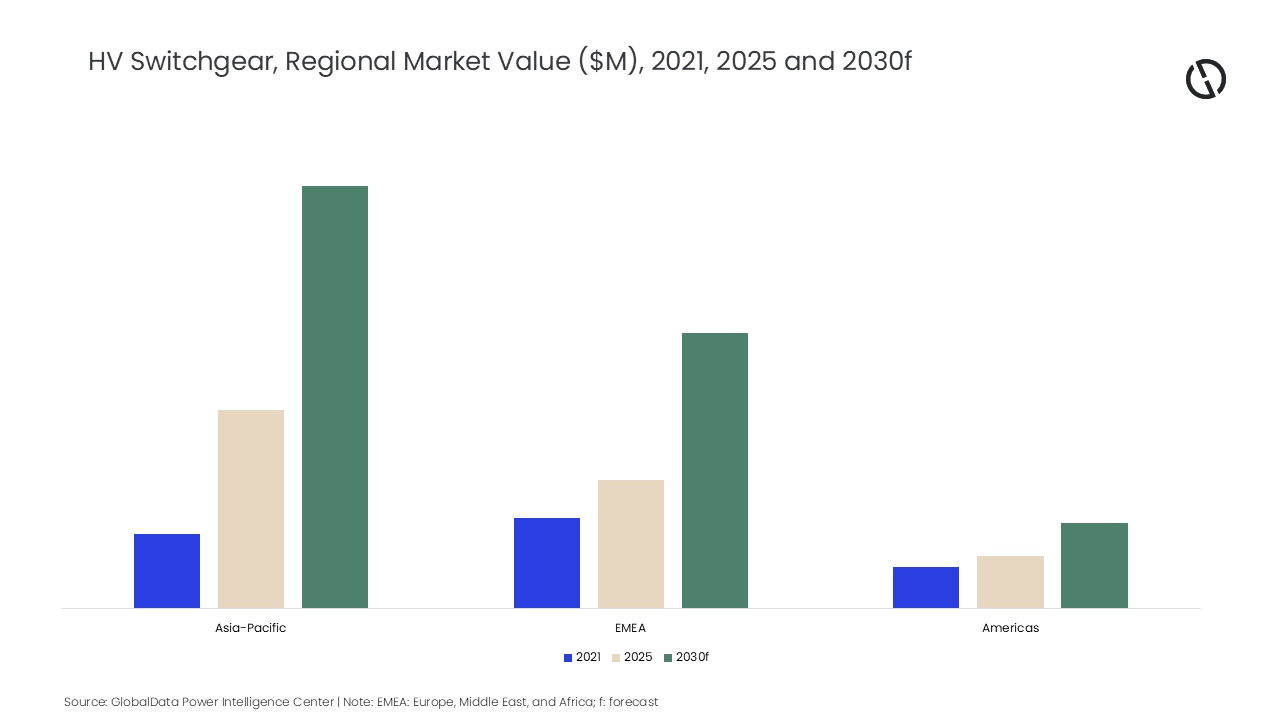
Grid operators are increasingly adopting digital substations, intelligent monitoring, and SF₆-free technologies to boost reliability, cut lifecycle emissions, and meet rising electricity demand across industrial and urban networks. As utilities ramp up investment in transmission infrastructure, grid modernization, and renewable energy integration, the global high-voltage (HV) switchgear market is forecast to expand rapidly through 2030, with Asia-Pacific (APAC) expected to remain the largest and fastest-growing regional market, according to GlobalData, a leading intelligence and productivity platform.
GlobalData’s latest report, “Switchgears for Power Transmission Market Size, Share and Trends Analysis by Technology, Installed Capacity, Generation, Key Players and Forecast to 2030,” identifies APAC as the main growth driver, led by China’s UHV expansion and grid modernization. India is growing rapidly on the back of the Green Energy Corridor, renewable energy evacuation projects, and interstate transmission upgrades. Japan and South Korea are supporting regional growth through offshore wind connections, wider use of compact GIS, and the replacement of aging grid assets.
Bhavana Sri Pullagura, Senior Power ( Analyst at GlobalData, comments: “HV switchgear is at the heart of grid expansion and modernization. As renewables, electrification, and new sources of load, particularly data centers and industrial growth, reshape power systems, utilities are accelerating investment in advanced, digitally enabled, and environmentally sustainable switchgear technologies, with APAC continuing to lead global deployment.”
EMEA remains the second-largest market, supported by Europe’s decarbonization push, cross-border interconnections, and large-scale retrofit and replacement programs led by Germany, the UK, and France, with strong momentum behind SF₆-free and modernized substations. The Middle East is expanding transmission and smart grid infrastructure, especially in Saudi Arabia and the UAE, while Africa is seeing gradual growth from electrification and reliability initiatives, with compact GIS gaining traction in dense cities.
The Americas are expected to grow steadily, led by the US, as utilities upgrade aging networks, build new substations, and integrate large-scale renewables. Canada is investing in transmission tied to hydropower and interregional connectivity, while Brazil is boosting demand through transmission auctions and HV network expansion to connect renewable generation.
Competition is intensifying as OEMs expand and localize manufacturing while accelerating digital and sustainable switchgear innovation. Leaders such as Hitachi Energy, Siemens Energy, GE Vernova, Schneider Electric, Mitsubishi Electric, Hyosung Heavy Industries, and Toshiba are scaling capacity and digital substation/GIS offerings to ease lead-time constraints, with SF₆-free and low-carbon technologies increasingly prioritized across voltage levels.
Pullagura concludes: “The HV switchgear market is being transformed by the need for smarter, cleaner, and more resilient grids. Manufacturers are investing in capacity, localization, and digitalization, while utilities adopt SF₆-free and intelligent switchgear solutions to improve performance and sustainability. These trends will remain central to grid investment strategies through 2030.”