Italy is undergoing a significant clean energy shift. With electricity demand set to grow and renewables expected to capture an ever-larger share of supply, solar PV and hybrid renewables are becoming central pillars of Italy’s energy future. However, without improvements in permitting, grid access, and system flexibility, Italy risks elevated costs, delayed projects, and reliability stress during peak-demand periods, according to GlobalData, a leading intelligence and productivity platform.
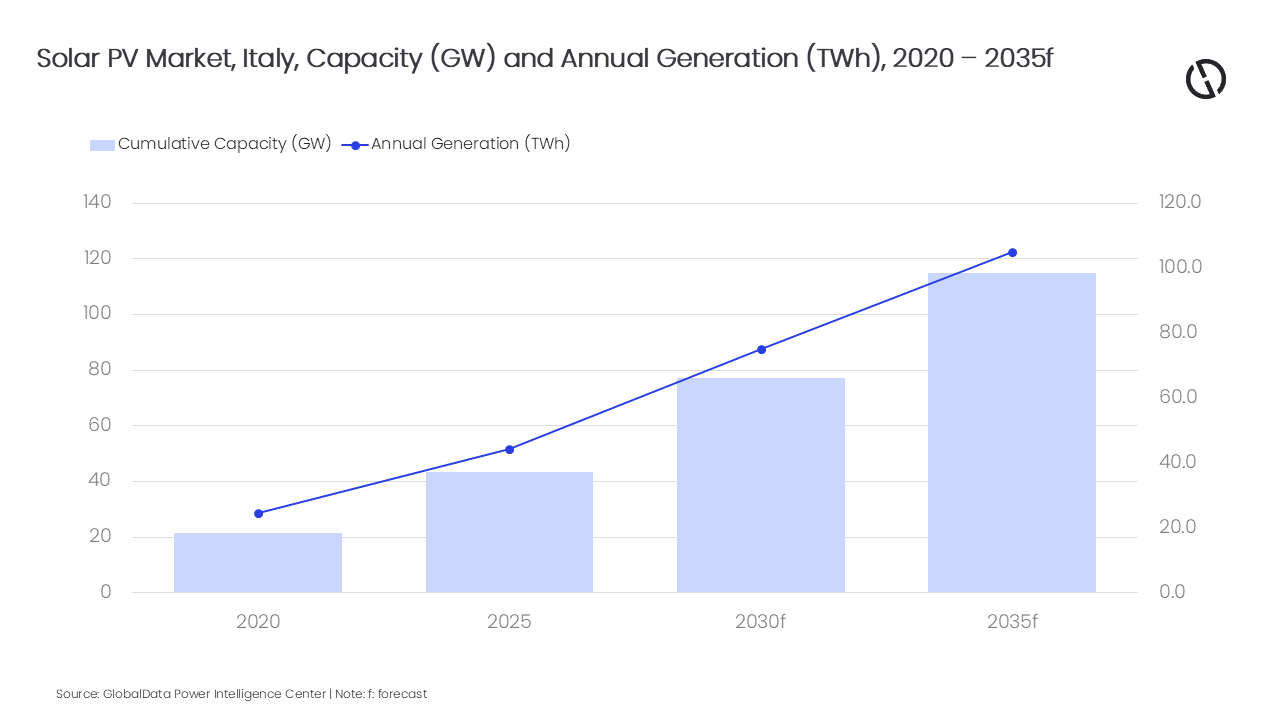
GlobalData’s latest report, “Italy Power Market Trends and Analysis by Capacity, Generation, Transmission, Distribution, Regulations, Key Players and Forecast to 2035,” reveals that solar PV is now the fastest-growing capacity segment in the country, supported by auctions, policy incentives, and favourable solar irradiance. Meanwhile, gas remains a critical provider of backup and flexibility, but its role is being squeezed by decarbonization and rising renewable penetration.
Attaurrahman Ojindaram Saibasan, Power Analyst at GlobalData, comments: “Italy is at a turning point: rising demand driven by electrification, industry, and urban cooling is converging with ambitious renewable and climate goals. The speed and clarity of grid reforms, permitting streamlining, and investment in storage will decide whether Italy’s clean energy transition delivers on time.”
Policy and regulatory momentum is accelerating renewables deployment and supporting infrastructure in the country. Italy’s National Energy and Climate Plan, along with new tender tools like the FER X scheme and reinforced capacity markets, are improving investor signals. Permitting reforms and grid planning enhancements also aim to reduce past delays.
Saibasan adds: “Hybrid projects—solar plus storage or wind plus storage—are increasingly attractive, as they help mitigate grid constraints and curtailment risk. However, regional zoning restrictions, heritage protection rules, and overlapping environmental assessments continue to slow progress in many renewable-rich zones.”
Italy’s electricity demand, after a slight decline in the early 2020s, is projected to rise from about 292.2TWh in 2025 toward 311.1TWh by 2030, propelled by electric vehicles (EVs), heat-pump adoption, hotter summers, and expanding industrial and digital loads. Southern Italy and island regions are expected to face the greatest stress on the grid and connection infrastructure.
Saibasan concludes: “For developers, utilities, and investors focused on solar PV, offshore wind, storage, and grid modernization, Italy offers substantial value. Success will depend on navigating policy uncertainty, securing firm offtake agreements, and staying ahead of operational and regulatory bottlenecks.”