Foreign investors stimulate market activity
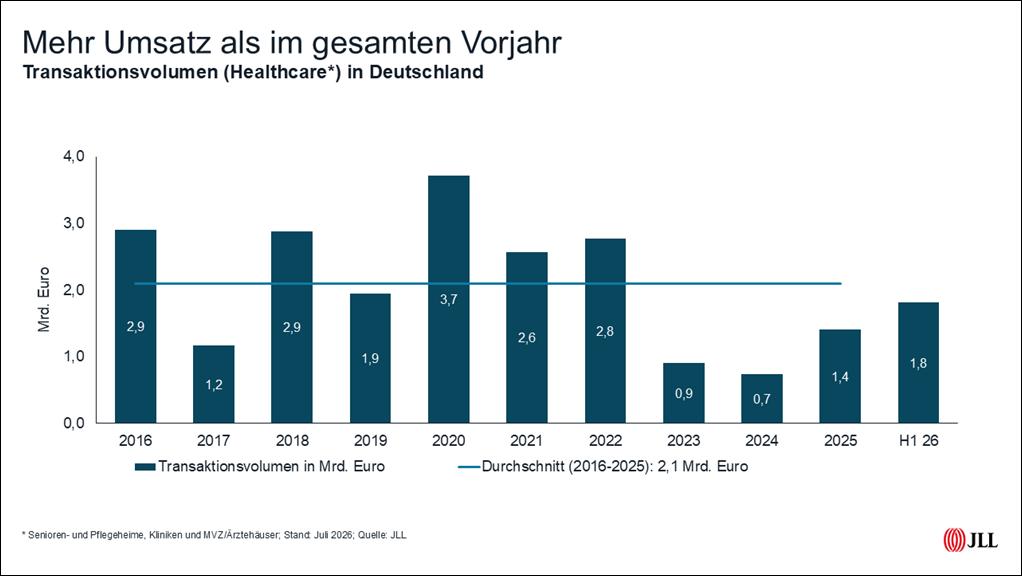
Although the investment market for healthcare real estate was unable to build on the high momentum of the previous quarter in the second quarter, with a transaction volume of 690 million euros, there is still a good result on the books compared to the previous year (460 million euros). For the first half of the year, this results in sales of 1.8 billion euros, which is already more than in the same period of the previous year (1.4 billion euros).
In 14 transactions in the second quarter, 33 properties were traded. For the first half of the year, there were a total of 35 transactions and 145 properties traded.
The first quarter had been marked by two portfolio deals with foreign participation. Among other things, the US investor TPG acquired a portfolio of 31 medical centers and medical care centers from the Canadian Reit Northwest Healthcare Properties, 19 of which are located in Germany. On the other hand, Aedifica secured its share in a nursing home portfolio with 58 properties in Germany by acquiring 80 percent of Cofinimmo.
In quieter market phases, according to Peter Tölzel, Senior Director Healthcare Investment JLL Germany, it is often foreign investors who ensure a noticeable revival: “German capital, on the other hand, finds it difficult to be one of the first to dare to re-enter an asset class. However, international investors also demand corresponding returns, which they usually find in the value-add segment or when they buy core-plus properties at value-add prices.”
As a result of the major deals with foreign participation, the proportion of international buyers increased to around 83 percent in the first half of the year. Usually, the rate is between 40 and 60 percent. Among the sub-asset classes, nursing homes account for the largest share of total sales at 58 percent. This is followed by clinics with 26 percent and medical centers and medical care centers with 16 percent.
Despite the strong investor interest, medical centers will not generate noticeable additional sales in the short term due to the comparatively low transaction volumes.
Critical view of nursing homes – prime yields remain constant
Nursing homes, on the other hand, are still often included in the sales process, sometimes in combination with assisted living and with all the characteristics of the qualities: “From core products to value-add with adapted pricing, everything is included,” notes Tölzel. However, investors would continue to look very closely here: “The care sector is eyed most critically by capital. The demand is there, but great attention is paid to the operator quality and creditworthiness, and of course also to the performance of the individual properties.”
The current rather quiet market phase can also be transferred to pricing. The prime yields for nursing homes are still around five percent. For assisted living, it is around 50 basis points less.