
JLL analysis confirms “Go Central trend” in the major German office markets
Law firms are among the most demanding users on the German office real estate market. Their focus is on very good locations and modern, high-quality space. In return, they are also willing to pay more rent than the average office tenant. This is shown by a recent analysis by JLL, for which the leasing behaviour in the seven metropolises of Berlin, Düsseldorf, Frankfurt, Hamburg, Cologne, Munich and Stuttgart was examined and enriched with targeted surveys of selected law firms.
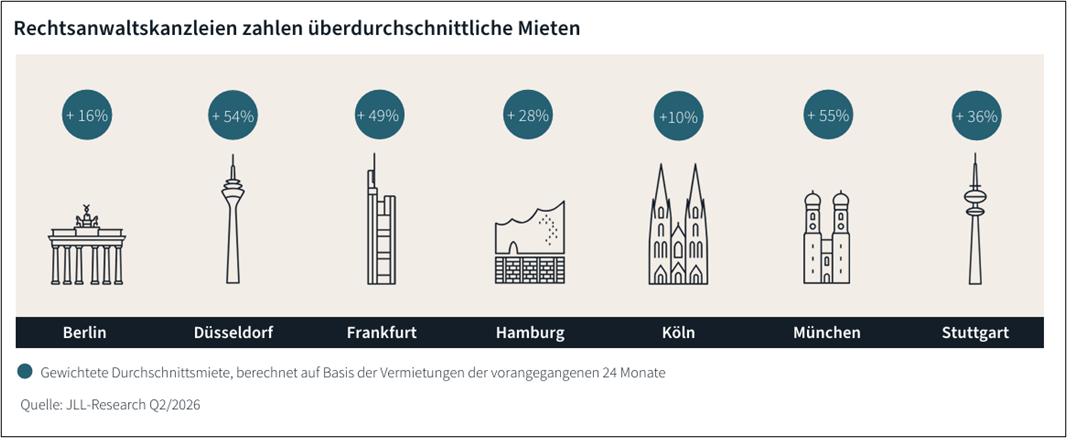
In all seven markets, the average rents paid by law firms are above the respective cross-industry market level. The surcharges range from ten percent in Cologne to 55 percent in Munich. Düsseldorf (plus 54 percent) and Frankfurt (plus 49 percent) also record significantly above-average rent levels for law firm space, while these are somewhat more moderate in Berlin (plus 16 percent) and Hamburg (plus 28 percent).
Another result of the JLL analysis: Leading law firms are systematically relocating their locations to the historic business centers of the seven metropolises. In Düsseldorf, for example, there were relocations from locations such as Seestern or Grafenberg-Ost to the city center or to Kennedydamm. In Frankfurt, the movement ran from peripheral locations such as Sachsenhausen or Nord/Ost to the CBD, in Hamburg from Eimsbüttel or Altona-Ottensen-Bahrenfeld to HafenCity and the city center. Similar patterns can be seen in Munich (from Bogenhausen and Arabellapark to Westend), Cologne (from Ehrenfeld/Braunsfeld to Rheinufer-West) and Stuttgart (from Feuerbach and Vaihingen-Möhringen to the CBD).
The driver of this development is the transformation of the office from a pure workplace to an “experience space” for personal collaboration and corporate culture. “Today, the office has to do things that the home office cannot: collaboration, culture, spontaneous professional exchange,” explains Miguel Rodriguez Thielen, Head of Office Leasing Germany at JLL.
The largest deals in the past three years have been Freshfields on Königsallee in Düsseldorf (10,500 m²), White & Case on Bockenheimer Landstraße in Frankfurt (10,100 m²) and Hengeler Mueller, also on Düsseldorf’s Königsallee (9,600 m²). International law firms such as Milbank, Jones Day and Herbert Smith Freehills have also secured new space in central city centre locations in recent years. “The list of new leases reads like a Who’s Who of the legal industry. They all have one thing in common: the address in the best city centre location. This is no coincidence, but strategic calculation ,” comments Rodriguez Thielen.
However, because the new construction pipeline on the German office markets is noticeably decreasing and speculative projects are becoming rarer, law firms are competing for an increasingly smaller market segment. “If you don’t plan ahead today, you run the risk of no longer being able to find suitable space at the end of the contract,” warns Rodriguez Thielen. “The lead time for location decisions is getting longer, especially for law firms with high quality standards. Periods of three to four years are no longer uncommon.”