Framework conditions improve for borrowers
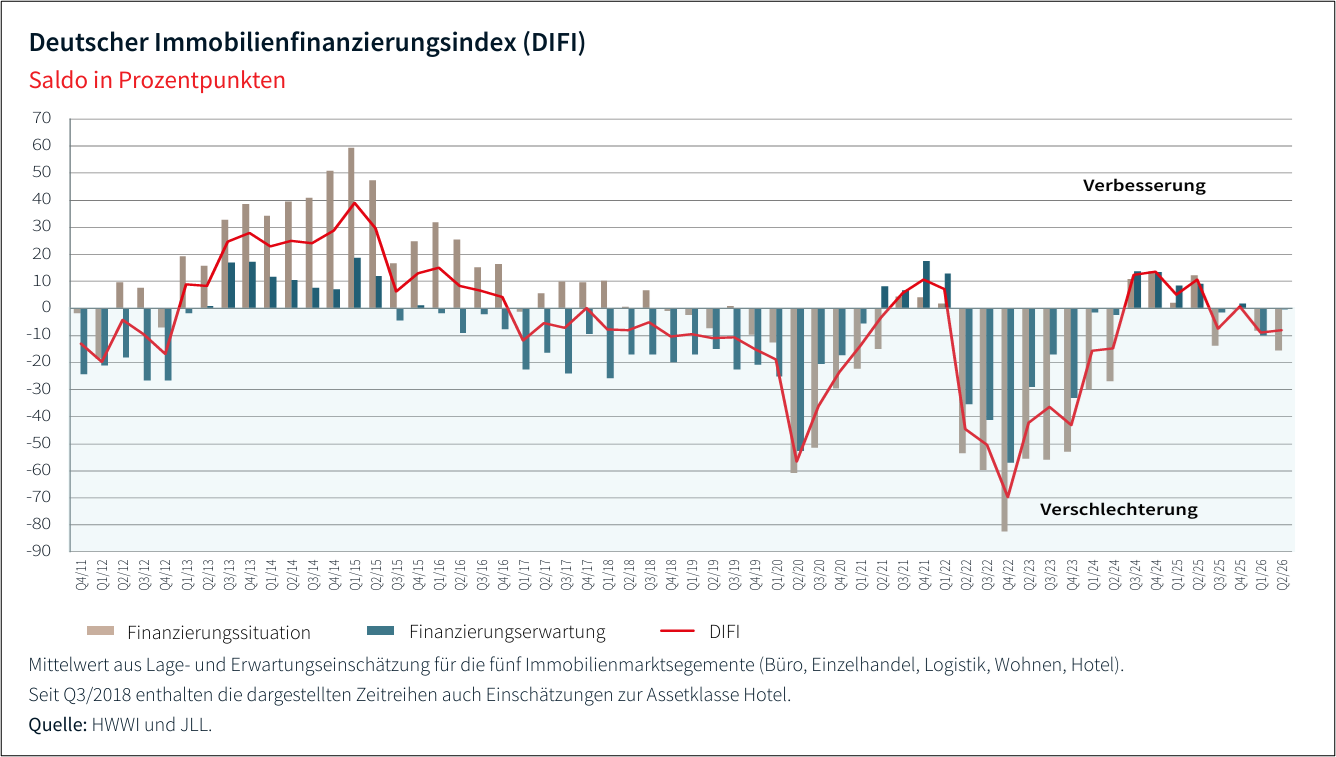
After the dampening of sentiment at the beginning of the year, the German Real Estate Financing Index (Difi)* showed a slight stabilisation at a low level in the second quarter of 2026. The index improved by 1.1 points to minus 8.0 points. The strongly divergent assessment of the present and the future is remarkable: the assessment of the current market situation is more pessimistic than it has been for two years, while at the same time hopes for an imminent trend reversal are increasing significantly.
The Difi is collected and published by JLL and the Hamburg Institute of International Economics (HWWI) and reflects the assessments of financing experts. The situation on the credit market in the past six months and the expected development in the next six months are assessed on a quarterly basis. The difi is calculated as an unweighted average of the balances of the two sub-indicators financing situation and financing expectation of all types of use.
The assessment of the current financing situation has deteriorated considerably. At minus 15.6 points, this sub-index reached its weakest value since the second quarter of 2024. The view ahead is quite different: Expectations for the next six months have improved by almost ten points and, at minus 0.3 points, are already scratching the neutral threshold. The gap of more than 15 points between the two components is unusually large and, according to Helge Scheunemann, Head of Research at JLL Germany, signals fundamental confidence in the industry despite the current difficult framework conditions. “The data very clearly reflect the uncertainty caused by geopolitical tensions. After the outbreak of the Iran war in February, there is a pronounced restraint in the market. At the same time, however, the experts see light at the end of the tunnel. Our special question on loan-to-value ratios shows that the institutions want to go on the offensive again.”
Types of use are developing differently – logistics is taking a big leap
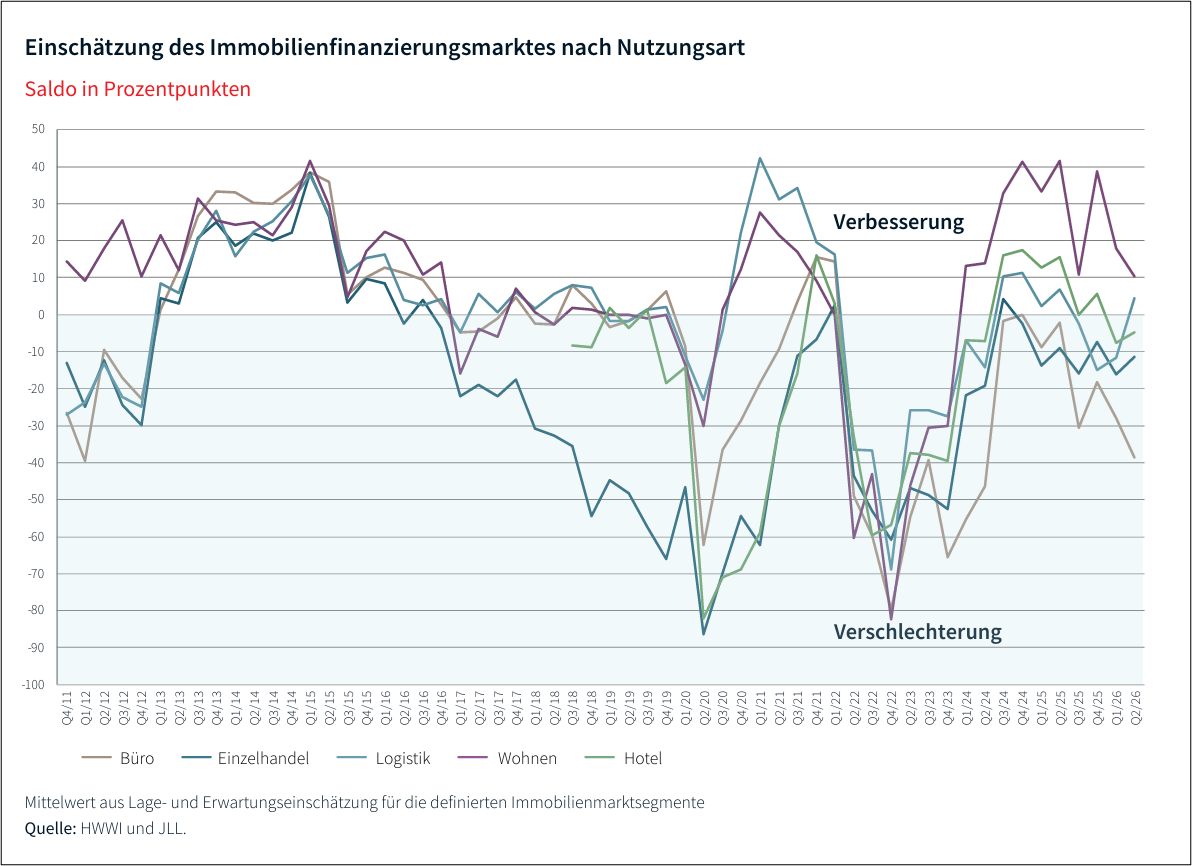
When looking at the individual real estate classes, a heterogeneous pattern emerges. The development in the logistics segment stands out positively, jumping by more than 16 points and, at 4.5 points, trading positively for the first time in a long time.
The housing sector continues to be at the top of the overall assessment with 10.4 points, even though it has lost almost eight points compared to the first quarter. Hotels (minus 4.8 points) and retail follow at a significant distance, recovering by almost five points and now standing at minus 11.4 points. The office segment, on the other hand, slipped by more than ten points and brought up the rear with minus 38.6 points.
With a focus on the current condition, the experts are particularly critical of office and retail properties. In the office sector, the assessment of the situation has plummeted – by more than 30 points to minus 59.1 points. In the retail sector, the value fell by almost nine points to minus 18.2 points. On the other hand, logistics (increase of five points to minus 4.5 points) and hotels (slight increase to minus 4.8 points) are developing positively. With a plus of 8.3 points, residential remains the only asset class above the zero line.
Expectations turn positive – office market sets for comeback
Optimism dominates in the assessment of the next six months. Four out of five segments recorded improvements, some of which were substantial. The front-runner is logistics with a significant increase of over 27 points to now plus 13.6 points. The retail sector gained more than 18 points, but still remained at minus 4.5 points. Offices and hotels improved by nine and a good five points respectively, coming to minus 18.2 and minus 4.8 points, respectively. Only housing swims against the tide and gives up more than eleven points, but remains comfortably in the green zone with a plus of 12.5 points.
The spread between current assessment and future forecast is particularly striking. “In the office segment, there is a gap of almost 41 points – a clear indication that a turnaround is expected soon despite the current predicament,” says Andreas Lagemann, Senior Researcher at HWWI. In logistics (18 points difference) and retail (just under 14 points difference), expectations are also much more positive than the current assessment.
Lenders relax loan-to-value limits
The current special survey on financing conditions reveals a positive development for borrowers. For example, the average loan-to-value ratios (LTV) are rising noticeably in almost all areas. In the case of first-class core properties, the retail sector recorded the strongest increase, with an increase of almost five percentage points to 66.3 percent. Logistics properties follow with 3.5 percentage points growth (67.0 percent), hotels with a good three percentage points (63.8 percent). Offices also benefit, with an increase of three percentage points to 64.9 percent. Although residential real estate is only growing moderately, it offers by far the highest loan-to-value limits at an average of 73.6 percent.
In the value-add area, the movement is even more pronounced. Here, the logistics segment recorded the strongest LTV increase, with growth of more than five percentage points to 63.3 percent. Housing climbed by almost five percentage points and secured the top spot with 68.5 percent. Retail (up 4.0 percentage points to 62.8 percent), hotels (up 3.5 percentage points to 61.4 percent) and offices (up 2.9 percentage points to 61.5 percent) are also rising strongly. This consistent expansion of credit lines signals a growing willingness to take risks on the part of financing institutions.
Risk premiums in the value-add area are declining
The development of credit margins shows a differentiated pattern. In the core segment, the conditions are mostly slightly more expensive. Office financing will be more expensive by almost seven basis points (172.6 basis points), hotels by a good five basis points (185.5 basis points), housing by four basis points (113.1 basis points). Only in logistics financing will the premiums fall by six basis points to 146.4 basis points, while in retail they will rise minimally by 2.5 basis points to 162.5 basis points.
The situation is completely opposite for riskier value-add projects. Here, margins are falling consistently and in some cases quite significantly, most sharply in logistics with a decline of almost 24 basis points to 215.0 basis points. For retail financing, they fell by around 14 basis points (230.3 basis points), for hotels by almost eleven basis points (248.6 basis points). Residential (down almost nine basis points to 191.3 basis points) and offices (down 7.5 basis points to 250.0 basis points) will also become cheaper.
According to Dominik Rüger, Senior Director Debt Advisory JLL Germany, this points to more intense competition for high-yield projects. “The combination of higher loan-to-value limits and at the same time falling interest spreads in the value-add segment is a good sign for the financing market. Credit institutions are aggressively positioning themselves for the expected market recovery and are actively competing for attractive transactions. This creates better conditions for borrowers and gives the market important impulses.”
*Note: 24 experts took part in the survey of the German Real Estate Financing Index from 27 May to 3 June 2026. The assessments of the market situation (past six months) and market expectations (next six months) were queried. The percentage shares of the response categories and the percentage point changes compared with the previous quarter (Δ previous quarter) are shown. The balances result from the difference between the positive and negative response categories (such as “improved” and “deteriorated”). The DIFI is calculated as an unweighted average of the balances of the financing situation and the financing expectations of all types of use.