Focus on top locations despite subdued overall demand
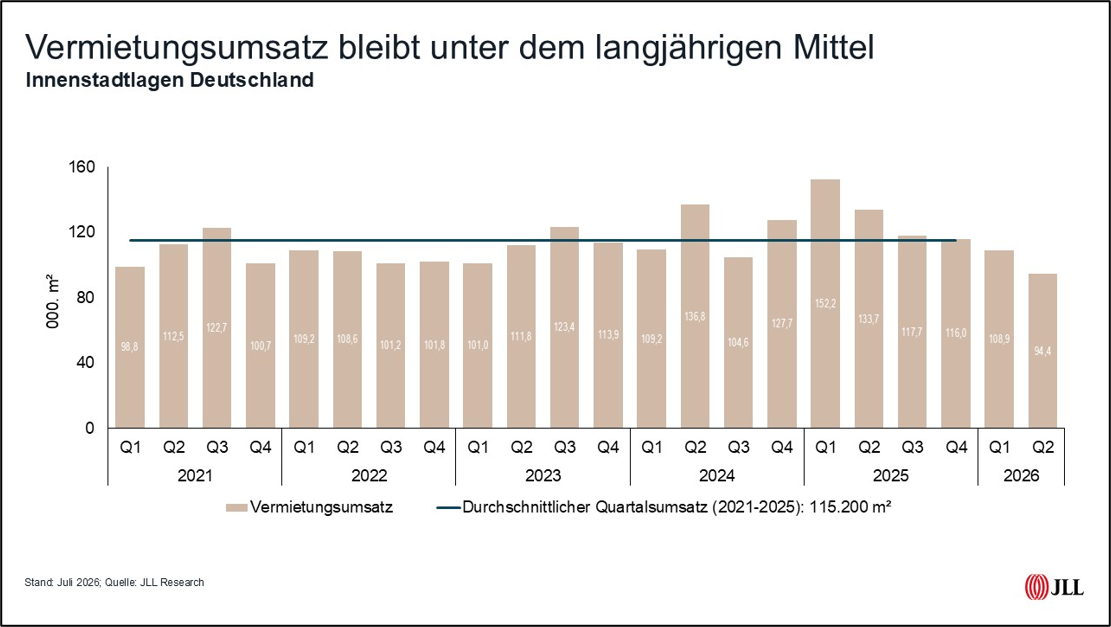
For the first time in five years, the retail letting market has failed to reach the 100,000 m² mark. In the second quarter of 2026, take-up in Germany amounted to 94,400 m² of retail space. This corresponds to a decline of 13 percent compared to the previous quarter (108,900 m²) and is significantly below the five-year average of 115,200 m² per quarter. Over the first half of the year, letting take-up totalled 203,300 m², which is the weakest figure in recent years. The number of leases also fell slightly in the second quarter to 168, compared with 182 in the previous quarter.
International concepts underline their interest in the German market
Aniko Korsos, Head of Retail Leasing JLL Germany: “The continuous focus on first-class locations is striking. At 51 percent, the share of deals in ten metropolises in the second quarter of 2026 remained at the elevated level of the previous quarter. This signals that retailers are focusing their expansion on top locations despite subdued overall demand.” A differentiated picture emerges in terms of take-up: while 41 per cent of the rented space is accounted for by the ten metropolises – a decline of 51 per cent compared to the previous quarter – the presence of international concepts remains strong. They are responsible for 61 percent of take-up in the second quarter. “The share of international players in terms of the number of deals has stabilized at 51 percent, which underlines the sustainable importance of cross-border trade concepts for the German market.”
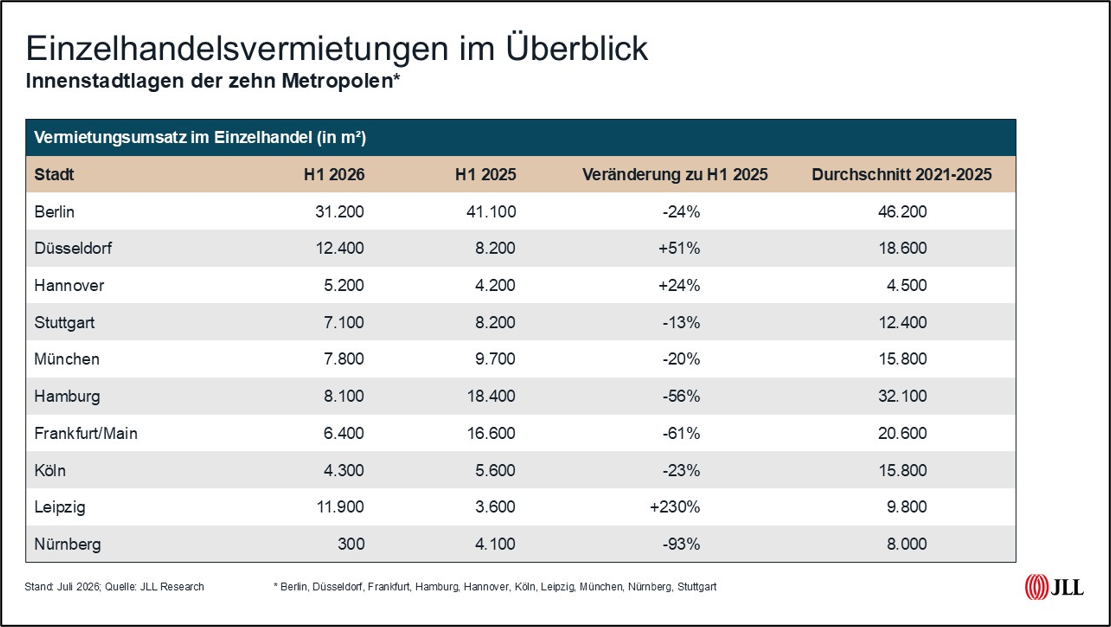
Berlin dominates the top ten markets unchallenged in the first half of 2026 with take-up of 31,200 m². The capital thus accounts for almost a third of the total turnover of the ten strongholds and, with 51 transactions, is also clearly at the top in terms of the number of deals.
This is followed by Düsseldorf with 12,400 m² from 17 deals and Leipzig with 11,900 m² and only six deals – an indication of above-average large-scale leasing in the Saxon metropolis. Hamburg ranks fourth with 8,100 m² from 22 transactions, followed by Munich (7,800 m², 18 deals) and Stuttgart (7,100 m², 23 deals).
Berlin generates around a third of the take-up of the ten metropolises
Frankfurt am Main recorded 6,400 m² with 20 deals, while Hanover showed considerable activity with 5,200 m² from 22 transactions. Cologne achieves 4,300 m² over nine deals, while Nuremberg brings up the rear of the ten main locations with only 300 m² and a single deal.
The distribution illustrates the pronounced market concentration: Berlin alone accounts for around a third of the total take-up of space in the ten metropolises, while the top five locations together already represent over two-thirds.
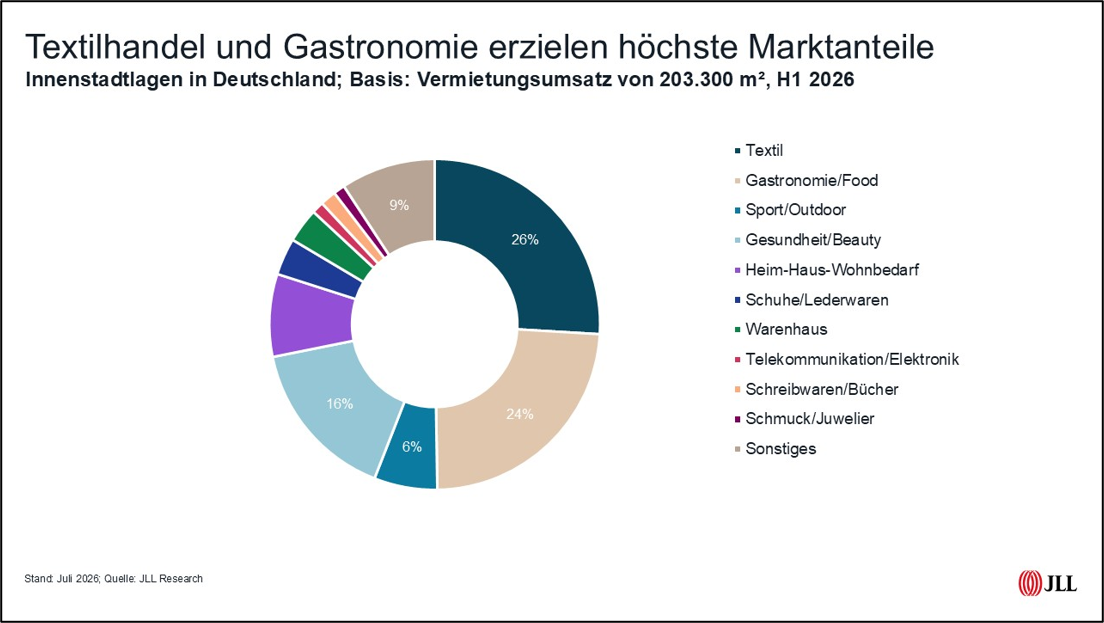
In the first half of 2026, the textile trade dominated the letting activity with a space volume of around 52,700 m², representing 26 per cent of total take-up. The clothing sector is thus once again establishing itself as the most important demand driver on the German retail market. The labels Jack & Jones were particularly active with four new leases. Lager 157 and Ernsting’s Family also contributed to the expansion dynamics.
The gastronomy/food division follows in second place with a share of 24 percent of total turnover, which corresponds to an area volume of around 48,400 m². The majority of these rentals are recorded in the catering industry. Among the most expansive formats in the first half of the year were Edeka, Kaspar Schmauser and 60 seconds to napoli, each with several new leases.
Noticeable decline in prime rents in the Franconian metropolis of Nuremberg
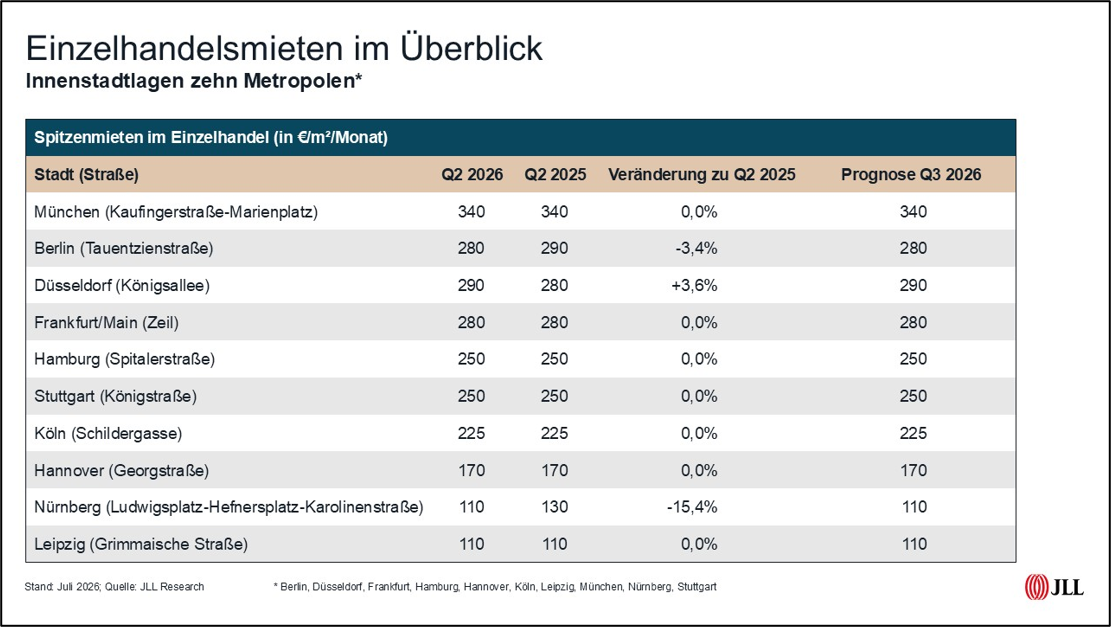
In the vast majority of the ten leading retail locations, prime rents are stable in the second quarter of 2026. Munich defends its position as the most expensive market in Germany with an unchanged 340 euros/m²/month. Frankfurt am Main is keeping the level at 280 euros, while Hamburg and Stuttgart are each quoted at 250 euros. Cologne remains at 225 euros, Hanover at 170 euros and Leipzig at 110 euros. Changes in a year-on-year comparison, on the other hand, can be observed in three locations: Berlin recorded a decline of 3.4 percent to 280 euros, while Düsseldorf increased by 3.6 percent to 290 euros. Nuremberg suffered the most striking slump with a minus of 15.4 percent to 110 euros – the lowest value among the ten strongholds. For the third quarter of 2026, there are signs of stabilisation across the board, with all ten markets expected to maintain their current prime rent levels.
For the other 56 cities surveyed by JLL, prime rents remained unchanged in the size class of 500,000 inhabitants and more and in the adjacent class of 250,000 to 500,000 inhabitants. In the smaller cities with 100,000 to 250,000 inhabitants and less than 100,000 inhabitants, prime rents were also constant. In the Germany-wide average of all 66 cities examined, the rent level remained almost identical. “There are signs of continued stabilisation for the rest of the year, with market conditions suggesting a balanced price level,” says Korsos.