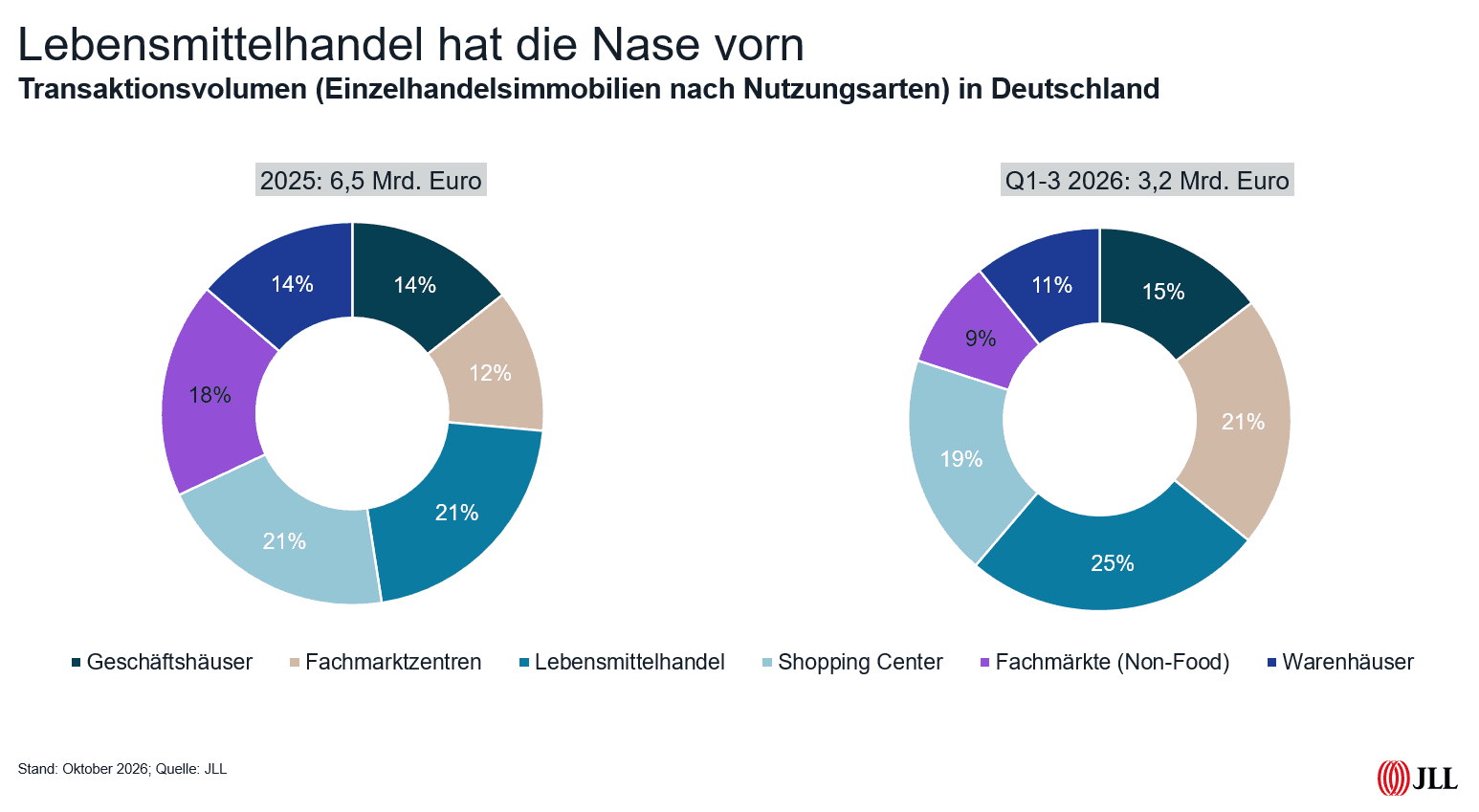


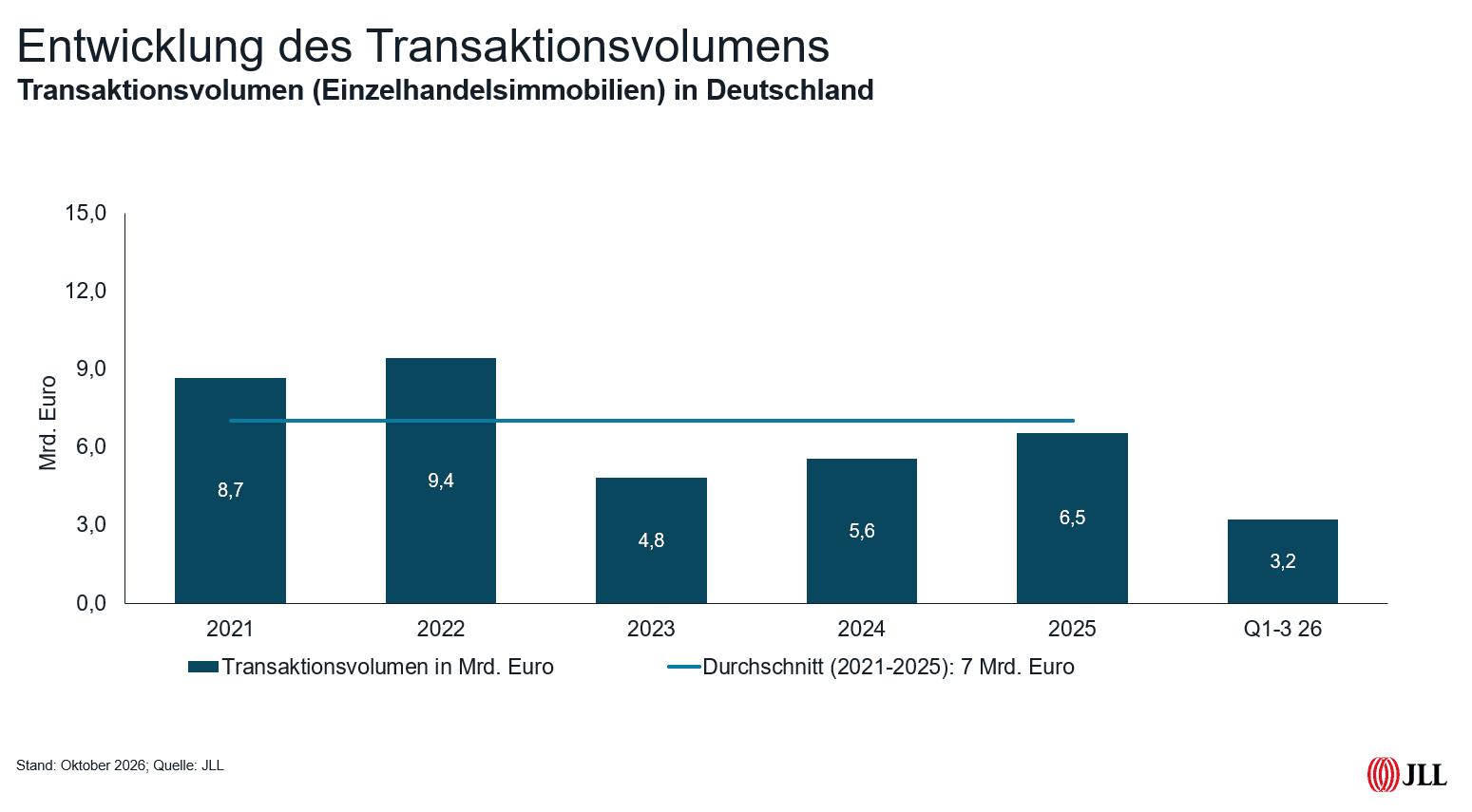
The German retail property investment market is in solid shape after the first three quarters of 2026. With a transaction volume of around 3.2 billion euros and 169 completed transactions, the asset class is showing sustained and broad-based market activity. Although this represents a decline of around a quarter (€4.2 billion) compared with the same period last year, taking the current transaction pipeline into account, JLL forecasts a transaction volume of between €6 billion and €6.5 billion for 2026 as a whole, which would be almost on a par with last year’s result and signal a significant stabilisation of the market.
“The high volume of supply in the second quarter was well absorbed by the market, and almost all well-known transactions have seen good to very good demand. Asset prices in line with market conditions were key to this success,” explains Sarah Hoffmann, Head of Retail Investment Germany at JLL. She adds: “Further properties were brought to market at Expo Real, which, according to our forecast, should be well absorbed by the market.”
The third quarter saw a somewhat subdued result of just under 900 million euros, which is below the quarterly average for the current year.
Healthier market structure: Broad distribution rather than mega-deals
A positive trend is evident in the transaction structure: the top five deals totalled around 820 million euros and accounted for 25 per cent of the total volume – a significant decline compared with the previous year (43 per cent). This points to broader market activity and a healthier distribution. Six transactions exceeded the €100 million threshold, compared with five in the previous year. “This observation shows that the market is less dependent on individual large deals and is based on a broader foundation,” says Hoffmann.
Asset and fund managers remain the most significant buyer group, with a 34 per cent market share (€1.1 billion), followed by private investors with 21 per cent (€700 million). Of particular note is the rise in the share of developers to nine per cent, as well as the active role played by private equity and hedge funds, accounting for four per cent, which points to growing interest in value-add and opportunistic strategies.
German investors are strongly represented on both the buyer’s side (59 per cent, 1.9 billion euros) and the seller’s side (59 per cent, 1.9 billion euros). The net figure for foreign investors has fallen by just 13 million euros – a virtually balanced ratio.
Expo Real as a barometer of trends: growing investor interest
According to Hoffmann, the discussions at Expo Real indicated that both national and international investors are interested in the German retail market and wish to expand their portfolios. “This is a very positive sign for the retail asset class. The focus is on specialist retail outlets and shopping centres.” For yield opportunities, she recommends high-street retail as an asset class: “This sector offers both yield and potential for scaling.”
Specialist retail products dominate the market, accounting for a combined 56 per cent market share: food-anchored properties account for 25 per cent, retail parks for 21 per cent and individual specialist retail outlets (non-food) for nine per cent. Shopping centres account for 19 per cent of the transaction volume, whilst retail premises account for 15 per cent.
The local retail segment remains in vogue. Despite a supply volume of over two billion euros’ worth of actively marketed properties, demand remains strong. Prime yields for individual specialist retail centres without a food anchor continued to stand at 6.0 per cent in the third quarter, whilst retail parks and specialist retail centres with a food anchor remained stable at 4.6 per cent. In addition to individual properties, large-scale food retail portfolios are in particularly high demand.
“However, the rise in interest rates is also affecting this highly sought-after asset class. We are seeing selective transactions at the very top end of the yield spectrum. Investors continue to bid very competitively for these products. Outside the very top segment, the rise in interest rates has had a more rapid impact, meaning that pricing adjustments are now evident across the market as a whole. We expect to see a further widening of the price gap between absolute core products and somewhat more average core-plus to core products,” explains Hoffmann.
Shift in demand for value-add portfolios
Generally speaking, after three quarters, investors favoured safety, allocating 44 per cent to core property and a further 38 per cent to core-plus. Value-add properties accounted for 11 per cent and opportunistic assets for 7 per cent, although their share has risen slightly compared with the first half of the year. The strong demand for value-add portfolios in recent months came as a surprise. The competitive bidding environment in these transactions led to the occasional optimisation of the purchase price during the sales process. “In this segment, there is certainly an excess of demand as a result of a significant increase in both international and domestic sources of capital.”
Hoffmann anticipates a busy end to the year in terms of transactions. He also expects the product offering to remain strong over the next one to two years, often driven by necessary disposal programmes. “The positive sentiment at Expo Real, the robust pipeline and the broad investor base give cause for cautious optimism for the rest of the year and 2027,” concludes Hoffmann.