
Transaction volume up 15 percent year-on-year at the end of the first half of the year
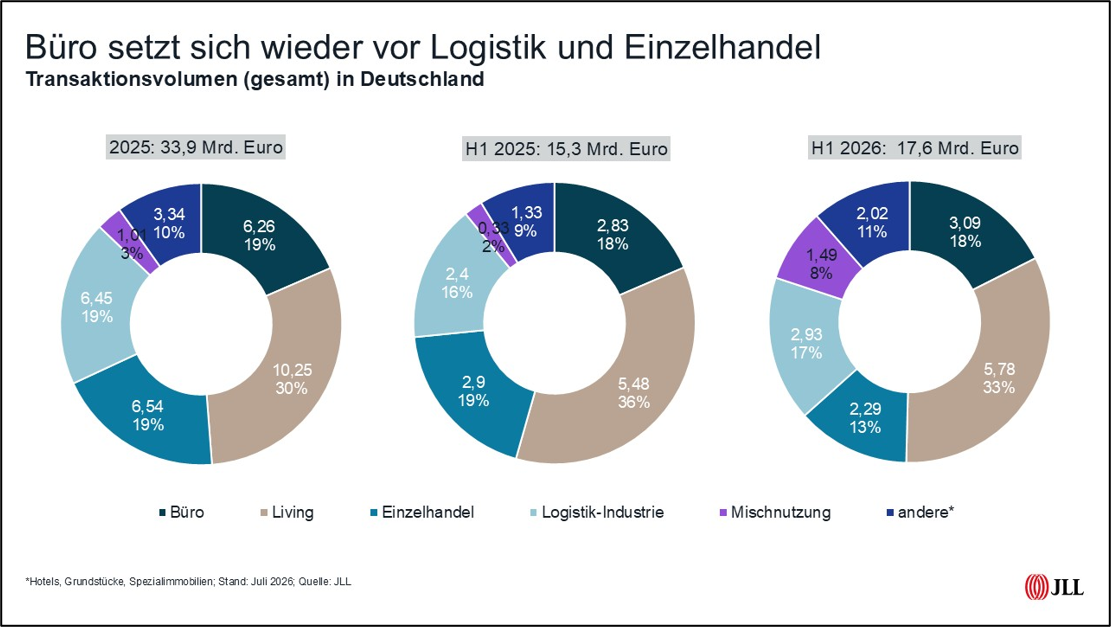
The increase in investment activity that has been visible since the end of 2025 continues: In the first three months of 2026, there were signs of recovery in the German investment market. Surprisingly for many, the continuation of the Iran war into the second quarter and the associated rise in inflation and interest rates did not lead to an end to the tender recovery plant. At around 17.6 billion euros, the transaction volume at half-time in 2026 was still around 15 percent consistently above the previous year’s level.
Konstantin Kortmann, CEO JLL Germany & Head of Capital Markets: “The general conditions are still volatile and contemplated or initiated transactions are still not taking place in many processes, the gap between the offer price and the price that buyers are willing to invest has at least not narrowed due to the rise in interest rates. There is no shortage of liquidity on the German investment market for real estate, and there is still interest from investors in principle.”
The current credit statistics in the eurozone, from which positive signals are coming, fit into this picture. Even though a momentum seems unlikely in view of the high level of uncertainty, the volume of loans to private companies grew by 3.9 percent year-on-year in May. In detail, medium- to long-term loans in particular represent an encouraging development, as these loans are more closely linked to business investment. Congruent to this, the availability of debt capital is also increasing on the real estate market. As early as 2025, new business at twelve large institutions analyzed by JLL rose by 27 percent to 37 billion euros. The planned figures for 2026 suggest a further increase.
“If the geopolitical situation calms down further – and it looks like it will at the moment – further interest rate hikes by the ECB may be off the table. Thus, the investment market could also continue its positive development. Against this backdrop, we continue to expect a transaction volume of EUR 35 billion to EUR 40 billion for 2026 as a whole,” adds Kortmann.
Individual transactions clearly up – 21 transactions beyond 100 million euros
There is still an enormous discrepancy between individual transactions and portfolio sales. There are still no signs of a trend reversal for the latter. The minus compared to the previous year is still around ten percent. “In package sales, properties of different qualities are often tied up in terms of location and equipment. Such an offer currently affects only a few investors willing to take risks. It is significant that almost all portfolio transactions come from the Living segment, including the two largest transactions of the past quarter, each with transaction values in the mid three-digit million euro range,” analyzes Helge Scheunemann, Head of Research at JLL Germany.
In individual transactions, on the other hand, Scheunemann sees the opposite picture and strong growth of around 29 percent compared to the previous year. “However, the volume is fed by a large number of medium-sized and smaller transactions. However, there were also some major transactions, which is perhaps somewhat surprising given the rather gloomy headlines: 21 deals with a volume of more than 100 million euros each in the entire first half of the year were distributed almost equally between the first and second quarters,” explains Scheunemann. Despite the increasingly adverse circumstances, sales already in the process were carried out. Nevertheless, sales of very large-volume properties, especially in the office sector, remain challenging, as the example of the Opera Tower in Frankfurt has shown. This is one of the reasons why the share of the seven metropolises in the total German transaction volume is stagnating at 37 percent.
Hamburg almost catches up with front-runner Berlin with a significant plus
There are also some positive signals from the big cities. In Berlin, a good second quarter ensured that the year-on-year decline in sales slowed significantly to 17 percent. With a volume of a good 1.6 billion euros, the capital is once again in first place, followed closely by Hamburg with just under 1.6 billion euros. With an increase of almost 60 percent, the Hanseatic city also recorded the largest increase in a twelve-month comparison. Cologne and Düsseldorf also registered strong growth rates of 42 and 37 percent, respectively. The Frankfurt investment market remains very subdued with a half-year result of only 530 million euros, undercutting the already very weak first half of the previous year by another 20 percent.
No changes can be seen in the analysis by type of use. As in previous quarters, the “Living” asset class will continue to assert itself as the strongest category in the first half of 2026 with unabated high demand. This is also evidenced by the fact that four of the ten largest transactions alone can be attributed to this asset class. Overall, the share of 5.8 billion euros is 33 percent.
“The market situation for office properties remains challenging, especially for core products. Demand is very much focused on modern, ESG-compliant properties in established locations. Energy efficiency including low ancillary costs and flexible space concepts are decisive criteria, and potential buyers continue to act very selectively. On the other hand, the supply of real top products is still low,” Kortmann observes.
Long-term portfolio holders such as insurance companies or pension funds currently have no selling pressure and are holding on to their properties. This is also confirmed by a recent evaluation by JLL: Only eleven percent of the registered sales volume in the period 2024 to Q1 2026 were made against the backdrop of financial pressure from lenders (excluding insolvencies), because, for example, in the case of refinancing, the debt capital was not available to the required extent or the costs were too high.
The situation is somewhat different for value-add objects. JLL already sees a relatively high level of activity in this segment. The lower prices for older existing buildings open up opportunities for repositioning, ESG upgrades or conversions. In the further course of the year, opportunities should also arise for private equity investors and project developers who have the necessary know-how and capital for the transformation of the properties.
In the half-year statistics, the transaction volume for offices totaled just under 3.1 billion euros, and there was no revival in the second quarter. On the contrary, the volume fell by another 16 percent compared to the first quarter.
The logistics/industry segment follows closely behind Office. This shows a contrasting picture with a much stronger second quarter. A total of 2.9 billion euros was generated in the first half of the year, around 22 percent more than in the same period last year. The geopolitical easing of tensions in the Gulf region and the stabilization of supply chains has obviously regained confidence among investors.
International investors are unusually dynamic
A look at the buyers shows a high proportion of foreign investors at 44 percent (7.9 billion euros) compared to the first half of the year. The picture is clearer among sellers: 65 percent of them are local portfolio holders who have parted with their properties. On the balance sheet, it remains the case that foreign investors continue to expand their holdings in the current market phase.
The spectrum of buyers was broad in the first quarter. Asset and fund managers remain the largest investor group, with their share of transaction volume remaining constant at 35 percent in the first half of the year. Private investors have also kept their share stable at eleven percent, while public sector activities have declined. Their share is now just under nine percent. Open-ended mutual funds have been in particular focus in recent weeks and months due to increasing outflows. Their current activities are correspondingly “restrained”. If they do, they mainly appear as actors in the seller statistics.
Yields for offices rise – stability for the other usage classes
“The development of the German real estate investment market in the second quarter of 2026 was characterised by an increase in yields on office properties, while all other types of use remained at their previous quarter level, at least in terms of prime yields,” Scheunemann summarises.
The average prime yield for office properties in the seven metropolises rose by 15 basis points to 4.46 percent in the second quarter. This increase was seen in all cities, with adjustments ranging from 10 basis points in Cologne, Munich and Stuttgart to 20 basis points in Berlin, Düsseldorf, Frankfurt and Hamburg. “This development signals that the market is now pricing in the higher cost of capital and is moving away from the wait-and-see attitude of the previous quarters,” explains Scheunemann.
However, this trend is not limited to core real estate. There were also significant increases in yields in the riskier segments. For properties in secondary locations and only average building quality, the average yield of the seven metropolises even rose by around 34 basis points to 7.82 percent. This shows that investors are again demanding higher premiums for the risk taken.
“The ongoing pressure from the changed interest rate environment with still high yields on government bonds and increased financing interest rates is forcing market participants to adjust their price expectations. The need to represent an attractive risk premium compared to alternative investments such as ten-year German government bonds increases the pressure on the seller side to adapt,” says Scheunemann. The previously often seen strategy of “sitting out” is becoming increasingly difficult to maintain under the current financing conditions, especially since a refinancing gap of around five billion euros is foreseeable on the German office investment market for this and next year combined. “It can be assumed that transactions will increasingly take place at this new, higher yield level as soon as a new price consensus between buyers and sellers has been established.”
Investment Market Overview
As of: July 2026
%: Percentage difference H1 2026 to H1 2025
Transaction volume Big 7 (million euros)*
| City | H1 2025 | H1 2026 | % |
|---|---|---|---|
| Berlin 1) | 1,930 | 1,630-16 | % |
| Düsseldorf 2) | 750 | 1,030 | 37% |
| Frankfurt/M 3) | 660 | 530-20 | % |
| Hamburg 4) | 1,000 | 1,590 | 59% |
| Cologne 5) | 260 | 370 | 42% |
| Munich Region 6) | 990 | 1,170 | 18% |
| Stuttgart 7) | 340 | 180-47 | % |
| Total | 5,930 | 6,500 | 10% |
Transaction volume nationwide (million euros)*
| H1 2025 | H1 2026 | % | |
|---|---|---|---|
| Individual properties | 9,930 | 12,780 | 29% |
| Portfolios | 5,340 | 4,820-10 | % |
| Total | 15,270 | 17,600 | 15% |
* incl. residential portfolios, micro-living and care properties
Prime yield in 1A locations (Aggregated net initial yield in the Big 7 in %)
| Segment | Q2 2025 | Q3 2025 | Q4 2025 | Q1 2026 | Q2 2026 |
|---|---|---|---|---|---|
| Office | 4,33 | 4,33 | 4,31 | 4,31 | 4,46 |
| Retail: Shopping Center | 5,90 | 5,90 | 5,90 | 5,90 | 5,90 |
| Retail: retail parks | 4,60 | 4,60 | 4,60 | 4,60 | 4,60 |
| Retail: individual specialist stores | 5,90 | 5,90 | 5,90 | 6,00 | 6,00 |
| Retail: Commercial buildings | 3,50 | 3,50 | 3,50 | 3,50 | 3,50 |
| Housing: Multi-family houses | 3,51 | 3,51 | 3,51 | 3,51 | 3,51 |
| Logistics industry | 4,40 | 4,46 | 4,56 | 4,56 | 4,56 |
Prime office yield in %
| City | Q2 2025 | Q3 2025 | Q4 2025 | Q1 2026 | Q2 2026 |
|---|---|---|---|---|---|
| Berlin 1) | 4,20 | 4,20 | 4,20 | 4,20 | 4,40 |
| Düsseldorf 2) | 4,50 | 4,50 | 4,50 | 4,50 | 4,70 |
| Frankfurt/M 3) | 4,60 | 4,60 | 4,60 | 4,60 | 4,80 |
| Hamburg 4) | 4,20 | 4,20 | 4,05 | 4,05 | 4,25 |
| Cologne 5) | 4,50 | 4,50 | 4,50 | 4,50 | 4,60 |
| Munich Region 6) | 4,05 | 4,05 | 4,05 | 4,05 | 4,15 |
| Stuttgart 7) | 4,25 | 4,25 | 4,25 | 4,25 | 4,35 |
1) Urban area
2) Urban area including Ratingen, Neuss, Erkrath and Hilden
3) Urban area incl. Eschborn and Kaiserlei
4) Urban area
5) Urban area
6) Urban area incl. surrounding municipalities
7) Urban area incl. Leinfelden-Echterdingen
Source: JLL, Research
