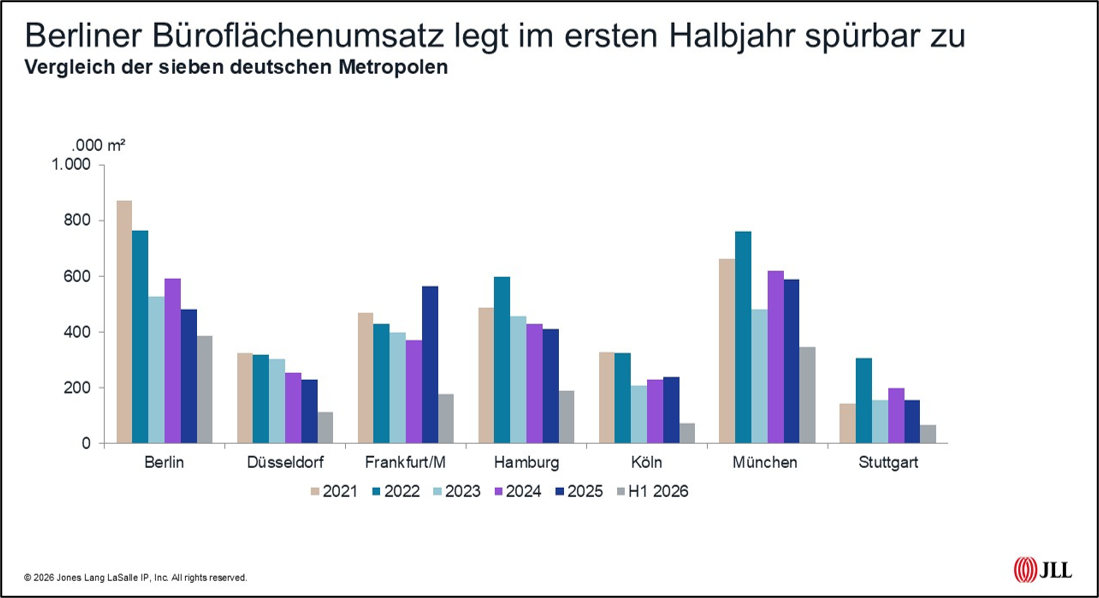
With take-up of 1.35 million m², metropolises are almost five percent below the previous year’s level
The German office letting markets were quiet overall in the second quarter of 2026. With a cumulative take-up of 1.35 million m² in the seven metropolises, the year 2026 is entering its halfway point and is thus around five percent below the previous year’s figure. Sales results are well below average in many cities – although individual markets are showing a slight upturn, the overall picture remains subdued. “Owner-occupier financial statements from the public sector and large companies support the quarterly results selectively, but cannot compensate for the structural decline in market activity. The leasing pipeline looks solid, but without gaining momentum. We are maintaining our full-year forecast and continue to expect moderate growth in the single-digit percentage range compared to 2025,” says Konstantin Kortmann, CEO JLL Germany.
The moderate optimism is based on several factors: After several years of economic stagnation, the first signs of economic stabilization in Germany are increasing in the middle of the year. The ifo business climate index rose to 85.6 points in June (May: 85.0 points), with an increase in the assessment of the current business situation in particular. “Business expectations are also brightening slightly, although the level of sentiment remains below the long-term average. Especially in the service sector – and thus in an economic sector that is particularly relevant for the office space market – the assessment of the current business development is improving,” Kortmann notes.
At the same time, the market environment remains characterized by uncertainty. Geopolitical risks, subdued export momentum and a persistently weak labour market are slowing down the willingness of many companies to invest and expand. “The ifo employment barometer fell to 92.3 points in June and signals continued restraint in personnel planning, which experience has shown to have a delayed effect on demand for office space,” analyses Helge Scheunemann, Head of Research at JLL Germany.
This results in a differentiated picture for the office letting market: while the leading economic indicators are gradually improving, demand for space remains selective overall. Companies continue to focus on high-quality, ESG-compliant and centrally located office space, while existing properties with lower equipment and energy quality are increasingly coming under competitive pressure.
Market revival focuses on Munich and Berlin
However, the market development in the seven metropolises of Berlin, Düsseldorf, Frankfurt, Hamburg, Cologne, Munich and Stuttgart is heterogeneous. The markets fluctuate between a plus of 62 percent in Berlin and a minus of 49 percent in Frankfurt. The plus is fed from the two largest markets, Berlin and Munich. There has been a significant revival in Berlin and with 386,000 m² let, the capital is now back ahead of Munich with 348,000 m². But even in the Bavarian metropolis, there is an increase of 33 percent at the end of the first half of the year. The remaining five markets, on the other hand, lost some significantly.
“The lack of medium-sized closures is particularly striking. While demand in the segment up to 500 m² remains good, there is noticeable restraint in the mid-range segment between 1,000 and 2,500 m². Only in the large-scale segment above 5,000 m² is a slight revival discernible,” says Miguel Rodriguez Thielen, Head of Office Leasing JLL Germany, describing market developments. The sectoral structure of the degrees is also heterogeneous; a clear sectoral focus is increasingly missing. Tech companies are increasingly emerging as buyers in the small-scale sector, but prefer short contract terms because their own growth is not yet clearly foreseeable.
The new enquiries accumulating on the market can serve as an indicator for future deals: “A slight but relevant decline can be seen here – across all size classes and also compared to the first half of the previous year. Whether this is a signal of continued weakness in demand remains to be seen, because the full extent would only become apparent at the end of the year or at the beginning of 2027,” Rodriguez Thielen looks ahead to the coming quarters.
The known reasons for the reluctance remain decisive: economic and geopolitical uncertainties continue to prevent companies from making binding rental decisions. Decision-making processes are delayed, rental processes drag on. And on the supply side, the gradual drying up of the completion pipeline is becoming increasingly noticeable.
“The tendency to extend existing leases instead of moving to new areas is also continuing. In doing so, users often orient themselves towards areas that correspond to 50 to 70 percent of the previous size – central locations are still in demand, but no longer at any price,” says Rodriguez Thielen .
The quality gap between first-class properties and space in B and C locations is widening. Properties with poor public transport connections, outdated technical equipment and a lack of sustainability can hardly be placed anymore. “ESG remains a relevant criterion, but is currently treated by tenants more as a mandatory item on the checklist than as a decisive differentiating factor. Location, quality and infrastructure are the dominant demand parameters.”
Vacancies are rising – completions are falling
In addition to the change in the occupied office space stock – in the past twelve months, this figure fell by around 188,000 m² across all seven strongholds – the total vacancy rate in the seven metropolises continued to rise (plus eleven per cent) and reached a volume of 8.5 million m² in the second quarter of 2026. The vacancy rate climbed accordingly to 8.5 percent, compared to 7.7 percent a year earlier. The highest rates are in Düsseldorf with 11.8 percent and Frankfurt with 11.1 percent. The lowest rate continues to be recorded in Cologne with five percent. However, the increase in vacancies must be viewed in a differentiated way. The gap between modern, well-equipped properties in central locations and properties in B and C locations in need of renovation is widening.
The sublet space market is now more stable: not as much new space is coming onto the market as in previous months, and in some cases space is even being taken off the market again because companies are using it themselves. Incentives continued to increase slightly, reflecting the tense market situation. Depending on the location and property quality, landlords are increasingly willing to make concessions in order to retain existing tenants and avoid vacancies. These include rent-free periods, renovations or flexibility in contract terms. Shorter contract terms are accepted by landlords, provided that complex expansions do not jeopardize profitability. At the same time, alternative usage concepts – including hospitality, coliving, educational institutions, healthcare providers and social facilities – are increasingly pushing into the office space market. This can be an opportunity for portfolio holders who are thinking about conversions. If conversions are classic apartments, selective options also open up through the recently launched subsidy.
Fewer new areas are coming onto the market
The completion figures, on the other hand, are declining significantly in many places, and few new areas are expected for the rest of the year. Speculative project development in particular has almost come to a standstill. By the end of the first half of the year, around 508,000 m² of new or completely renovated space had come onto the market, a decrease of five per cent compared to the same period last year. Around 600,000 m² of new space is expected for the second half of the year, so the total volume in 2026 is likely to be slightly below the previous year’s level. According to the current status, a slightly higher volume is expected for 2027, with 1.2 million m² under construction or still in the planning stage. The occupancy rate of this space is 30 percent, which means that the rental market currently has only 737,000 m² at its disposal, almost half of which is in Berlin alone.
“Overall, the development indicates that the low of the market cycle was reached last year and a bottom has been formed. However, a rapid reversal of the trend is not to be expected – the market remains characterized by structural restraint in the current economic environment,” says Scheunemann.
Users continue to pay rent surcharges for top space
In terms of rents, the prime rent remains unchanged in most markets. In Berlin, Munich and Frankfurt, on the other hand, rents rose again in the most recent quarter. At 62 euros/m²/month, Munich now has the highest value in Germany, and within the past twelve months, the rent here has risen by almost seven percent. “By the end of the year, we expect further slight prime rent increases in almost all strongholds, so that the JLL prime rent index should then be 3.4 percent above the year-end value of 2025 at 316.2 points,” says Scheunemann.
“It remains to be seen how long this “flight-to-quality” trend will be reflected in rising prime rents in view of the further rise in construction and operating costs. At the moment, companies are still willing to pay a rent surcharge for premium space. This does not necessarily have to be in the CBD, we see isolated rentals in state-of-the-art buildings in good second locations, which then establish a new rent level there,” Scheunemann differentiates.