Prime yields remain stable, rents develop moderately
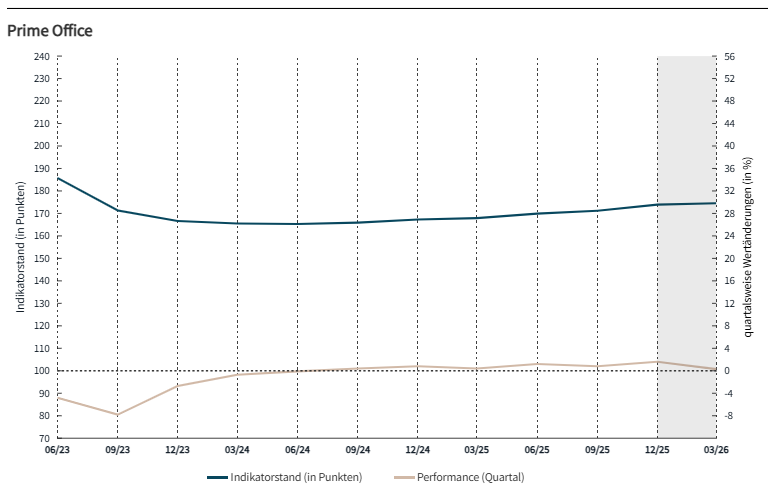
At the beginning of 2026, the office performance indicator Victor Prime Office was not quite able to match the positive trend of the previous quarters. In the first quarter of 2026, the index recorded only a moderate increase of 0.3 percent compared to the previous quarter, showing a sideways movement since the outbreak of armed conflict in the Middle East. While the signs were still cautiously optimistic in the fourth quarter of 2025 and the office investment market in Germany was also gaining momentum, the start of the Iran war led to a significant slowdown in the activities of many market participants. The indicator level for the observed top locations in the German real estate strongholds of Berlin, Düsseldorf, Frankfurt, Hamburg and Munich stood at 174.5 points at the end of March 2026.
“The geopolitical upheavals did not bring the overall market to a standstill – numerous transactions still crossed the finish line in the second half of February and in March, which can certainly be seen as positive compared to investor behaviour during previous external shocks of a similar dimension. However, uncertainty has increased enormously and many market players, especially equity investors, are currently waiting for further developments,” says Ralf Kemper, Head of Value and Risk Advisory JLL Germany, commenting on the current situation. “The investment market has slowed down sharply. What we are observing, however, is that transactions of top properties continue to take place at current yield levels. Although we regularly observe buyer-induced price adjustments at the end of sales negotiations, they are moderate. Furthermore, the seller side does not seem willing or pressured to accept or have to accept significant price reductions, so that transactions either take place in line with the seller’s expectation – albeit at a slower pace – or real estate sales are simply withdrawn again.”
Prime yields thus remained unchanged in the first quarter of 2026 in all five real estate strongholds considered, ranging from 4.05 percent in Hamburg and Munich to 4.6 percent in Frankfurt. “Germany is still relatively expensive compared to other European countries. In many other European markets, higher returns can be achieved with an office investment. However, the risk-free interest rates measured against the current yield on long-term government bonds (due to higher government debt) are also significantly higher in some cases. However, international investors do not seem to be rewarding the lower risk in Germany at the moment,” explains Kemper.
Despite the challenging market environment, the office investment market was able to carry the positive momentum from the end of 2025 into the new year. At around one billion euros, the transaction volume on the office investment market in the five cities under consideration in the first quarter of 2026 exceeded the result of the previous quarter by a good five percent and is thus even slightly above the quarterly average of the past three years. The outlook for the rest of the year is unclear.
Berlin shows positive impetus from the rental market
In the first quarter, the index values showed a differentiated development. Berlin’s top locations recorded the strongest growth among the five metropolises, up 1.6 percent to 182.9 points. With stagnating prime yields, as in the other cities considered, the capital benefited exclusively from positive impulses from the rental market and the associated market rent increase. The other strongholds have remained more or less stable: Hamburg’s city centre rose moderately by 0.5 percent to 199.6 points and maintained its top position, which was mainly due to rent increases. Munich’s city centre recorded an increase of 0.2 percent to 194.5 points, while Frankfurt’s banking situation stagnated at 152.6 points and is exactly at the level of the previous quarter. With a minus of 0.4 percent to 157.9 points, Düsseldorf’s banking situation is in last place, which is due to a higher vacancy rate in addition to lower rents across the board.
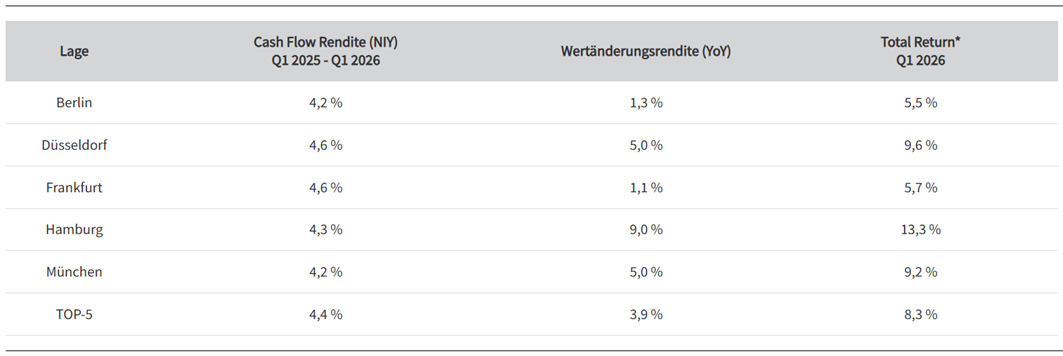
The annual performance calculated across all locations (comparison of the indicator level Q1 2026 to Q1 2025) shows a positive result of 3.9 percent. Hamburg is at the top with an impressive increase of nine percent and benefits from its continued strong market position. Düsseldorf and Munich share second place with growth of five percent each year-on-year. Berlin is in fourth place with 1.3 percent, while Frankfurt brings up the rear with 1.1 percent.
“Berlin has done better year-on-year than in 2025. There were some lettings, including in the Mediaspree submarket, which has been viewed critically by investors in recent quarters,” reports Kemper. “We are seeing larger applications on the market, for example from the public sector. Another high-profile deal in Schöneberg for 12,000 m² underlines the improved leasing dynamics in the capital.” However, the office leasing market has weakened throughout Germany. With just under 540,000 m² of take-up, the result in the five cities remains slightly above the result of the previous quarter, but at a low level and below the average of the past three years. Due to the supply bottleneck for the sought-after segment of high-quality office space in prime locations and the still low completion volume, prime rents could increase further in the second half of 2026 – despite the low letting volume and the geopolitical and associated economic challenges.
Wide range of financing options for quality properties
For example, the economic framework has changed fundamentally since the outbreak of the war. Economic growth is bobbing along, growth forecasts have recently been halved, while inflation expectations have risen significantly. Yields on government bonds, one of the investment options for investors competing with real estate, are significantly higher than they were just a few months ago. “All long-term forecasts from the end of 2025 are basically obsolete. At present, it is only possible to plan in the short term and drive ‘on sight’, which inhibits activities in the segment of a long-term form of investment such as real estate,” says Kemper. If inflation remains high, one or two further interest rate hikes by the ECB are possible, which would put pressure on prime yields on the real estate market. “The volatility of swap rates and thus financing costs are also not helping, although we are seeing a high willingness to finance, broad liquidity and strong competition for high-quality products from debt investors, both from traditional banks and from the segment of alternative lenders, such as debt funds.”
However, the spreads between risk-free interest rates and real estate yields do not necessarily have to remain constant. “In the case of indexed leases, a deal can be worthwhile despite the gap to government bonds if the cash flows increase accordingly through indexation and, in the case of re-letting, through market rent increases,” explains Kemper. However, the challenge remains: “If financing costs continue to rise despite the high level of competition in the debt capital market, hardly any equity is available and purchase price expectations on the seller side continue to be too high, the positive momentum from 2025 is likely to slow down further and the hoped-for market recovery will be even longer in coming.”