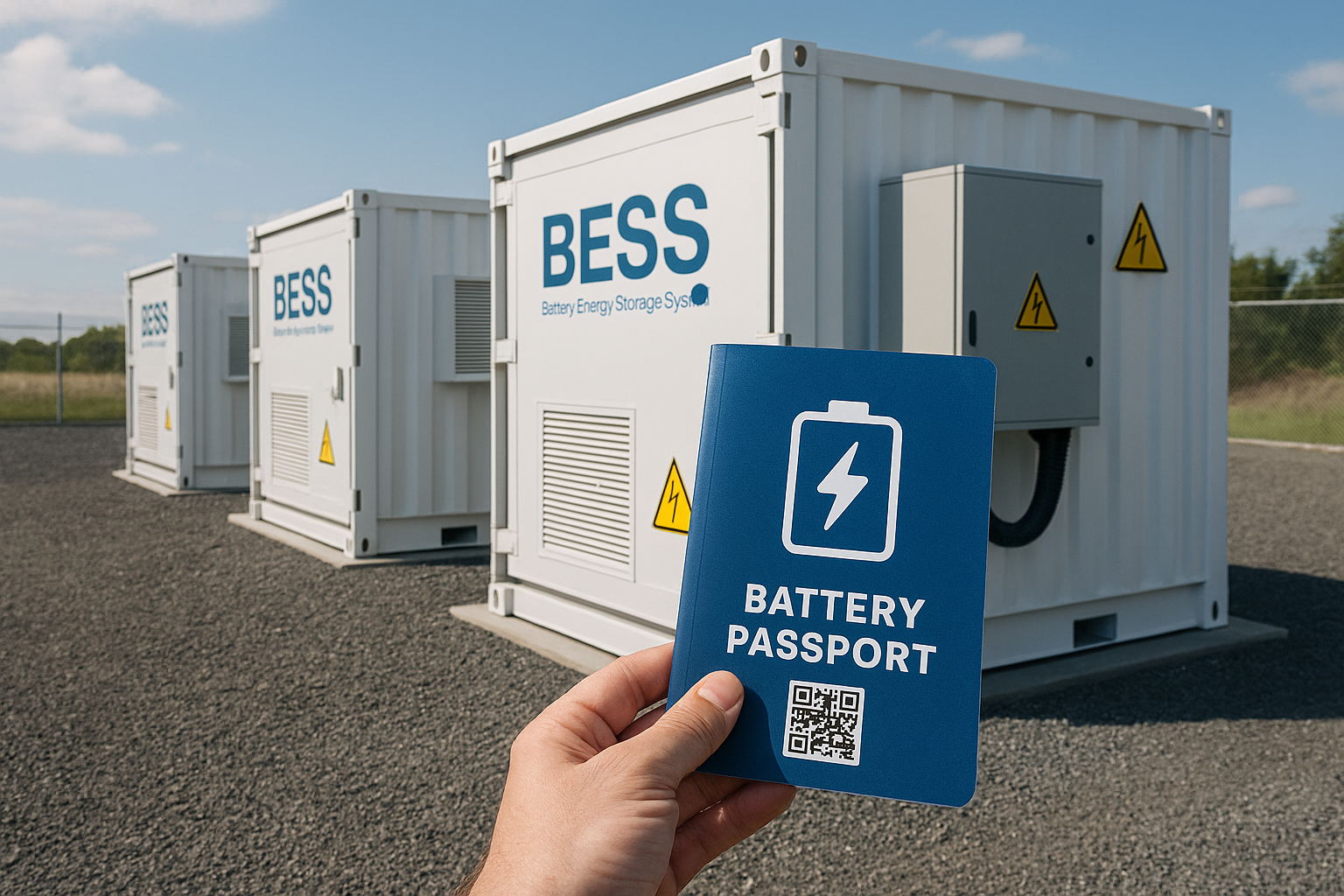
Large battery storage systems (BESS) are increasingly becoming the investment focus of institutional investors. At the same time, there is also a growing demand to reliably assess ecological, social and governance risks along the entire battery value chain. This is exactly where the battery passport will become relevant from 2027.
It turns a supply and usage chain that was often difficult to verify into a structured data object. For some institutional investors, this could be important because ESG in BESS does not end at the property line, but starts with raw material origin, production CO2, operation, residual value and end-of-life.
Why are ESG considerations important for BESS schemes for institutional investors?
From an investor’s point of view, there are three levels:
Firstly, about origin and production: Critical raw materials, CO2 footprint and evidence of recyclability are no longer marginal issues, but part of the investment logic.
Secondly, it is about ongoing operation: A storage system is only a resilient infrastructure case if performance, durability and security parameters are comprehensible.
Thirdly, governance: Those who work improperly on data, responsibilities and supply chain transparency increase the risk of greenwashing allegations, valuation discounts and time-consuming post-due diligence.
The political and market pressure on transparency is visibly increasing. KPMG describes the Digital Product Passport as an opportunity to build trust, unlock value and strengthen long-term competitiveness. At the same time, the study cites data quality across several delivery stages, insecure technical specifications and integration into existing systems as central hurdles. For investors, this means that ESG at BESS is not decided solely by policies, but by resilient data architectures.
To what extent will the battery passport create transparency for investors from 2027?
As things stand today, the EU battery passport will become mandatory from 18 February 2027 for three battery categories: EV batteries, batteries for light transport and industrial batteries over 2 kWh. This means that stationary storage solutions also fall into the relevant area of application.
The BatteryPass Ready initiative refers to more than 80 data points – from material origin and circularity to performance, durability and CO2 footprint. For institutional investors, this creates a more uniform data space for the first time, which can plausibly verify ESG statements via a BESS.
The real added value lies in standardization. Where PDFs, supplier declarations and individual queries are often juxtaposed today, the battery passport is intended to provide machine-readable and verifiable information. This facilitates the comparability of technologies, OEMs and supply chains. In due diligence, the passport can thus become a kind of “baseline of truth”: not as a substitute for auditing, but as a structured introduction to questions about carbon footprint, material use, recyclability and technical history.
At the same time, it is important not to exceed expectations. Even at the EU level, the implementation architecture is still being discussed in 2026: According to a parliamentary question, harmonised standards must first be adopted, a register must be set up by July 2026 and access rules must not be defined until the fourth quarter of 2026. BatteryPass-Ready also emphasizes that standardization and regulation are still in motion and that individual points need to be further clarified. For investors, this means that the battery passport significantly increases transparency, but it does not start as a finished final solution.
What does the battery passport do in addition – and what does it not?
In addition, the battery passport does three things in particular. First, it can bring compliance and value creation together. BatteryPass-Ready explicitly describes the passport as an instrument that not only helps with standardization, but is also intended to support sustainable and transparent value chains and enable circular business models. Second, it can promote data quality and interoperability, because test environments already aim for completeness, plausibility and system functions. Thirdly, it can help investors think beyond the initial use: If you have structured, origin, condition and end-of-life relevant information, you can discuss residual value, repowering or recycling assumptions in a more well-founded way.
What the battery passport does not do: It does not replace technical, commercial or legal due diligence. It says nothing about whether a specific project at a location is optimally designed in terms of fire protection, how robust the revenue strategy in individual markets really is, or whether EPC and O&M contracts are structured in an investor-friendly way. Likewise, the passport is not identical to a complete supply chain due diligence. The European legislator has postponed the application of the obligations on battery due diligence policies until August 18, 2027. The battery passport is therefore more of a reliable data framework – not the complete ESG verdict.
Result
For institutional investors, the battery passport will become an important touchstone in BESS transactions from 2027. Its greatest benefit lies not in marketing, but in the translation of ESG into comparable, digital and more verifiable information in the future. Anyone investing in storage systems today should therefore not treat the battery passport as a late reporting issue, but as a future database for investment decisions, asset management and exits. This makes ESG more measurable, especially in the case of large-scale battery storage systems.