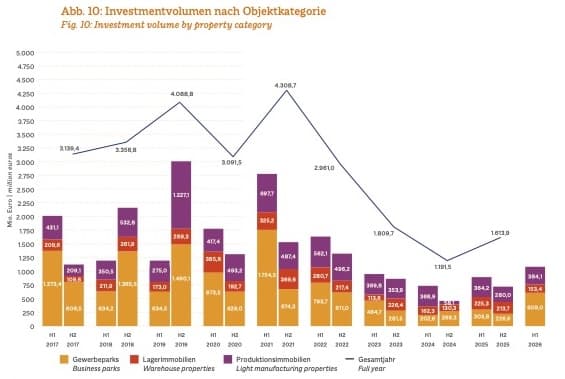
The German market for light industrial property has started 2026 with a significant upturn in activity. Investment volume rose by just under 59 per cent compared with the second half of 2025 to around €1.15 billion, thereby exceeding the billion mark within a half-year period for the first time since the second half of 2022. At the same time, space take-up rose by 30 per cent to around 1.68 million square metres. This increased market activity is spread across several regions and property categories. These are the key findings of the 25th market report by INITIATIVE LIGHT INDUSTRIAL.
“The increased activity on both sides of the market is a positive sign. It is particularly important that the upturn is not driven solely by one property category or a single region. At the same time, the market remains selective: investors and occupiers continue to pay very close attention to location, quality and the usage concept. It would therefore be too early to speak of a sustained upward trend,” says Alexander Fieback, Team Lead for Office and Commercial Property at bulwiengesa.
Business parks are driving the investment market
The upturn is particularly evident in business parks. With a transaction volume of around 609 million euros, this property category accounted for 53 per cent of the total investment volume. This represents more than double the volume recorded in the second half of 2025. Industrial properties followed with around €384 million (34 per cent), whilst warehouse properties accounted for around €153 million (13 per cent). Major transactions included the Berlin Decks, the Business Campus Kiel and a business park in Fulda.
The increased willingness to transact continues the recovery that was already evident in 2025. However, it is not yet possible to infer a sustained upward trend from the half-year results. Major individual transactions continue to have a significant influence on market activity, whilst portfolio transactions play a minor role.
On the buyer side, asset and fund managers, as well as private equity firms, remained the most active group, accounting for around 333.8 million euros. At the same time, the market continues to be strongly dominated by domestic capital: around 64 per cent of the purchase volume was accounted for by German buyers, with a further 28 per cent coming from European investors.
Space turnover rises across all three segments
Activity on the tenant side also increased noticeably. Take-up totalled around 1.68 million square metres in the first half of the year, 30 per cent higher than in the second half of 2025. Industrial properties remained the strongest segment, accounting for around 811,000 square metres and a 48 per cent share. However, demand for warehouse property showed particularly strong growth: take-up rose by just under 54 per cent to around 543,000 square metres. Business parks grew by just under 37 per cent to around 325,800 square metres.
At the same time, larger user decisions are regaining in importance. Transactions of 10,000 square metres or more accounted for around 39 per cent of total space take-up, just under 16 percentage points more than in the previous half-year. Lettings and owner-occupancy were almost evenly balanced: around 49 per cent of take-up was attributable to lettings, and 51 per cent to owner-occupancy.
The manufacturing sector remained by far the most important source of demand, accounting for around 56 per cent. At the same time, the logistics and transport sector gained in importance: its share rose from 8 to around 15 per cent. Demand is thus broadening, but remains clearly dominated by the industrial sector.
Market activity is becoming more widely distributed across regions
The increase in market activity is spread across several established industrial and business hubs. In the first half of the year, activity was more widely distributed across regions, both in terms of space take-up and on the investment market. The Southern region remained the strongest market in terms of space take-up, with around 376,400 square metres. Significant growth was recorded, amongst others, in the Northern region as well as in Berlin and its surrounding area.
In terms of investment volume, too, the Southern Region maintained its leading position with around 259.5 million euros. Berlin and the surrounding area followed with around 214.8 million euros, ahead of the Northern Region with around 187.1 million euros. Established industrial and business locations thus remain the focus of investment activity.
Rents remain stable, with yields seeing a slight adjustment
Despite increased market activity, rental rates are largely holding steady. For industrial space, the prime rent remained unchanged at 13.90 euros per square metre, as did the average rent of 7.20 euros per square metre. Slight increases are evident primarily in high-quality flex spaces: here, the prime rent rose by 0.10 euros to 21.10 euros per square metre.
Yields, on the other hand, saw slight upward movements. The prime yield rose to 5.3 per cent for business parks, to 5.2 per cent for warehouse properties and to 6.2 per cent for high-quality manufacturing properties. The changes therefore remain modest and suggest a moderate adjustment rather than another sweeping price correction. Property quality, location and flexibility of use remain decisive factors in valuation.
Construction activity remains at a high level
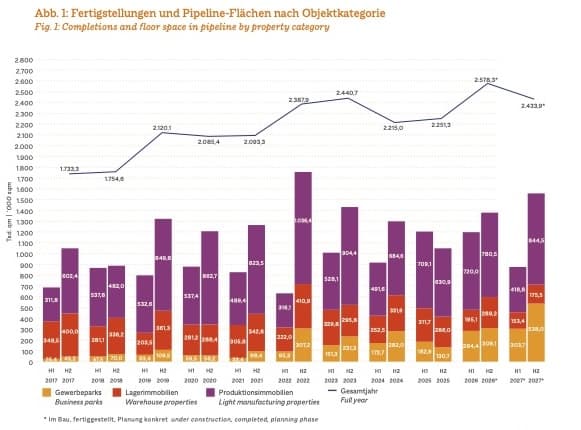
At around 1.2 million square metres, the volume of completions in the first half of 2026 was approximately 14.5 per cent higher than in the second half of 2025. Industrial properties dominated, accounting for 720,000 square metres, or around 60 per cent, of completions. Business parks saw particularly strong growth: at around 284,400 square metres, their volume of completions more than doubled compared with the previous half-year.
The project pipeline for the second half of 2026 and 2027 is also well-stocked. However, construction delays, difficult financing conditions and changing market conditions remain factors of uncertainty regarding the actual completion of the projects.
Contacts: Daniel Sopka, daniel.sopka@bulwiengesa.de and Alexander Fieback, alexander.fieback@bulwiengesa.de
You can download the 25th market report from INITIATIVE LIGHT INDUSTRIAL here: https://www.bulwiengesa.de/initiative_light_industrial/