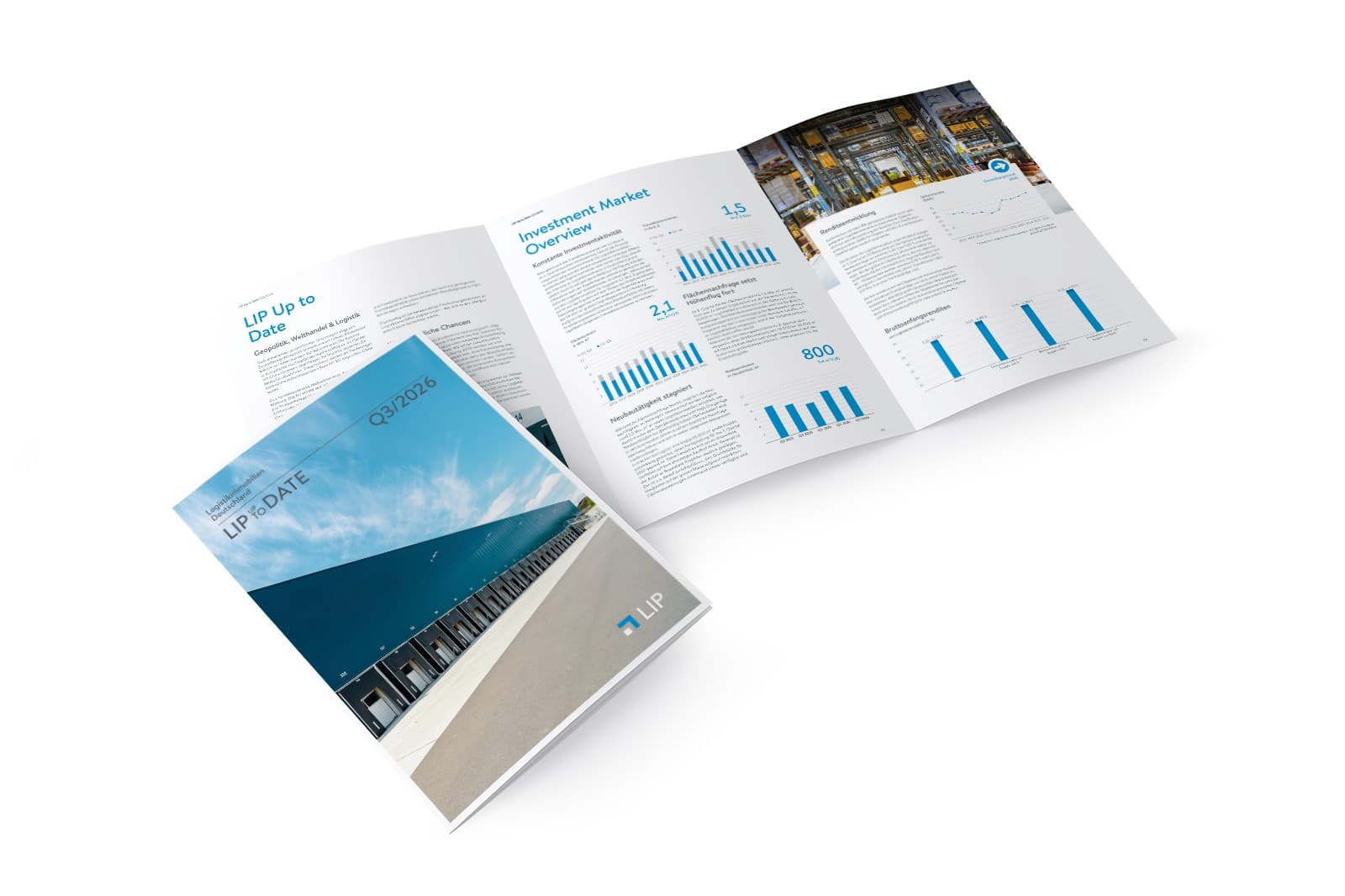
LIP Invest, a leading provider of specialist logistics property funds in Germany, has published the latest edition of its quarterly market report, “LIP UP TO DATE – Logistics Property Germany”. In this report, LIP Invest analyses trends in investment volumes, space take-up and new construction, as well as yield trends and the impact of geopolitical factors on the logistics sector.
Yield differentiation continues
IRR-driven foreign capital is seeking suitable logistics investments in Germany. As a result, the divergence in yields is continuing: gross initial yields for properties valued at over 40 million euros and for smaller properties are diverging significantly. Yields on logistics properties valued at under 40 million euros rose by 20 basis points in the third quarter and are likely to increase further by the end of the year if interest rates remain high. For larger properties, yields are around 50–70 basis points higher, ranging between 5.70% and 6.20%.
“We are currently seeing a similar trend with properties occupied by automotive tenants, where price discounts of up to a factor of one are sometimes being applied. Such a blanket assessment of tenants is, of course, too simplistic. The property criteria are far more decisive. The majority of properties used by the automotive sector are suitable for third-party use by many other industries, and a price discount is therefore unjustified. The diversity of users is the great strength of logistics property in Germany. Anyone who focuses solely on the tenant rather than first considering the location and property criteria is disregarding this strength,” says Sebastian Betz, managing partner at LIP Invest.
Investment market with steady transaction volumes
The transaction volume on the German investment market for logistics property amounted to 1.5 billion euros in the third quarter, remaining at the same level as the previous quarter. In total, logistics properties worth €4.1 billion have been traded since the start of the year, bringing the figure in line with the previous year’s level. Among the larger transactions was the change of ownership of the approximately 94,000-square-metre Fiege Megacentre in Hamburg. However, the tighter interest rate environment is dampening investment activity to some extent. The 10-year swap rate rose at times by more than 50 basis points. With long-term financing costs at around 4.50 per cent, debt leverage is becoming increasingly less effective; instead, the equity component is being increased in current transactions. Despite continued high investor interest, a significant rise in transaction volume is therefore not expected by the end of the year.
Demand for space continues to soar, whilst new construction activity remains stagnant
With a take-up of 2.1 million square metres, the German logistics lettings market once again recorded a strong quarter. A total of 5.4 million square metres were let in the first nine months, significantly exceeding the figure for the same period last year. Among the larger deals was the letting of around 61,000 square metres in Könnern, near Halle, to Bw Bekleidungsmanagement to supply the German Armed Forces. By contrast, new-build activity remains stagnant at a low level. In the third quarter, only around 800,000 square metres of new logistics space was built. Brownfield developments are becoming increasingly important as available greenfield sites become scarcer. For example, Logicor is developing around 65,000 square metres of new logistics space on the former Kaufhof site in Frechen.
Chinese companies are strengthening local logistics infrastructure
The EU customs duties on small consignments from third countries, which have been in place since July, are slowing the growth of Chinese e-commerce platforms in Germany. In response, Chinese companies are increasingly establishing local logistics structures. Their share of space take-up is rising, driving additional demand for logistics property. Increasing automation is also changing the requirements for logistics sites. Some companies are already testing humanoid robots for sorting, warehousing and order-picking processes. In the long term, this could reduce dependence on the available workforce, whilst a reliable energy supply becomes increasingly important.
Download the market report free of charge
The full market report, “LIP UP TO DATE – Logistics Property in Germany”, containing all the figures, charts and analyses, is available to download free of charge at: https://www.lip-invest.com/downloads/