
Modern living: High yields meet complex cost structures
Modern living concepts such as student housing, co-living and micro-living are becoming increasingly important in the German investment market. According to analyses of the past quarters, which show increasing market activity in the segment, a transaction volume of 267 million euros in 2025 confirms the relevance of this asset class. Compared to 2024, this is an increase of 145 percent. At the same time, the economic logic of the segment differs significantly from the classic residential segment. These are the results of a recent analysis by the global real estate service provider CBRE. The report can be downloaded here.
Revenue structure: All-in rents dominate
A central feature of the modern living segment is the extensive use of all-in rents. In addition to the basic rent, these also include all ancillary and operating costs as well as additional services such as furniture and internet. On average, around 76 percent of the total rent is accounted for by the basic rent.
Additional sources of revenue also play an important role. Income from services or additional services, for example, contributes an average of around seven percent to the total rent and stabilizes the cash flow.
“The income structure in modern living is much broader than in the classic residential segment. Additional services can stabilize earnings, but basic rent remains the mainstay,” says Marcus Max, Director Valuation Advisory Services at CBRE.
Cost structure: operation determines profitability
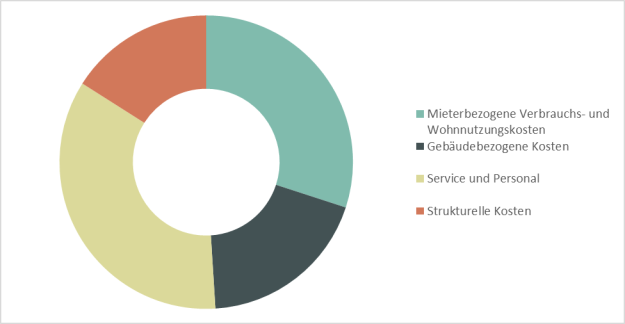
On the other hand, there is a complex cost structure that clearly distinguishes modern living from classic residential properties. While about 30 percent of the costs are attributable to consumption-related operating costs, around 70 percent are determined by building, service and structural costs.
Personnel and services in particular represent the largest cost block at up to 40 percent, followed by building-related expenses and structural costs.
“Modern living combines elements of residential and operator properties. The high proportion of service and personnel costs requires active management and significantly increases operational complexity,” says Christoph Huth, Senior Consultant Valuation Advisory Services at CBRE.
Capacity utilisation as a key lever for returns
The analysis shows that a large part of the costs are incurred regardless of capacity utilization. This makes the occupancy rate a decisive factor for profitability. At the same time, additional income can be generated through additional offers and services.
As a result, the segment achieves an average NOI margin of around 65 to 75 percent with stable capacity utilization. In the top 7 cities and in energy-efficient/ESG-compliant properties, this tends to be higher and can be as high as 85 percent at its peak.
“A high proportion of fixed costs makes capacity utilization the most important lever for the operating result. At the same time, the interplay of location, concept and target group determines long-term performance,” says Jirka Stachen, Head of Research Consulting Continental Europe.
Distribution of costs in modern living – share of consumption costs, building costs, service/personnel and structural costs
Source: CBRE Research