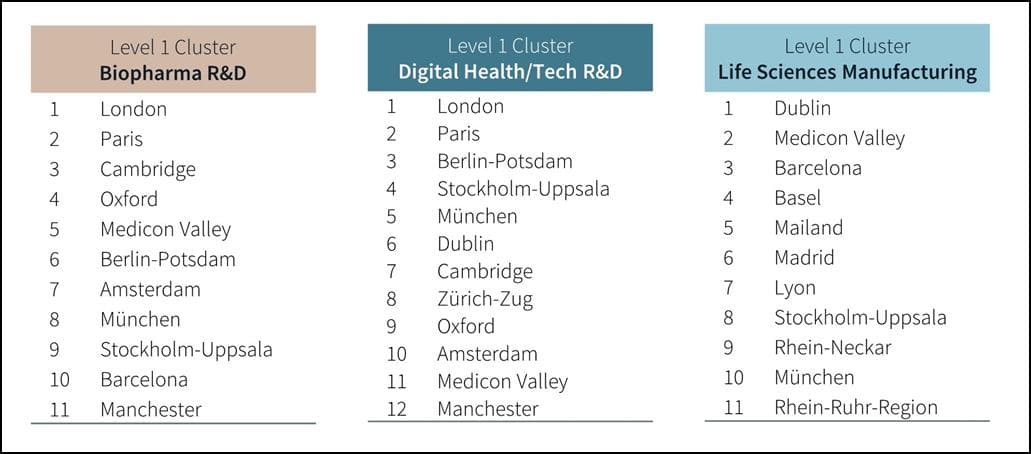


German clusters Berlin-Potsdam and Munich are well positioned in a European comparison
Artificial intelligence (AI) is fundamentally changing the design, function, and need for laboratory space in the life sciences, driving demand for next-generation facilities. The trend is to connect traditional wet labs with environments suitable for digital R, such as the " EMEA Life Sciences Cluster Report 2025" by JLL.
The report highlights how AI is driving change in life science real estate. Laboratory spaces must evolve to enable hybrid research models. This, in turn, requires the presence of flexible units that seamlessly integrate wet laboratories (for biotechnological experiments) and dry laboratories (for mechanical experiments) and directly connected offices for data analysis and computational work. The development reflects the growing convergence of biotechnology and data science, as AI fuels hopes that medicine can be developed much faster and cheaper in the future.
Record investment volume at the start of 2025
This change is being driven by record investments. In 2024, there were 100 deals across Europe with more than 500 million US dollars invested by venture capital (VC) in life science companies specializing in AI. The momentum continues in 2025, with total investment in European life science VCs reaching €3.8 billion in the first quarter – the highest amount ever recorded in the first quarter for the entire life science sector.
Alexander Nuyken, EMEA Head of Life Sciences at JLL, says: "The life sciences real estate market is poised for significant, long-term expansion, driven by the increasing role of AI in laboratory efficiency and drug discovery. AI is no longer just a tool. It's a catalyst for a new kind of lab – one that's inherently more digital, collaborative, and adaptable."
Life sciences companies are often grouped into geographic clusters to provide them with access to research institutions, talent, and other supporting companies. The report analyzes these clusters and finds that they can be broken down into three key areas:
• Biopharma RD (top cluster: Golden Triangle in the UK and Paris)
• Digital Health/Tech RD (top clusters: London and Berlin)
• Pharmaceutical manufacturing (top clusters: Dublin and Medicon Valley)
Stockholm-Uppsala, Medicon Valley and Munich are the only clusters that rank at the top in all categories and have completely balanced ecosystems. These findings show how real estate needs differ significantly by specialization – from lab-intensive biopharma spaces to technology-friendly digital health offices.
The increasing demand for modern, technology-enabled laboratories and the fact that demand is often concentrated in these clusters is leading to a shortage of suitable real estate across the EMEA region. Private laboratory stocks in Berlin, Paris and London are still scarce, although the pipelines could double the stock in the next five years. The projects under construction at six major European hubs account for over 27 percent of the existing supply.