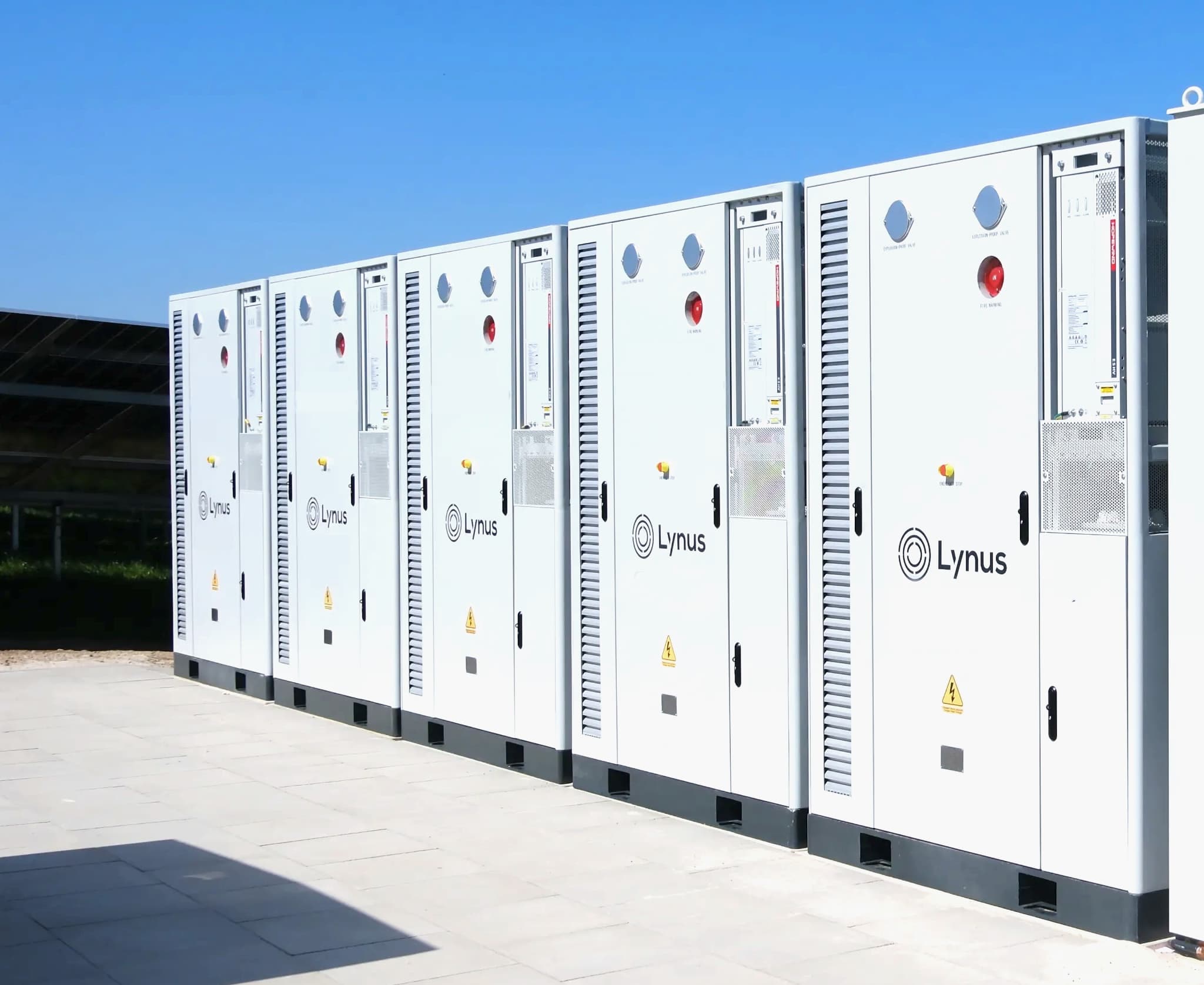
Lynus AG, a subsidiary of Enerfin AG, starts manufacturing large-scale battery storage systems in Dillingen an der Donau, Bavaria. With the Lynus BESS Cube 2.0, the company produces a modular storage system with a usable battery capacity of around 800 kWh. The system is scaled by cascading, can be integrated into energy projects on both the DC and AC sides, and can also be used as a gray current storage system. Lynus has developed the BESS Cube 2.0 specifically for the requirements of the German market and can flexibly adapt the configuration to project-specific grid connection conditions.
The storage system is supplemented by an energy management system (EMS), also developed by Lynus, as well as the multi-market marketing of electricity and storage flexibility. Lynus thus offers hardware, control and marketing as an integrated, European overall solution. The machine learning-based multi-use EMS is already in use in more than 1,500 plants in Germany and Switzerland.
Developed for the requirements of the German market
One focus in the development of the BESS Cube 2.0 was on flexible integration into PV systems. This is especially true for co-location projects in which existing photovoltaic parks are subsequently expanded to include battery storage systems. Here, storage systems must fit into existing plant layouts and grid connection concepts. With a footprint of just over 5 m2 and a weight of around 7.5 tons per cube, the system is compactly designed and thus facilitates transport and positioning on existing plant areas.
Another basis for development was the different technical grid connection conditions in Germany: Depending on the grid operator, voltage level and existing infrastructure, the requirements for a storage project can differ considerably.
"EPC companies and operators are regularly faced with the challenge of adapting storage systems to the specific grid and plant situation on site. Since we develop and manufacture the BESS Cube 2.0 ourselves in Germany, we can react quickly to project-specific requirements and significantly accelerate adjustments," says Paul Hauser, CEO of Lynus.
DC and AC coupling for new and existing systems
In new photovoltaic systems, the BESS Cube 2.0 can be connected directly to the DC side via MPPT modules. This saves additional AC components such as inverters and reduces conversion losses. AC coupling, on the other hand, is particularly suitable for retrofitting existing systems.
LFP technology, liquid cooling and multi-stage safety concept
Technologically, the BESS Cube 2.0 relies on lithium iron phosphate (LFP) cells. The battery cells are designed for more than 8,000 full cycles with 80 percent residual capacity. The rack system achieves DC round-trip efficiency (RTE) of at least 94 percent at 0.5 C.
The storage system is available with the voltage levels 400 volts, 690 volts and 800 volts. The charging and discharging capacity is up to 500 kW, depending on the version.
An integrated liquid cooling and heating system keeps the battery cells within as homogeneous a temperature range as possible, thus supporting performance and service life. The multi-level safety concept includes smoke, gas and temperature sensors, an automatic aerosol extinguishing system and mechanical pressure relief.