

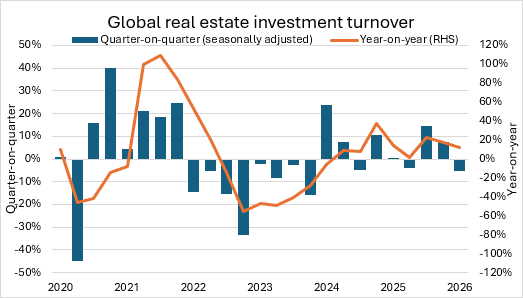
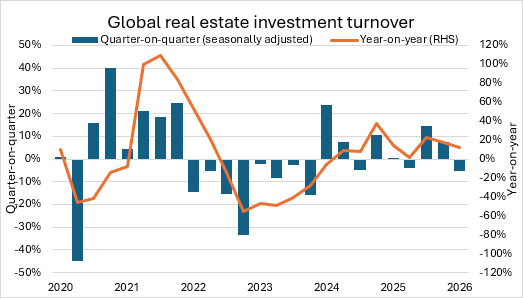
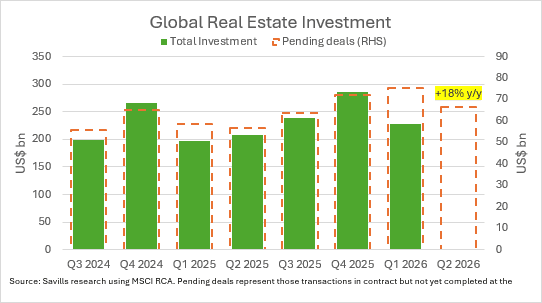
Global real estate investment volume was $230 billion in Q1 2026, down 5% sequentially, according to Savills' latest Quarterly Capital Markets Report. According to the international real estate service provider, however, market activity could pick up significantly: The number of ongoing transactions in the 2nd quarter is 18% higher than the previous year's figure. However, this is subject to a rapid de-escalation of events in the Middle East, which proves to be true.
According to Savills, a strong transaction pipeline suggests that transactions are currently being deferred rather than permanently removed from the market. This is in line with the pattern observed on global real estate markets after last year's customs shock on "Liberation Day": a weak first half of the year was followed by a noticeable revival in transaction activity in the second half of 2025.
According to Savills, a rapid resolution of geopolitical tensions would keep the impact on the fundamental conditions of the real estate market to a minimum. The company expects prices to remain stable despite low risk premiums and a higher risk-free interest rate, while there is still sufficient liquidity in the debt capital markets. At the same time, a limited development pipeline is likely to continue to provide significant support for rental growth, as increased uncertainty, increased financing costs and higher energy cost-related construction costs weigh on the profitability of new projects. Any short-term weakening in the outlook for rental growth is therefore likely to give way to a more severe shortage of supply in the medium term. In Savills' view, it is also crucial that after Liberation Day, the conclusion of a series of bilateral trade agreements has reduced the greatest risks and thus created a more stable environment for investors that will favour the revival of transaction activity.