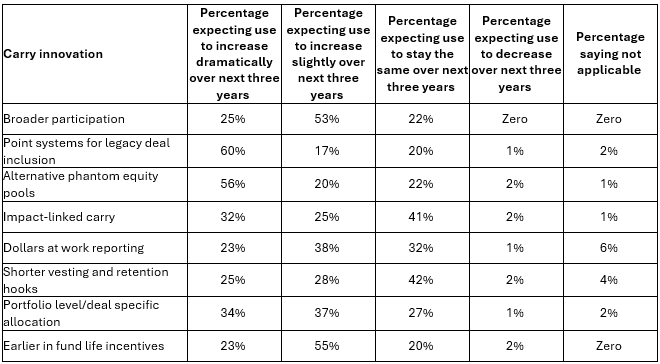
- Alternative phantom equity pools are currently the most widely used innovations, but points-based systems for including legacy deals will see the greatest growth
- Ocorian’s global study finds that the complexity of fund structures and regulation are key drivers of change
The modernisation of carry allocations is set to accelerate over the next three years as private equity fund managers move towards more flexible and inclusive models, according to new research from Ocorian, a leading US and global asset services provider.
The study, which surveyed private equity managers across the US and Europe who collectively manage $3.511 trillion, found that 84 per cent expect the pace of modernisation to increase, with the complexity of fund structures, regulation and tax issues being the key drivers of change.
Research across key US markets, the UK, Switzerland, Germany, Italy, Spain, Poland, Sweden and Bulgaria has found that alternative phantom equity pools are currently the most widely used innovations, whilst points-based systems for including legacy deals are set to see the most growth over the next three years.
More than half (54%) of those surveyed currently use alternative phantom equity pools, whilst 53% use shorter vesting and retention periods and 50% use points systems to include legacy deals. Around two in five (37%) focus on broader participation as a way of innovating the allocation process.
Looking ahead, 60 per cent expect a dramatic increase in the use of points systems for the inclusion of legacy deals over the next three years, whilst 56 per cent expect the same for the use of alternative phantom equity pools
Fund complexity, regulation and talent are driving change:
The study identified the complexity of fund structures, regulatory changes and tax developments as the main drivers of changes to carry allocation. More than a third (37 per cent) say that the complexity of fund structures, including continuation vehicles and longer fund lifespans, is creating a need for greater flexibility, whilst 33 per cent say that regulatory and tax changes, including UK reforms, are making changes necessary. Around 10 per cent of firms are already using tiered performance-based carry, where carry rates can rise above 20 per cent when higher return thresholds are achieved, depending on higher return multiples, whilst 90 per cent are considering it.
Balancing broader participation with LP protection:
The survey also found that carried interest or other equity-linked remuneration is increasingly being shared with non-principals, with 82 per cent reporting a slight increase over the past three years and 11 per cent reporting a significant increase.
However, there is also greater demand from LPs for stronger protection against over-distribution, with 92 per cent reporting an increase.
* The study was conducted by the independent research company PureProfile on behalf of Ocorian, involving 300 senior executives at private equity fund managers with total assets under management of $3.511 trillion in May 2026. The study included 210 executives across all major US markets and 90 in the UK, Switzerland, Germany, Italy, Spain, Poland, Sweden and Bulgaria. These comprised 150 working at emerging firms managing up to $500 million, 90 at mid-sized firms managing between $500 million and $10 billion, and 60 at large firms managing more than $10 billion.