

Transaction volume is clearly up at EUR 2.9 billion at the end of the first half of the year
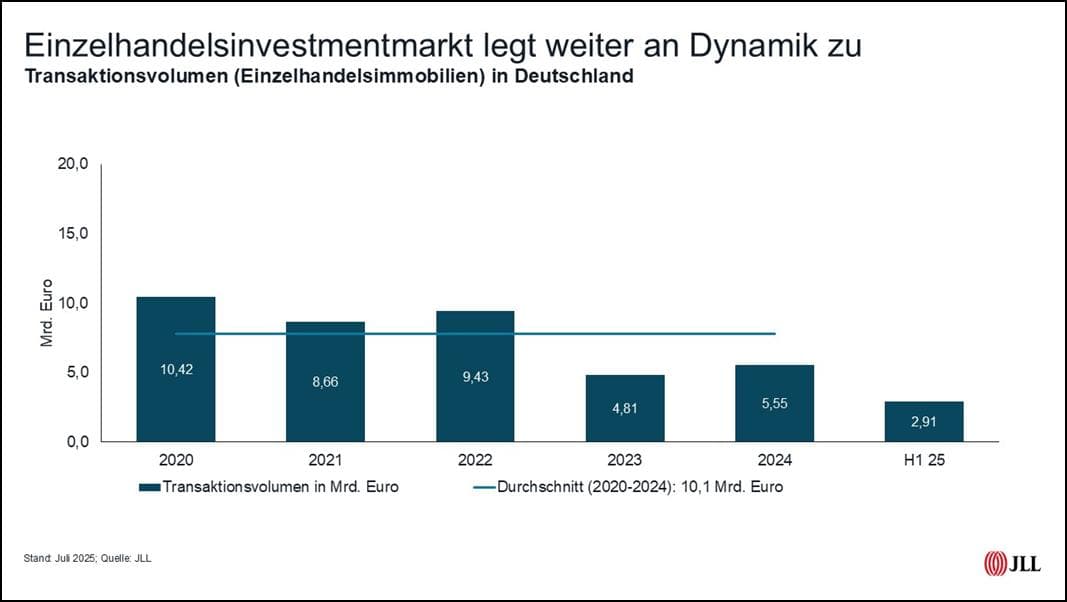
At the end of the first half of the year, the investment market for retail real estate continued its recovery and, with a transaction volume of EUR 2.9 billion, exceeded the previous year's figure by ten percent. However, there is still a gap of 15 percent to the average of the past five years. The number of transactions also increased with the volume, rising from 96 to 112 trades year-on-year. Once again, retail park products were the focus of the transaction activity. It is noteworthy that there has been a significant increase in non-food-anchored trade mark transactions.
"These are one-off effects from some portfolio transactions in this segment. Nevertheless, it should be said that non-food-anchored properties have also experienced a significant increase in liquidity," observes Sarah Hoffmann, Head of Retail Investment at JLL Germany. Nevertheless: "The current product landscape is dominated by classic products, which will also be the focus of transactions in the segment in the further course of the year," adds Hoffmann.
Three major transactions together raise more than 1.5 billion euros
In addition to the two transactions in the three-digit million range from the first quarter, another has now been added with the takeover of the Porta Group by XXXL Lutz, which together add up to more than 1.5 billion euros. This means that the three major deals together achieve more volume than four transactions of more than EUR 100 million in the same period of the previous year.
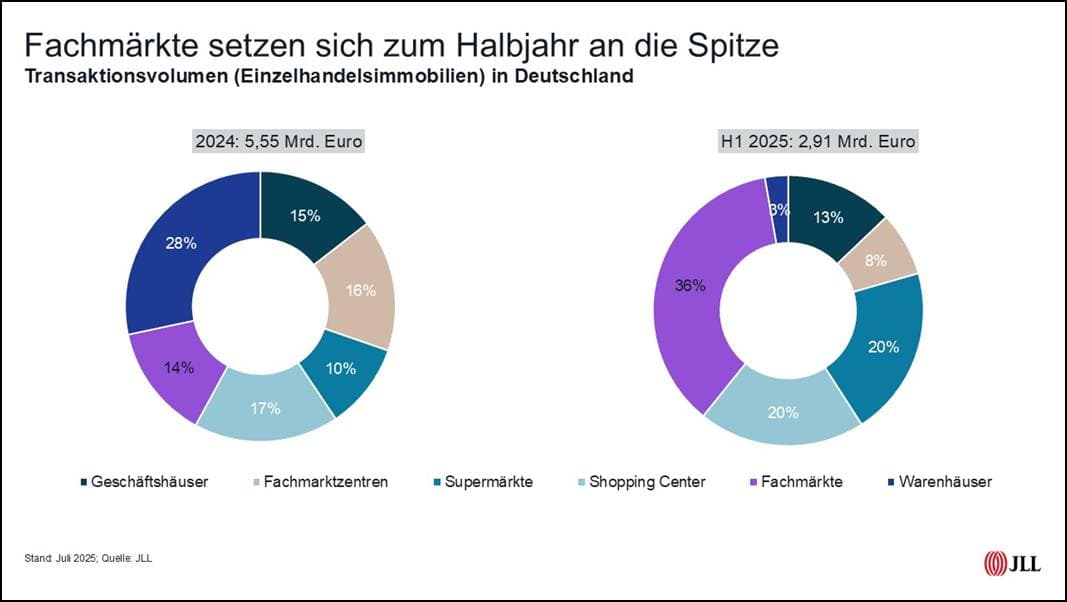
The strong dominance of supermarkets, which accounted for 43 percent of the total volume in the first quarter through a portfolio transaction, was put into perspective in the second quarter. With a total of 64 percent, retail park products are still by far the most important part of the market. However, specialty stores themselves contribute the most with 36 percent, while supermarkets now follow with 20 percent and retail parks with eight percent. Shopping centers come to 20 percent, commercial buildings to 13 percent and department stores were hardly traded with a share of three percent.