The crisis in German residential construction is increasingly evident in the gap between planned and actually realized projects. A review of bulwiengesa’s Development Monitor shows: At the end of 2023, residential projects with around 30.1 million m² of living space were known to be completed by the end of 2026. According to the current status of the project, around 9.4 million m² of this will not be realised as expected at the time. This corresponds to 31 percent of the project volume at the time, or around 125,000 apartments.
“The decisive question is not only how much living space is planned, but how much of it is actually created. If there is a mathematical shortfall of around 125,000 apartments compared to the original plans, this shows the dimension of the implementation backlog,” says Felix Embacher MRICS, Managing Director at bulwiengesa.
Larger residential pipeline does not yet mean a construction turnaround
As of 30.06.2026, the Development Monitor covers almost 22,000 projects with a total project area of around 174 million m². The total volume recorded is thus 2.7 percent below the level of 31.12.2025.
While many types of use continue to decline, the recorded residential project volume has risen by 2.9 per cent to around 68 million m² compared to the last reporting date. The strongest growth was recorded in the other locations outside the classic A to D cities with 6.6 percent. The A-cities also grew by 3.4 percent in the residential segment.
However, the increase can only be understood to a limited extent as a recovery in construction activity. Around 31 million m², or almost half of the recorded residential volume, are still in the concrete planning stage. Only around 15.5 million m² are currently under construction.
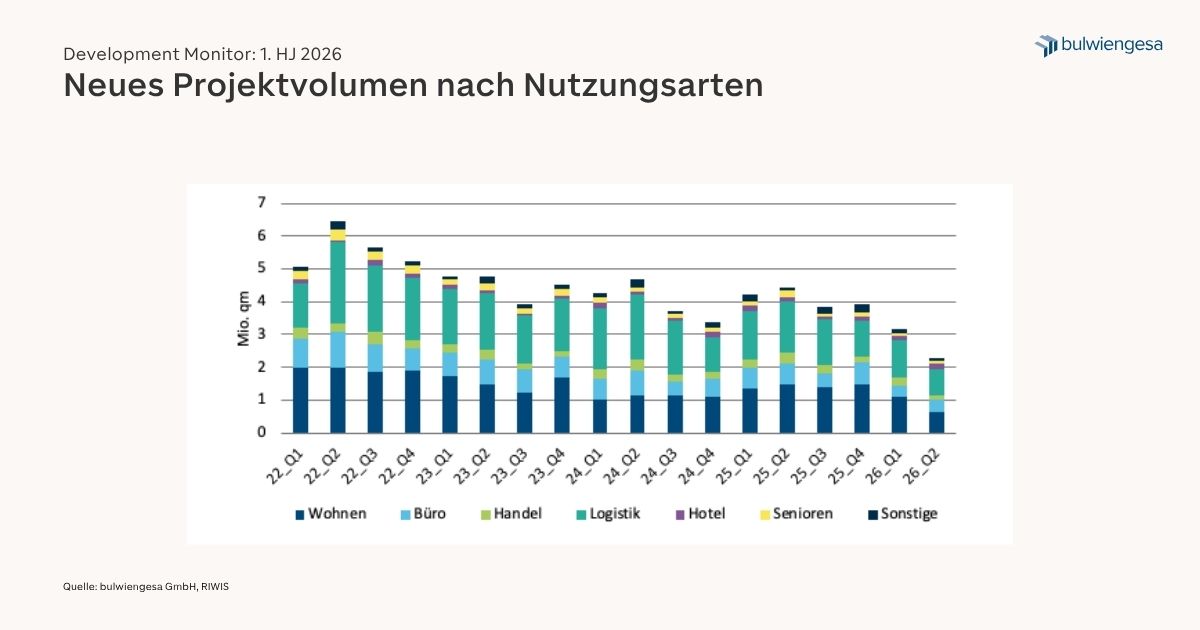
The start dates of construction also speak against a broad trend reversal. The newly launched project volume in the second quarter of 2026 is around 65 percent below the peak of the time series. In the residential segment, the gap to the peak of the second quarter of 2022 is around 67 percent.
“The pipeline in the residential segment is getting a little bigger again. However, the decisive factor is whether these projects overcome the threshold from planning to construction. This is exactly where the market has been stuck so far,” says Embacher.
Delays remain a structural problem
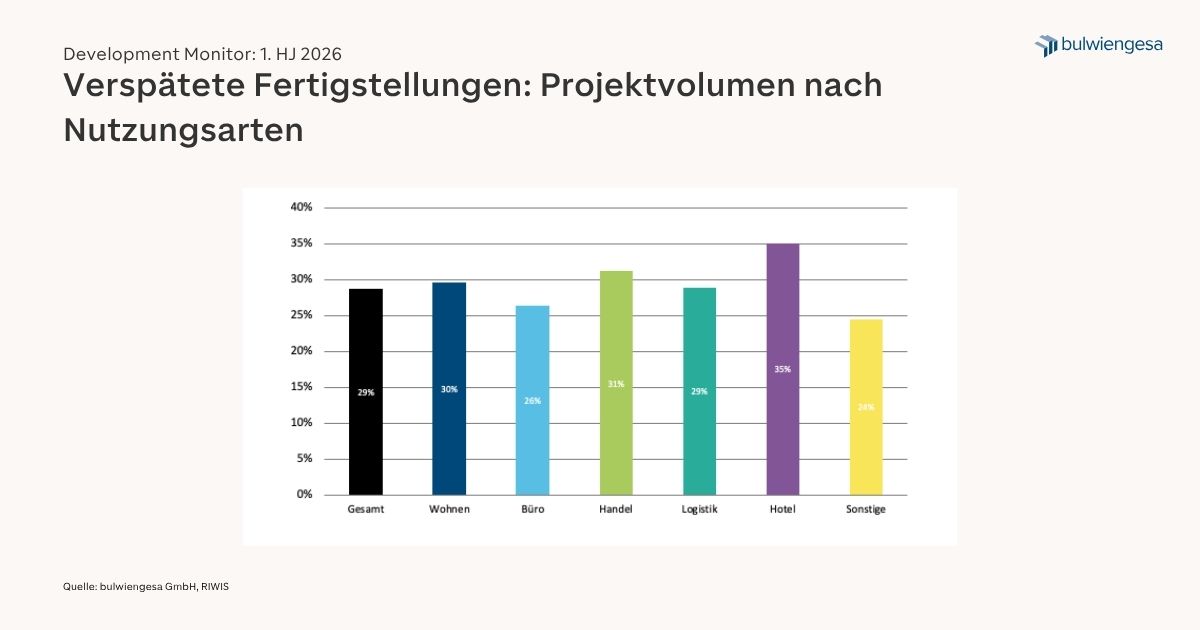
Around 29 percent of the residential project volume is currently affected by a delayed start of construction. In terms of late completions, the share in the residential segment will increase from 23 percent in the second half of 2025 to 30 percent in the first half of 2026.
“Even if the number of building permits is actually increasing, no one should be mistaken: On paper there is a plus, but in reality many projects do not make it past the permit. This is due to the continuing rise in costs for materials and financing. But this is also due to the still missing simplifications, the necessary push in reducing slowing down bureaucracy. Where is the overdue building type E-Law? In addition, incentives for investments through a special depreciation and other accompanying measures would help,” says Dirk Salewski, President of the BFW Federal Association of Independent Real Estate and Housing Companies.
Other types of use declining
While housing remains comparatively stable, the correction continues in other segments. The volume of office projects fell by 5.7 per cent to around 25.8 million m² compared to the end of 2025, while the decline in logistics projects was 7.7 per cent to around 50.2 million m². Senior living recorded a decline of 8.4 percent to around 6.8 million m².