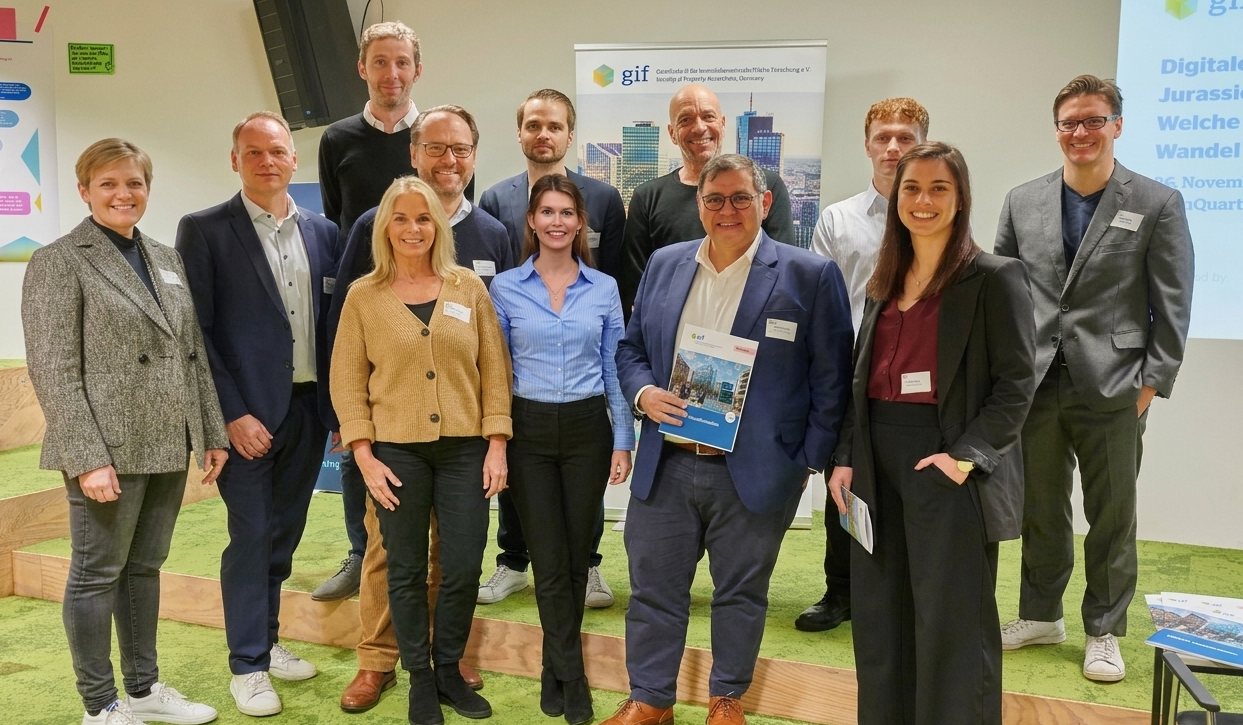
With the “Digital Transformation Guideline”, the Gesellschaft für Immobilienwirtschaftliche Forschung e.V. (gif) publishes a practice-oriented orientation and action framework for the digital transformation of real estate companies. The guideline emerged from the gif Digital Transformation Competence Group and was developed together with authors and partners from science and practice.
The focus is on a holistic understanding of digital transformation. The focus is not on individual technologies or isolated digitization projects, but on the targeted further development of the company. It ranges from strategic objectives and implementation to consolidation and continuous development.
A central element of the guideline is the gif transformation framework. It combines seven success factors with a transformation process consisting of five phases. The image of a rocket illustrates how these elements interact within the framework. Strategy and continuity, culture and personnel, as well as processes and data form the “engines” of the transformation. The technology forms the core and provides the technical basis for implementation. The departments take the pilot’s seat in the cockpit: they set the technical direction, formulate the requirements from the core business and steer the transformation. At the same time, the presentation makes it clear that digital transformation is not just a task for IT. Only the interaction of the various factors enables sustainable impact. “Digital transformation does not begin with the selection of a technology, but with the question of what development the company wants to achieve. The guideline helps to determine one’s own starting point, to formulate goals and to systematically create the necessary prerequisites,” says Dr. Christoph Holzmann, head of the gif Digital Transformation Competence Group.
Another focus of the guideline is the gif maturity model. It evaluates their characteristics on the basis of defined questions and fully formulated answer options on a scale of 1 to 5. In this way, it supports companies in classifying their initial situation and determining a target state appropriate to their respective situation. The aim is explicitly not to achieve the highest possible level of maturity everywhere. Rather, the decisive factor is which skills a company needs with regard to its strategic goals, its business model and its framework conditions.
“Transformation does not mean striving for the highest level of maturity in every area. It is crucial to develop skills in a targeted manner where they are relevant to the respective company and make a concrete contribution,” says Mahmoud Hawari, co-head of the gif Digital Transformation Competence Group.
The guideline structures the transformation process in five phases: from the strategic and organizational prerequisites to the initial situation and target state to implementation, as well as consolidation and further development. Even before the actual start, prerequisites such as a common understanding of goals and benefits, clear responsibilities, sufficient resources and corresponding freedom are considered. The guideline also shows how companies can create clear responsibilities, prioritize measures according to their practical benefits and use suitable key figures to check whether the digital transformation makes a measurable contribution to achieving the goals.
Consolidation and further development play an overarching role in this. Transformation does not end with the completion of a project or the go-live of a new application. The decisive factor is whether changes in everyday work are actually used, generate the expected benefits and can be further developed in the event of changing framework conditions. The guideline is aimed in particular at board members, management, owners, executives and specialists who shape or accompany digital transformation processes in real estate companies. Three fictitious companies, so-called personas, and practical application examples illustrate typical initial situations along the real estate value chain.
With the “Digital Transformation Guideline”, gif provides the real estate industry with a structured framework that does not specify a uniform transformation path. Rather, it supports companies in analysing their initial situation, determining a suitable target state, prioritising changes and ensuring their long-term impact. The guideline is now available in the gif online shop: Link
Presentation at Expo Real 2026
The “Digital Transformation Guideline” will be presented for the first time at Expo Real 2026.
Tuesday, 6 October 2026, 3:30 p.m., Hall C1 / 140
Interested representatives of the real estate industry are invited to get to know the guideline and the underlying gif transformation framework on site, to talk to the participants of the competence group and to experience how the rocket of digital transformation takes off at Expo Real.