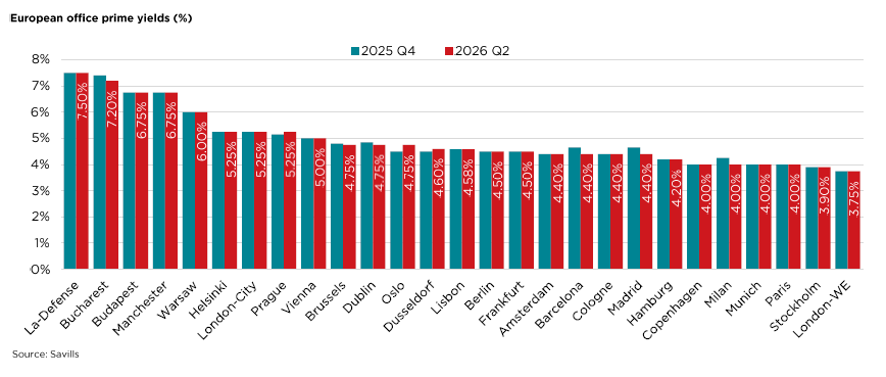
According to Savills, average prime yields for office properties in Europe remained broadly stable at 4.9% in the second quarter of 2026. Yields declined in Dublin (-10 basis points to 4.75%), Milan (-25 basis points to 4.00%) and Brussels (-5 basis points to 4.75%). In Oslo, prime yields rose by 25 basis points to 4.75% as a result of an interest rate hike by Norges Bank, while in Düsseldorf they rose by 10 basis points to 4.60%.
According to Savills, the conflict between the US and Iran has slowed the recovery of investment activity in 2026, as transaction processes take longer to complete. However, buyers are again showing an increased willingness to invest in European office properties, especially if they guarantee secure returns and there is little need for renovation. Due to a lack of selling pressure, owners continue to hold on to their price expectations. The shortage of buyable, first-class properties also supports the prices for top properties.
James Burke, Director, Global Cross Border Investment at Savills, says: “According to Real Capital Analytics data, cross-border investment in European office real estate accounted for 36% of total activity in the first half of 2026, which is the largest share since 2022. We continue to observe particularly high activity from buyers from the European region, including Spanish family offices, French SCPI ́s, German institutional funds and insurance companies, and Czech corporations. Swedish foreign investment is also gaining momentum. At the same time, we are seeing a moderate but nevertheless remarkable increase in owner-occupier activity.”
Savill’s analysis shows that the average vacancy rates of office space in European CBD locations have increased by 220 basis points to 4.9% since 2019. At the overall market level, the increase was much stronger over the same period, at 500 basis points to 9.5%, reflecting the increasing preference of tenants for prime locations.
Mike Barnes, European Office Research Director at Savills, says: “Occupier demand in the European office markets continues to make a compelling case for investors. Take-up has proven to be resilient overall, but the composition of demand has changed. Tenants are taking longer to decide on new space, and the proportion of lease renewals remains high, reflecting both economic restraint and the high cost of interior fit-outs. At the same time, the limited supply of prime space in central locations is driving rental growth, especially for buildings with high levels of equipment and energy efficiency.”
You can find the corresponding report under this link: Savills Germany | Spotlight: European Office Investment – Q2 2026