Stable first half of the year with subdued market activity
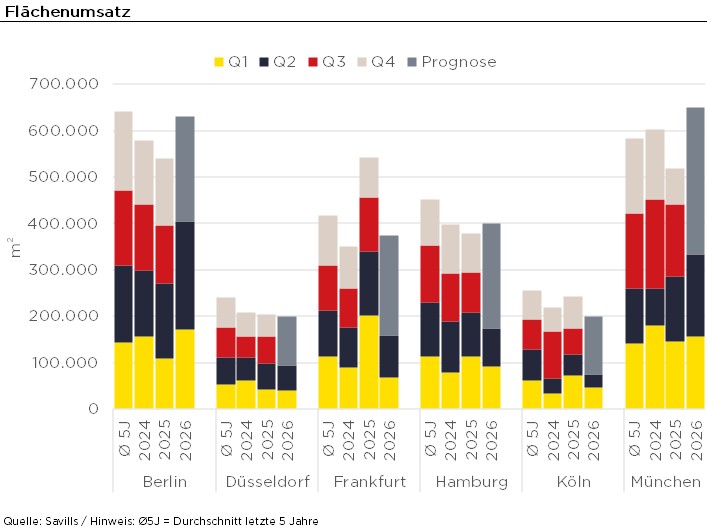
In the first half of 2026, take-up in the top 6 office markets* reached 1.2 million m². This was 6% below the previous year’s figure and 12% below the ten-year average. Jan-Niklas Rotberg, Managing Director and Head of Office Agency Germany at Savills, comments: “The first half of the year shows a stable picture overall in the top 6 office markets with continued subdued market activity. There are clear differences between the cities: Berlin had a strong first half of the year and continues to show high market dynamics, while Munich is developing steadily. Both markets benefit from leasing from the AI and technology segment as well as their appeal to international users. Cologne and Düsseldorf, on the other hand, recorded a weaker first half of the year – there is a lack of comparable growth impulses here.”
Uncertainty and cost pressure are dampening demand
Economic uncertainty and cost pressure dominate across all locations as the central drivers of restraint. “The uncertainty among users is mainly fed by the geopolitical situation and the economic weakness and is noticeably slowing down rental activity. In addition, there is the topic of AI: The question of AI-related future personnel requirements triggers uncertainties among some companies regarding the space requirements. In addition, hybrid working models continue to reduce demand, but at the same time release impulses to move towards higher quality. Modern, high-quality space is in demand – in new buildings as well as in modernised existing buildings,” explains Antonia Wecke, Associate Research at Savills.
Between quality focus and cost pressure
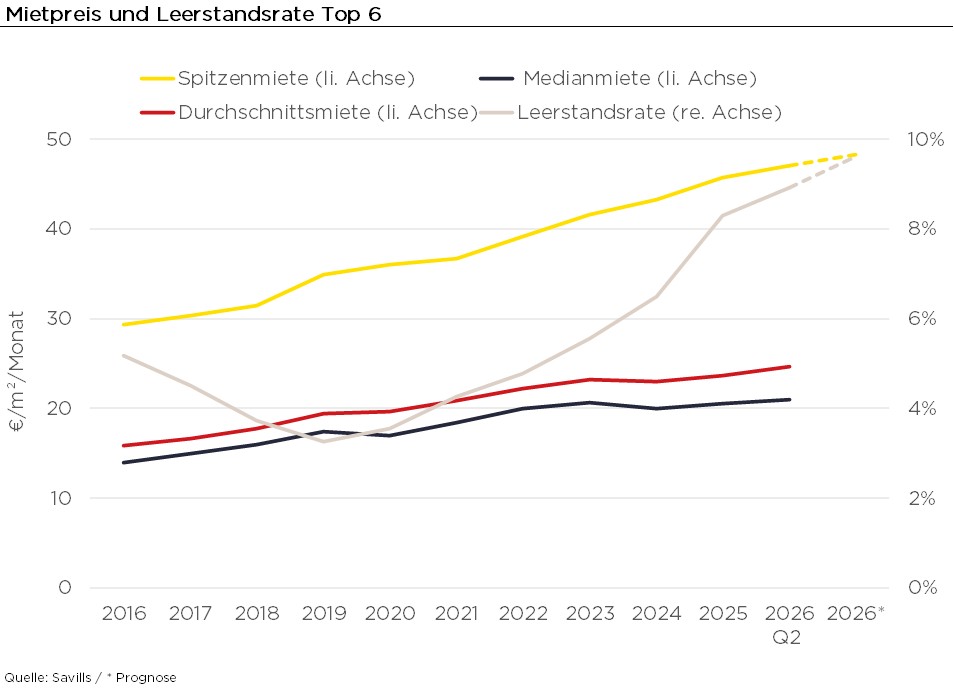
Despite the focus on quality, users are extremely price-sensitive. “We often see a discrepancy between quality standards and budget expectations. This inhibits relocations and new contracts, prolongs decision-making processes and leads to more intensive negotiations. Even with top products, negotiations sometimes take a long time. At the same time, individual top deals show that users continue to pay exceptionally high rents for the right space. The main driver for such space decisions is the competition for top workers. As a result, prime rents continue to rise – while vacancies are increasing at the same time,” says Rotberg. The average prime rent of the top 6 cities rose by 1.6% compared with the previous quarter. At the same time, the vacancy rate on average in the top 6 cities increased by 20 basis points to 8.9%.
“The increase in vacancy depends on quality and location and is mainly concentrated in older areas and weaker locations. Price pressure is particularly high in these properties. Landlords are willing to negotiate, grant incentives more often, offer more flexible contract terms and more often make concessions on the amount of rent,” adds Rotberg.
Outlook: Demand remains subdued and selective
“There are no signs of a fundamental change in sentiment in the second half of the year. Economic uncertainty is likely to continue to cause caution among users and cost pressure remains a central factor in land decisions. A broad revival of the market is therefore not to be expected. Instead, the differences are likely to become more entrenched: high-quality, modern space remains in demand, while marketing in older stocks and in weaker locations is becoming increasingly difficult,” Rotberg summarises.
* Berlin, Dusseldorf, Frankfurt, Hamburg, Cologne and Munich