Den här artikeln är automatöversatt.


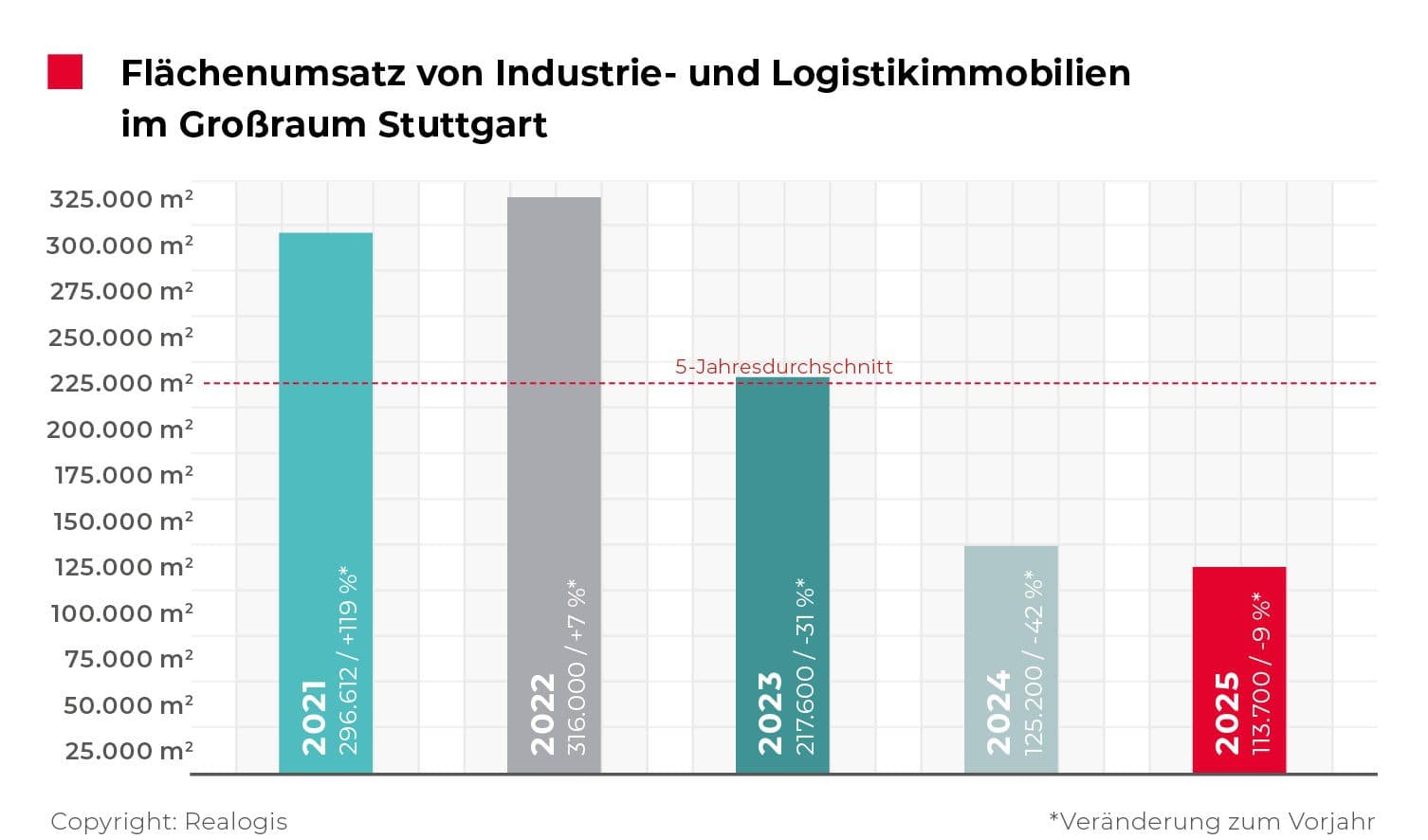
The logistics and industrial real estate market in the Stuttgart Region recorded take-up of 113,700 m² in 2025 as a whole. REALOGIS Immobilien Deutschland GmbH (REALOGIS), Germany's leading consulting firm for industrial and logistics real estate as well as commercial properties, is thus observing a continuation of the decline of recent years, which, however, is much more moderate than in previous years. Starting from 125,200 m² in the previous year, total take-up fell by 11,500 m² or 9%. While 2022 was the strongest year since records began in 2011 at 316,000 m², 2025 marks the weakest year as a whole. The 5-year average was missed by 47%. The three largest deals by LIDL, Klauss GmbH and a logistics service provider totalled 21,000 m² or 18% of total earnings.
Joel Adam, Managing Director of Realogis Immobilien Stuttgart GmbH, comments: "Demand for space remains selective against the backdrop of the overall economic situation and structural challenges, especially in the automotive industry. But the Stuttgart Region has a high level of industrial competence, distinctive technological know-how and strong innovation structures. These will have a stabilising effect and form the basis for a moderate revival of take-up in the course of 2026."
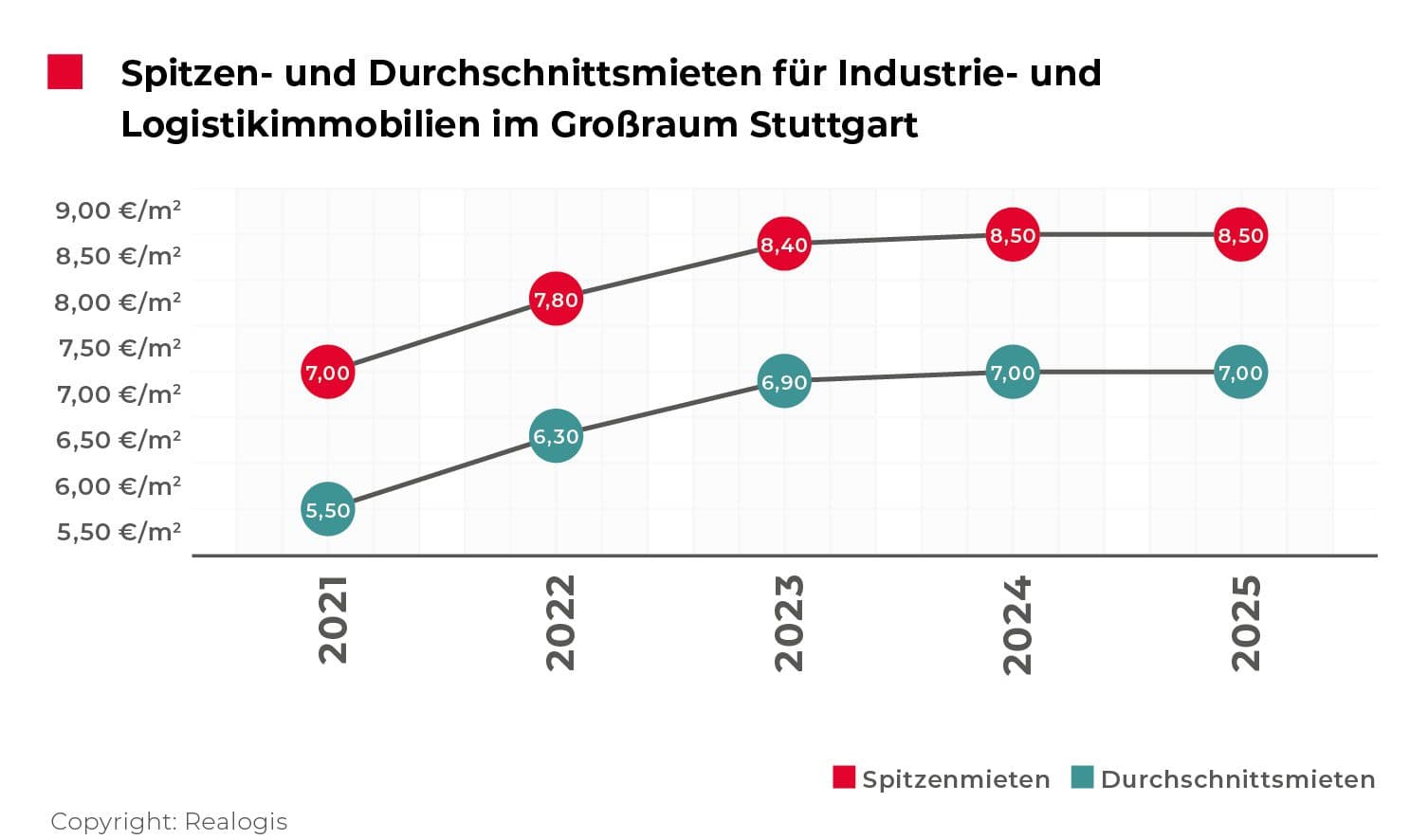
The prime rent remains stable at €8.50/m², halting the upward trend that has been ongoing since 2020. The average rent is stagnating at €7.00/m². Both figures are 6% and 7% above their respective 5-year averages, respectively. The gap between prime and average rents has remained stable at €1.50/m² for five reporting periods. While the supply of modern space in sought-after locations remains limited, increased construction and financing costs are driving up prices, but restrained demand is preventing further price increases.
At 98,200 m², or 87% of total take-up, deals in existing space remained pace-setting. In 2025, new buildings reached a total of 15,500 m², or 13% of take-up, with the vast majority (12,900 m² or 83%) being former brownfield space. The 9,000 m² deal by LIDL in the Esslingen district accounted for around 70% of the brownfield volume. At 2,600 m² (17%), greenfield contracts played a subordinate role in lettings in new buildings.
With 44,300 m² or 39% of total take-up, the district of Esslingen replaces last year's leader Ludwigsburg. The district of Böblingen follows in second place with 23,500 m² and recorded the highest growth of all regions with an increase in take-up of 17,100 m². Take-up increased by more than 3.5 times compared to the previous year. Ludwigsburg slips to third place with 20,600 m². Due to the lack of major deals, take-up halved again. The fourth-placed district of Göppingen remained unchanged in rank with 13,000 m² or 11%. With 8,700 m², the city of Stuttgart contributes only 8% of total take-up.
The industry and production sector maintained its top position with 39,500 m² or 35% of total take-up, but recorded a decline of 26% compared to the previous year. The main reason for the decline in take-up was the lack of major take-up, which accounted for around half of the sector's take-up in the previous year.
Retail follows in second place with 27,900 m² or 24% of total take-up. Within retail, traditional brick-and-mortar retail companies clearly dominated with 82% of retail space take-up, compared to e-commerce companies with 18%. While the percentage share ratio of e-commerce to brick-and-mortar retail was still 75% to 25% in 2023 as a whole, the ratio tipped to 61% to 39% as early as 2024.
Third place went to the logistics and freight forwarding sector with 23,900 m² or 21% of total take-up. It was the only industry to record a significant increase of 546%, compensating for around two-thirds of the declines in the other sectors.
In the size class from 10,001 m², no deal was recorded in 2025. This means that this size class remains without a qualification for the second year in a row. Spaces between 1,000 m² and 3,000 m² took the lead with 45,100 m² or 40% of total take-up, recording an increase of 47% compared to the previous year. The 3,001 m² to 5,000 m² size class follows in second place with 34,000 m² or 30% of total take-up. Together, space under 5,001 m² accounts for a total of 86% of total take-up. In the previous year, it was only 56%.