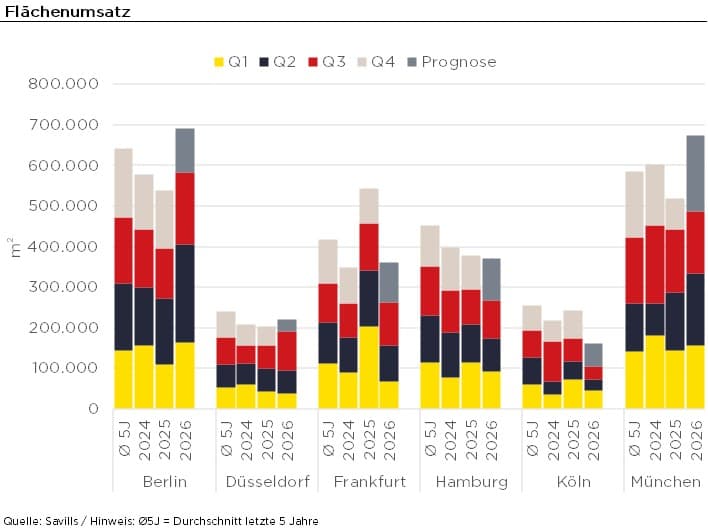



In the first nine months of the current year, take-up in the top six office markets* totalled 1.9 million m², roughly in line with the previous year’s figure. Prime rents remained at a high level, whilst vacancy rates continued to rise. The polarisation of the office markets observed since the coronavirus pandemic thus continued. Jan-Niklas Rotberg, Managing Director and Head of Agency Germany at Savills, comments on this development as follows: “The number of companies and institutions seeking to consolidate their office space and make it more efficient remains consistently high. At the same time, we are seeing a continuing desire to strengthen employees’ ties to the office, which is competing with working from home. To achieve this, the office must offer added value compared to working from home. Quality over quantity therefore remains a defining theme in the office markets. Demand for space is likely to remain below average compared with the last ten years and to concentrate on prime locations and properties. This polarisation is also becoming increasingly evident in the market figures: whilst prime rents have been at record levels for years and are predominantly continuing to rise, the vacancy rate has now also reached a new all-time high.”
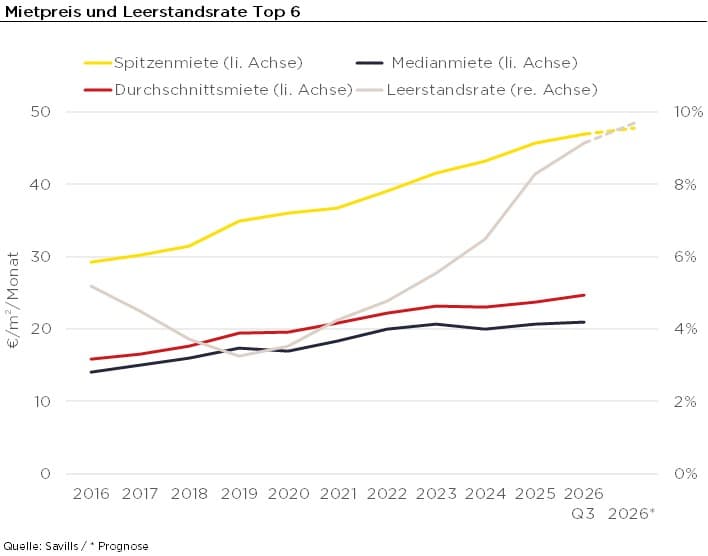
In the top six cities, the vacancy volume rose to around 8.1 million m² in the third quarter of 2026, reaching its highest level since reunification. The vacancy rate increased by 20 basis points compared with the previous quarter to 9.1 per cent, exceeding the 9 per cent mark for the first time since 2011. The average prime rent in the top six cities remained at a high level. It stayed unchanged in five of the six cities, whilst it fell slightly in Berlin. A further rise in prime rents in the top six cities is expected by the end of the year.
Outlook: The office market remains in flux – demand is characterised by less space and higher standards
Rotberg looks ahead: “In recent years, numerous large companies have bought themselves time by extending their leases in order to develop a strategy for their office space and hybrid working concepts. Some of them have now completed this phase and have already relocated. Others are still based in buildings or locations that do not fit with the new concepts and requirements. The recent announcements by the City of Hamburg and Deutsche Bahn that they intend to reduce their office space by up to half a million square metres underpin the trend towards more efficient and, at the same time, better-quality space. Further relocations are therefore on the cards, which, whilst likely to increase vacancy rates, will ensure that competition for good office space remains as intense as ever.”
* Berlin, Düsseldorf, Frankfurt, Hamburg, Cologne and Munich