Cases

Answers from theory and practice to the key questions of real asset investment. Investment cases and best-in-class approaches for investors, asset managers and other market players.


Cases weeklys

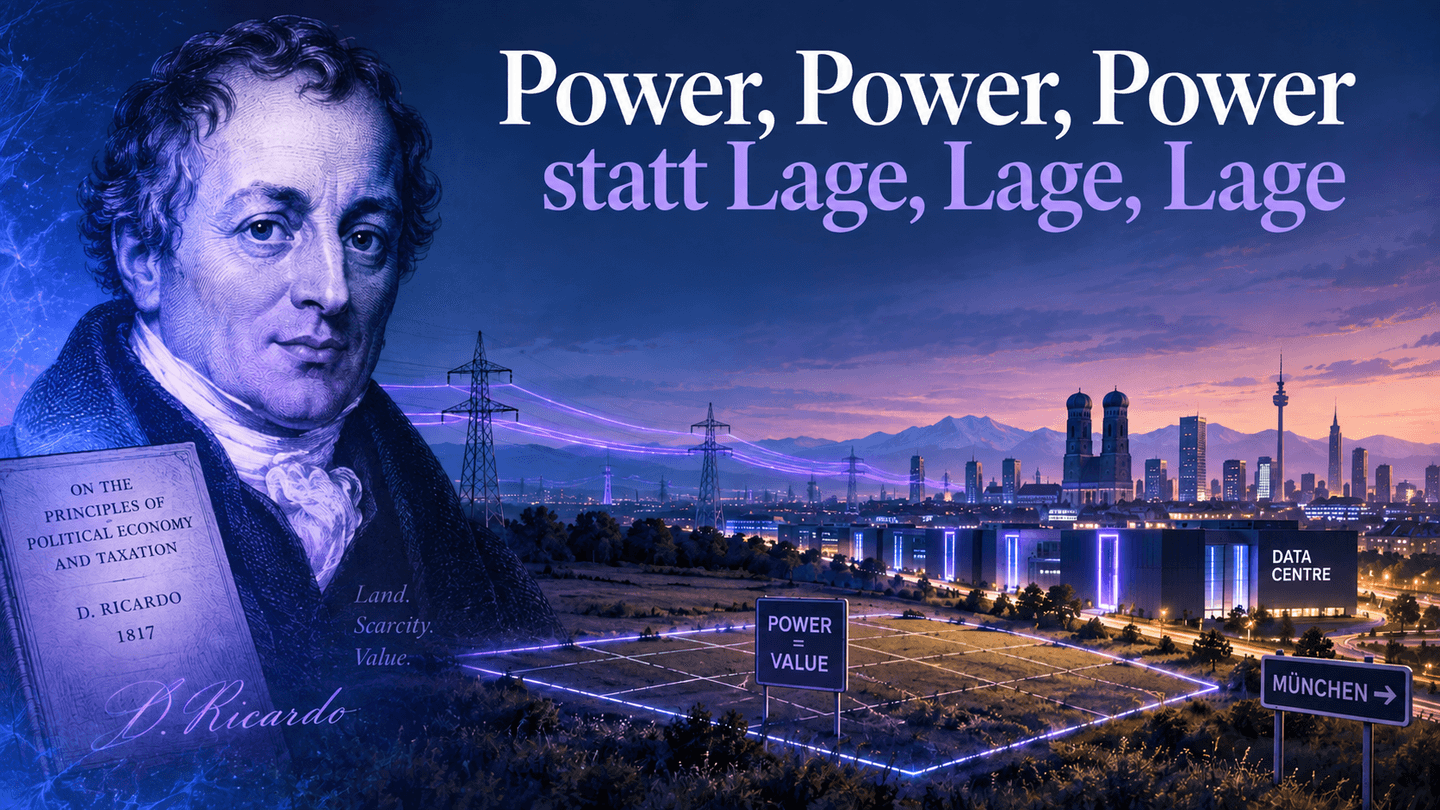
Power, power, power instead of location, location, location
CommentWeekly

Power, power, power instead of location, location, location

The AI boom is changing the real estate economy: where grid capacity becomes scarce, secure access to electricity increases in value – and capitalizes on the price of land.

Five asset classes, one data center
ArticleCommentWeekly

Five asset classes, one data center

The AI boom is devouring immense capital for data centers and infrastructure, for example, which is reflected in very different segments of the portfolio. For institutional investors, the question arises as to whether this allocation allows sufficient conclusions to be drawn about the actual risks.

The real AI revolution is taking place in the investment process
AnalysisWeekly

The real AI revolution is taking place in the investment process

AI is shifting competition in real asset management from information advantage to efficient processing in the investment process. China's focus on rapid diffusion rather than maximum model performance supports this view. Alpha is created through better process integration and faster decisions.

Secondaries: When a market emerges around long-term capital commitment
CommentWeekly

Secondaries: When a market emerges around long-term capital commitment

The global secondaries market reached record volumes in 2025, but it does not simply make private markets liquid. Instead, an infrastructure is being created for orderly entry and exit of long-term tied capital. Artificial intelligence is likely to accelerate this development even further.

What Ronald Coase could reveal about the future of private markets
CommentWeekly

What Ronald Coase could reveal about the future of private markets

Based on Coase's transaction cost theory, the article outlines how AI could change the structure of private markets. AI makes due diligence, matching, sales and secondaries more efficient – with possible effects on platform models and illiquidity discounts.

Why coordination is becoming more important than analysis again
AnalysisCommentWeekly

Why coordination is becoming more important than analysis again

Technology makes analyses cheaper, regulation makes unclear division of labor more expensive. As a result, coordination and responsibility are becoming increasingly important in the fund industry. Competitive advantage comes from the consistent organization of analysis, decision-making, accountability, and execution.

The more division of labor the fund world becomes, the more bank-like its governance becomes
CommentWeekly

The more division of labor the fund world becomes, the more bank-like its governance becomes

BaFin submits draft of KAGB amendments. Lending is not part of portfolio management and can be outsourced, if necessary with a KWG licence requirement. MiFID services remain permissible, but must be clearly assigned and transparently mapped in the licence notice.

That's the hammer: When civil courts start reading special funds sentence by sentence
CommentWeekly

That's the hammer: When civil courts start reading special funds sentence by sentence

The Higher Regional Court of Cologne (judgment of 25 April 2024) on redemption suspensions for open-ended special real estate funds clarifies: In case of doubt, contractual rather than market logic decides. The question of price is particularly relevant in the case of time-stretched returns. KVGs should specify their investment conditions.

The surprise of the energy transition could be that volatility, of all things, is becoming one of the most valuable raw materials in the system.
CommentWeekly

The surprise of the energy transition could be that volatility, of all things, is becoming one of the most valuable raw materials in the system.

Negative electricity prices are piling up: in 2025, Germany counted 573 hours below zero, the average day-ahead spread was €130/MWh. Battery storage monetises volatility; BNEF expects +1/3 installations in 2026, costs since 2018 -75%. PV redispatch Q2/2025: 605→1,168 GWh.

The Acceleration of Institutional Narratives
CommentWeekly

The Acceleration of Institutional Narratives

Institutional narratives are accelerating, diffusing from liquid to traditionally slow asset classes such as real estate and infrastructure. Topics rotate faster, attention organizes capital and influences perception, allocation and cost of capital.

When volatility becomes a business model in infrastructure investments – the example of battery storage
CommentWeekly

When volatility becomes a business model in infrastructure investments – the example of battery storage

Battery storage is currently the most visible proxy for the role of infrastructure shifting for investors. Falling costs, rising electricity demand and volatile energy markets are reinforcing this development.

Infrastructure is no longer boring – and do investors also want excitement?
CommentWeekly

Infrastructure is no longer boring – and do investors also want excitement?

The asset class is changing. Have the expectations of investors done the same?

#Newsletter: Stay up to date!

Sign up for our newsletter and receive regular updates on the latest topics.

Register now