An office building can be used for 50 years. An Nvidia chip can become economically obsolete after just a few years. Nevertheless, loans running into the billions are now being granted against AI processors and the associated cash flows. How does this work – and who bears the residual value risk?
Three ways to the same chip
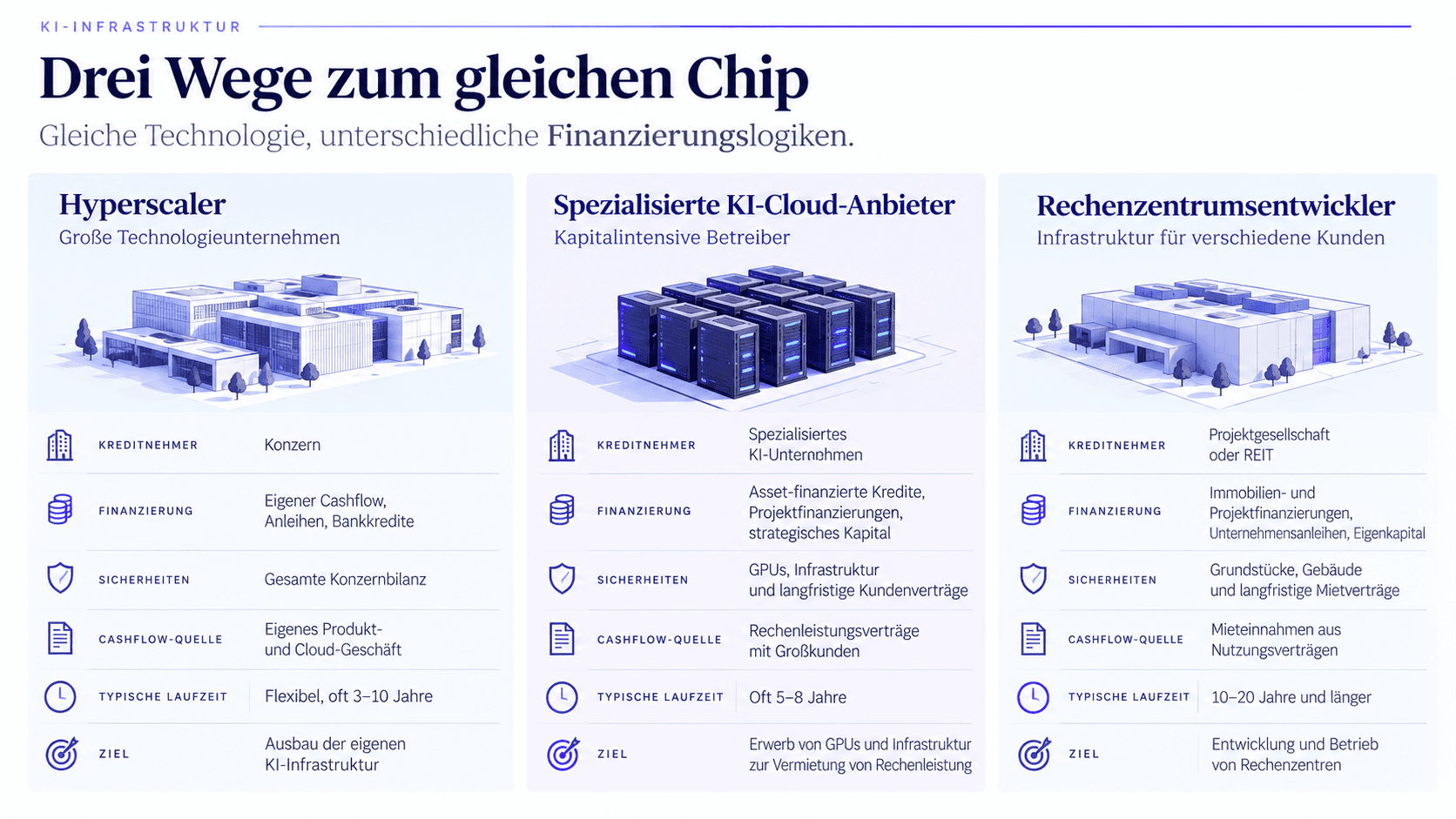
Microsoft can finance its AI investments from its cash flow and via its own consolidated balance sheet. A traditional data centre developer, on the other hand, relies on property and project financing, secured by land, buildings and long-term leases.
In between, a third world of financing is emerging: specialised AI cloud providers who purchase large numbers of graphics processing units in order to lease their computing power to customers. Their capital requirements are enormous, yet their balance sheets are not comparable to those of a global technology conglomerate.
The solution: financing arrangements in which the processors, the associated infrastructure and the revenue they generate serve as collateral.
Eight billion dollars in exchange for chips and contracts
CoreWeave demonstrates how this works. In March 2026, the US company secured a credit facility of up to US$8.5 billion through a subsidiary. The funds are primarily intended for the purchase of graphics processing units and associated infrastructure for a major client contract.
The structure is reminiscent of traditional project finance. The borrower is an independent company, and the financing is structured as a non-recourse arrangement with no regular recourse to the parent company. It is secured by the subsidiary’s assets and an associated customer contract. The financing was assigned an A3 rating by Moody’s and an A-(low) rating by DBRS – both of which are investment grade.
The assessment of creditworthiness is based on a two-pronged approach: in addition to the value of the hardware being financed, the ability of the contractually guaranteed revenue to cover interest and repayments is also taken into account. Thus, it is neither the chip alone nor the customer contract alone that is financed, but rather the economic interplay between the two.
The logic is familiar: for a wind farm, a power purchase agreement enables financing; for an aeroplane, it is the leasing contract. With CoreWeave, it is the contractually agreed provision of computing power.
When the loan outlives the chip
However, one crucial difference remains. A wind turbine generates electricity for decades. An aeroplane can be sold to another operator once its initial lease has expired. There is a lack of similarly reliable empirical data for AI processors.
CoreWeave’s funding will run until March 2032. During this period, several new generations of chips may come onto the market. The existing processors may still function perfectly well by then, but may become less attractive from a commercial perspective.
Nvidia believes its chips can have a long, productive lifespan. Some lenders, however, take a much more cautious view. The key question, therefore, is not just whether a chip will still be performing in five years’ time, but also whether it will still be possible to make enough money from it by then.
As long as the contractually agreed revenue continues to flow, a decline in hardware value can be absorbed initially. The situation becomes critical when a customer defaults, contracts expire or new generations of chips put pressure on the prices that can be achieved. Then the outlook shifts: financing based on expected cash flows also raises the question of what value the underlying assets will actually still hold in the event of realisation.
When the manufacturer facilitates the financing
An Nvidia chip does not become an infrastructure asset simply because of its high purchase price. It can only be financed in accordance with the principles of traditional infrastructure investment if its computing power can be translated into sufficiently predictable cash flows through long-term contracts.
Nvidia itself openly acknowledges the problem: some specialist AI cloud providers are growing faster than their balance sheets and credit profiles allow for traditional financing. The chip manufacturer is responding by securing external financing, entering into long-term agreements for computing capacity and providing project-specific guarantees. In addition, options are being discussed to hedge the residual value risk of the GPUs in individual financing deals.
This shifts the focus of a bottleneck in the AI boom: it is not just a matter of high-performance chips being available. There must also be enough companies capable of financing their purchase. This means that the financing of the AI boom – and, by extension, the question of its long-term sustainability – must be considered in a nuanced way. Large hyperscalers can continue to draw on their financially strong corporate balance sheets. For specialised, capital-intensive AI providers in particular, however, the financing structure itself is becoming a key component of their business model.
Nvidia now supports its ecosystem in several ways: through shareholdings in companies that are also its customers, through off-take agreements for their computing power, and now through the mobilisation of external financing. Any residual value hedges would add a further dimension to these economic interdependencies.
📌 Conclusion
Whether GPU-backed financing will establish itself as a permanent asset class remains to be seen, once customer contracts expire, new generations of chips replace the old ones, and lenders have to assess what their collateral is actually still worth.
However, the real insight goes beyond the financing of individual Nvidia chips. At the level of the individual loan, cash flows secured over the long term enable the financing of a technology whose economic lifespan is comparatively short and uncertain. At the level of the AI ecosystem as a whole, the financial strength of the buyers and operators themselves becomes a prerequisite for further growth.
The AI boom therefore depends not only on how powerful the next generation of chips will be, but also, increasingly, on whether sufficient capital can be found to deploy them commercially.
Sources
- CoreWeave / SEC, March 2026: Form 8-K regarding the DDTL 4.0 financing – financing structure and contractual terms.
- CoreWeave, March 2026: CoreWeave Closes Landmark $8.5 Billion Financing Facility – Financing volume, collateral and ratings.
- Reuters, 1 October 2026: Nvidia’s bet that its chips can finance the AI boom gets a Wall Street reality check – technological useful life, residual value risks and financing support.
- Nvidia: Investor Relations – SEC Filings – Financing initiatives, off-take commitments and guarantees.
- CoreWeave / SEC, second quarter 2026: Quarterly Report – Supplementary information on the financing structure.