The Catella Residential Market Overview for Q1 2026 shows that supply bottlenecks in European housing markets are expected
to worsen
further. Recent developments in
housing completions and building permits clearly point to a
continuing imbalance between housing demand and supply across
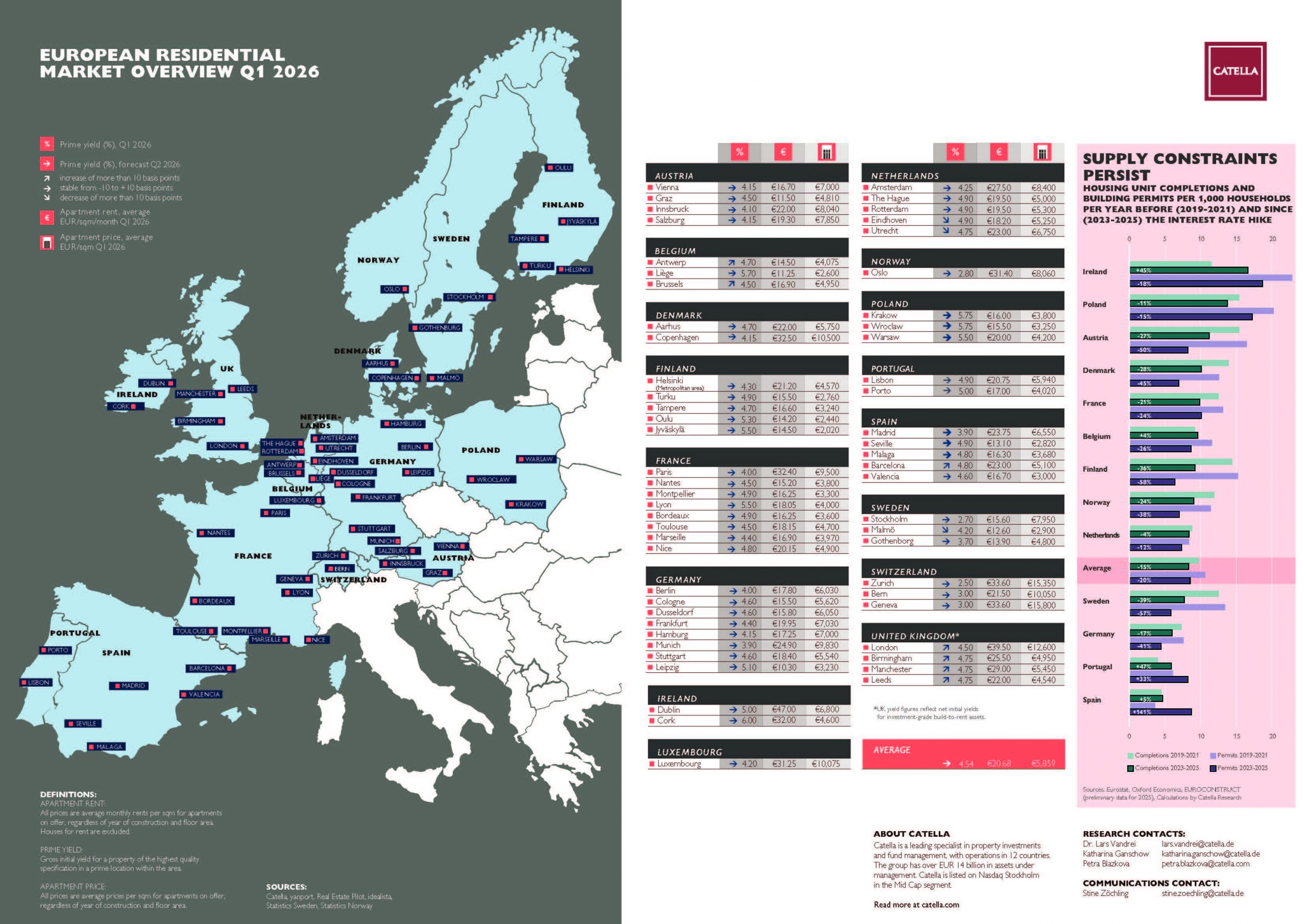
the region. The semi-annual report provides
reliable data based on 59 cities in 16 European countries.
The main findings of the analysis are:
- The sharpest declines are concentrated in Northern Europe (Finland, Sweden and Denmark), where building permits have roughly halved since 2022
- Southern Europe shows a different development – albeit from a structurally low starting level: Spain has the lowest number of new apartments per household within the comparison group
- Price momentum remains robust on average in Europe, with rental and purchase prices rising by 3.3% 2.9%.
According to the report, housing completions in the countries surveyed decreased by an average of around 15% in the period 2023-2025 compared to 2019-2021. With a view to future supply, building permits – as an early indicator of later completions – have fallen even more significantly over the same period, by around 20%, indicating a further restriction in new construction activity.
“The data show that the housing shortage in Europe is still primarily due to a supply problem,” says Dr. Lars Vandrei, Head of Research at Catella Investment Management GmbH (CIM). In many European cities, any relief from tight housing markets is further delayed – the structural excess demand is unlikely to be reduced in the coming years.”
Declining building permits are weighing on the future new construction pipeline
The declines are particularly pronounced in several northern and central European markets. In Finland, completions fell by 36% and building permits by 58%, while Sweden recorded declines of 39% and 57%, respectively. Austria and Denmark also registered significant weakening of the central supply indicators.
In contrast, a different dynamic is evident in southern Europe. Spain and Portugal are the only markets with increasing numbers of both building permits and completions. However, the still very low level is still not sufficient to noticeably reduce demand pressure in core markets such as Madrid, Barcelona and Lisbon.
Ireland stands out with the highest construction activity per 1,000 households, without significantly reducing the imbalance between supply and demand so far. Buoyed by robust economic and population growth, Dublin remains the most expensive rental market in Europe, with an average new lease rent of €47.00/m².
Across all cities surveyed, the average new contract rent in Q1 2026 was €20.68/m², moderately above the level of six months ago (€20.43/m²). Markets with strong international demand continue to fetch the highest rental prices – Dublin is followed by London, Zurich and Geneva.
Housing market regulation influences market pricing – local dynamics vary considerably
European prime yields remain broadly stable at 4.54% compared to 4.57% six months ago, although regulatory changes are influencing local dynamics. In the Netherlands, the recent reduction in real estate transfer taxes has supported price formation and led to yield compression. In contrast, the increased transaction taxes in Barcelona are likely to lead to an increase in yields in the medium term, even if the level is currently still stable at 4.80%.
At the same time, average condominium prices in Europe rose slightly to €5,859/m² (Q3 2025: €5,795/m²), driven by high-income, supply-scarce markets with strong international demand. The Swiss cities – Geneva and Zurich – lead the ranking, followed by London, Luxembourg and Bern.
“Housing market regulation has been and continues to be a key driver of price developments and potential yield movements in European markets,” says Petra Blazkova, Head of Catella Group Research and Strategy.
“Changes in transaction taxes, such as recently in the Netherlands and Barcelona, have a direct impact on investment behaviour and pricing – underlining how important local market dynamics are alongside structural demand in high-income, supply-scarce cities.”
Focus on Germany: Munich remains the most expensive market
Germany is significantly affected by the worsening shortage of supply in the housing segment. The number of completions per 1,000 households decreased by 17% between 2023 and 2025 compared to the same period 2019–2021. Building permits fell by 41% over the same period. This supply dynamic is noticeably reflected in average rent growth – rents have risen in line with inflation since Q3 2025. In Berlin and Munich, average rent growth was most pronounced in the period under review, at 5% and 4% respectively. In Munich – the most expensive rental market in Germany – the average rent is currently €24.90/m². The city also recorded the highest purchase prices for residential properties: €9,830 /m² in Q1 2026, followed by Frankfurt and Hamburg.
For investors, the German housing market is likely to remain complex in the future. Prime yields in Germany range from 3.90% in Munich to 5.10% in Leipzig. While the large metropolitan regions are characterised by high price and rent levels, peripheral markets such as Leipzig continue to offer comparatively attractive yields at significantly lower entry price levels.