New technology offers operators opportunities for significant margin growth
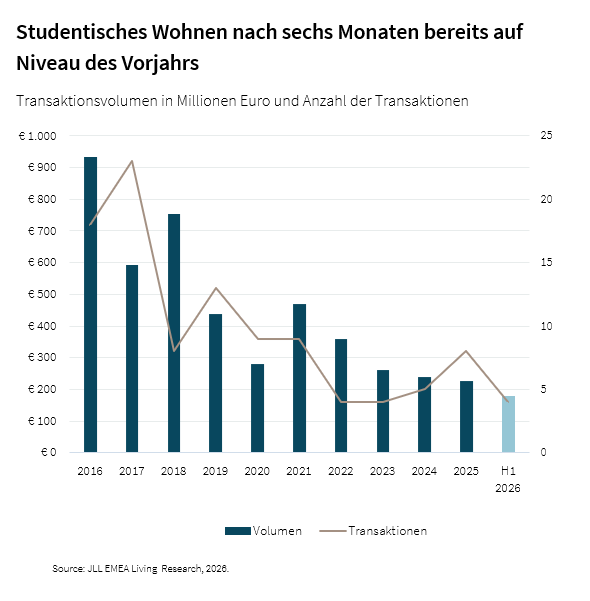
The German market for private student accommodation (Purpose-Built Student Accommodation, PBSA*) is showing clear signs of growth and professionalization: In the first half of 2026, the transaction volume reached around 200 million euros, which is on a par with the previous year. Further asset deals worth around 400 million euros and portfolio transactions totalling around two billion euros are currently in advanced negotiations. If these are realized, the total volumes of the past ten years, in some cases well below one billion euros, are likely to be clearly exceeded, analyzes JLL in the current study “German PBSA Market Perspectives 2026”.
The average monthly rent in the seven metropolises is currently 988 euros, with PBSA properties achieving a premium of 200 euros to 400 euros compared to shared rooms, but offering various amenities such as gym, media rooms or on-site support. Initial yields for high-quality properties have stabilised at 4.1 to 4.4 per cent.
International Student Demand Drives Market Growth
The general conditions for the PBSA segment are positive: The total number of students in Germany reached a new high of 2.88 million in the winter semester 2025/2026 (plus 0.4 percent). The proportion of international students is particularly striking, with 469,500 people (16.3 percent of all students) growing by 46 percent since 2014. International students now make up 30 percent of all first-year students – a significant increase compared to the 19 percent in 2004. “International students are the primary growth driver for PBSA demand,” explains Sören Gröbel, Director of Living Research Germany at JLL. “They need immediately available, furnished solutions with all-inclusive rental models and are largely excluded from the classic rental market due to language barriers and a lack of local credit ratings. In addition, there is a strong need for security and the desire for local contact persons.”
Smart technology increases efficiency and margin
After years of strong rental growth, the momentum has recently generally weakened, as has the case with the rental housing market. Rents in the seven metropolises rose by 2.9 percent year-on-year, with Düsseldorf (up 13.6 percent), Cologne (up 5.5 percent) and Hamburg (up 5.1 percent) leading the way. “The focus is now clearly shifting from rent-driven growth to operational efficiency,” says Marius Romer, Team Leader Residential Investment Capital Markets Germany NRW and specialist for the PBSA sector at JLL. “Optimising operating costs is becoming a decisive performance driver.”
AI-driven smart building technologies for optimizing consumption are particularly promising. Experience from the British market shows that, for example, intelligent heating controls can reduce operating costs by around seven percent with minimal capital investment, which corresponds to annual savings of 233 euros per bed.
Many investors are pivoting from forward deals to portfolio transactions
The German PBSA investment market is evolving from a development-driven to a portfolio-based market. “The first portfolios compiled from the first wave of growth are now coming onto the market – a clear sign of the increasing maturity of the asset class,” explains Romer. Initial yields for high-quality PBSA properties in good locations range from 4.1 to 4.4 percent. The narrowing of the yield spread between PBSA and prime residential real estate is remarkable: this has fallen from 120 to 130 basis points (2021) to the current 75 to 85 basis points – a compression of 40 to 45 basis points that reflects the increased investor confidence.
Scaling and quality locations offer market players potential
For market players, growth creates long-term potential: “Investors should focus on portfolio acquisitions with proven operating performance. In addition to the primary locations of Berlin, Munich and Hamburg, Cologne and selected B cities such as Münster, Mainz or Darmstadt also offer attractive opportunities with higher return prospects,” says Romer.