

The market environment for private equity has changed fundamentally in recent years. After a decade of low interest rates, abundant debt financing and rising valuation multiples, the market is now dominated by higher financing costs, longer holding periods and subdued exit activity. In Sagard’s view, this also shifts the key value drivers within the asset class.
In his current analysis “Investing in the Mid-Market”, Paul Newsome, Head of Investment Solutions, at Sagard Private Equity Solutions, concludes that the small and mid-markets in particular offer structural advantages under these changed conditions. Not short-term market movements, but more realistic valuations, operational development potential and broader exit opportunities could give this market segment additional importance in the future.
Operational value creation replaces financial leverage
For many years, the development in the buyout market was significantly supported by favorable financing conditions and rising valuation multiples. This environment has changed fundamentally. Today, returns can be achieved much less frequently through leverage or multiple expansion alone. Instead, operational improvements, strategic corporate development and active portfolio management are gaining in importance.
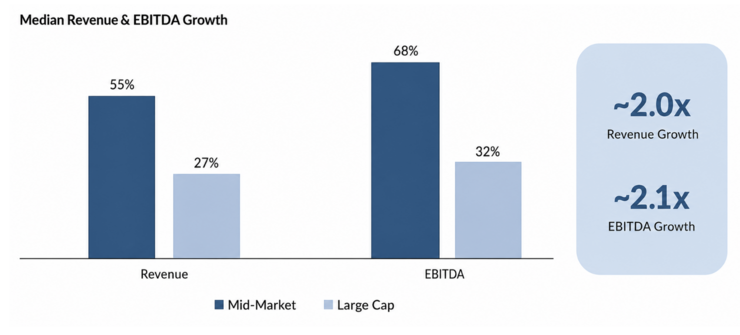
The underlying market data also shows that this development is particularly reflected in the mid-market. Between entry and exit, small and mid-market companies achieved a median revenue growth of 55%, while comparable large-cap companies achieved 27%. At 68%, EBITDA grew more than twice as high as that of large-cap transactions (32%). Operating value creation is thus increasingly becoming a key driver of returns.
Medium-sized companies in particular often have considerable development potential – for example through digitalization, internationalization, buy-and-build strategies or the professionalization of management structures. Many are active in attractive niche markets or are still managed by their founders. Value creation is therefore increasingly created within the company itself – and less through leverage or increasing valuation multiples.
Median revenue and EBITDA growth from entry to exit and exit path by transaction volume
Valuations are gaining importance again
With the end of the low interest rate environment, entry prices are also coming more into focus. Large buyout transactions are often concluded at higher valuation multiples and require correspondingly extensive financing.
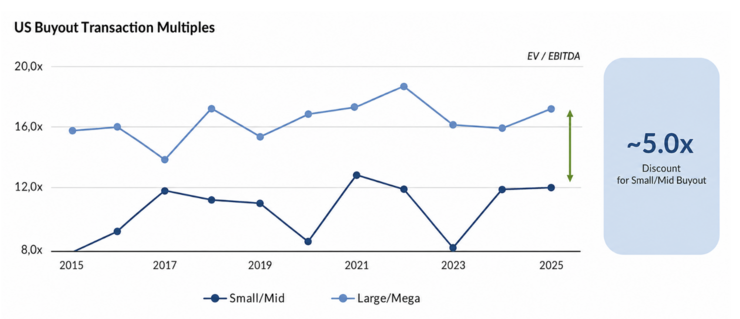
The market data shows that small and mid-market buyouts in the US market have been valued at an average valuation discount of around five EBITDA multiples compared to large and mega buyouts in recent years. This difference is no guarantee of higher returns. However, it provides investors with a larger valuation buffer and reduces their dependence on rising multiples or high debt financing.
Especially in a market environment with higher financing costs and more restrained exit activity, realistic entry prices are becoming increasingly important again. Those who invest at a lower valuation level have greater strategic leeway in later performance. Disciplined valuations are thus once again becoming a decisive competitive factor in private equity.
Multiples in U.S. Buyout Transactions – Small/Mid-Cap vs. Large/Mega-Cap
More flexibility in the exit process
The market segments also differ on the exit side. While large-volume transactions often rely on a few strategic buyers or a favorable stock market window, medium-sized companies often have a broader circle of potential buyers. Strategic investors, financial investors or other medium-sized companies are equally suitable buyers.
Especially in a market where IPOs are still only possible to a limited extent and M&A processes are more selective, this greater flexibility increases the options for investors and fund managers.
Quality is more important than ever
However, the structural tailwind for the mid-market does not mean that every investment is automatically attractive. Rather, the importance of careful manager and company selection is increasing. Successful fund managers today are increasingly characterized by in-depth industry knowledge, a differentiated approach to attractive transactions and the ability to consistently implement operational value creation.
As the private equity market matures, competition is increasingly shifting from the financing structure to the quality of investments. Local networks, sectoral specialisation and operational expertise are becoming more important than the ability to use as much debt capital as possible.
In our view, the mid-market is benefiting from this development. Not because the basic principles of private equity have changed, but because the characteristics of this market segment better meet the requirements of today’s market environment. In a phase in which operational value creation, disciplined valuations and flexible exit strategies are becoming more important, the mid-market is likely to continue to play a central role within private markets in the future.