
Between progress and uncertainty: Schumpeter’s view of Germany
How do geopolitical tensions, inflation and monetary policy affect capital markets and real estate investment? This question was addressed in the May issue of Macro Matters – Investment Insights entitled “Interest Rate Cycles and Real Estate Markets – Evidence from Historical Time Series”. The starting point of the analysis was the observation that despite far-reaching transformations, Germany is often characterized by a perception of stagnation. Drawing on Joseph Schumpeter’s concept of “creative destruction”, it was shown that we are in the midst of a fundamental structural change – characterized by artificial intelligence, geopolitical fragmentation, the energy transition, digitization and demographic change. While public debates are often characterized by uncertainty, polarization and loss of trust, Schumpeter would probably argue that the problem is not too much change – but possibly too little.
In macroeconomic terms, an environment of weak growth and increased inflationary pressure is currently emerging. Although the latest ifo data surprised positively, geopolitical risks, high energy prices and structural competition problems are weighing on the German economy at the same time. The Iran conflict makes it clear that, in addition to short-term price shocks, deglobalization, higher security requirements and the increasing energy demand due to AI and electrification could permanently increase the cost base. The Council of Economic Experts’ Spring 2026 report therefore expects an environment of structurally higher inflation, higher government spending and potentially higher interest rates.
From export world champion to China shock 2.0
Another focus was on Germany’s development from the “export world champion” of the 2000s to today’s handling of the so-called China Shock 2.0. The participants were first transported back to the year 2006 – a year marked by World Cup euphoria, economic optimism and historically high ifo business climate values. At that time, Germany benefited from the Agenda 2010 reforms, globalization, the China boom and a comparatively favorable euro exchange rate by German standards. The result was high export surpluses and the title of export world champion.
Today, the situation is much more differentiated. While Germany has benefited significantly from China’s rise since the 1990s, the relationship has since changed fundamentally. The first China shock after China’s accession to the WTO in 2001 had a predominantly disinflationary effect and supported the global low interest rate regime. The second China shock, on the other hand, directly affects Germany’s core industrial competencies – from electromobility to battery technology to mechanical engineering. China is increasingly developing from the “workbench of the world” to a direct competitor of German industrial companies.
Why economies don’t function like households
In connection with this, the focus was on the famous “Swabian housewife”. The discussion made it clear that the logic of a private household can only be transferred to economies to a limited extent. For decades, Germany’s high savings were only possible because other countries were willing to build up corresponding current account deficits. At the same time, global value creation is increasingly shifting from physical goods to digital services, cloud solutions and AI applications – areas in which US technology companies in particular dominate. While globalization in recent decades has had a strong disinflationary effect and supported the global low interest rate environment, deglobalization, reindustrialization and geopolitical fragmentation are now more likely to lead to rising structural costs and higher interest rates in the long term.
Another block of topics was dedicated to artificial intelligence as a potential disinflationary supply shock. AI can increase productivity, automate processes and reduce costs. At the same time, the Jevons paradox was pointed out: efficiency gains often lead to additional demand and higher resource consumption. Nevertheless, many economists see AI as an important factor in dampening long-term inflationary pressures.

Interest rate cycles and real estate markets in historical context
Finally, the webinar focused on the question of how strongly real estate markets are actually influenced by interest rates. To this end, historical time series of European office real estate markets since the 1980s were analysed. The central working hypothesis is that while real estate markets used to be more strongly influenced by real economic factors, monetary policy, liquidity and capital market conditions have become considerably more important over time.
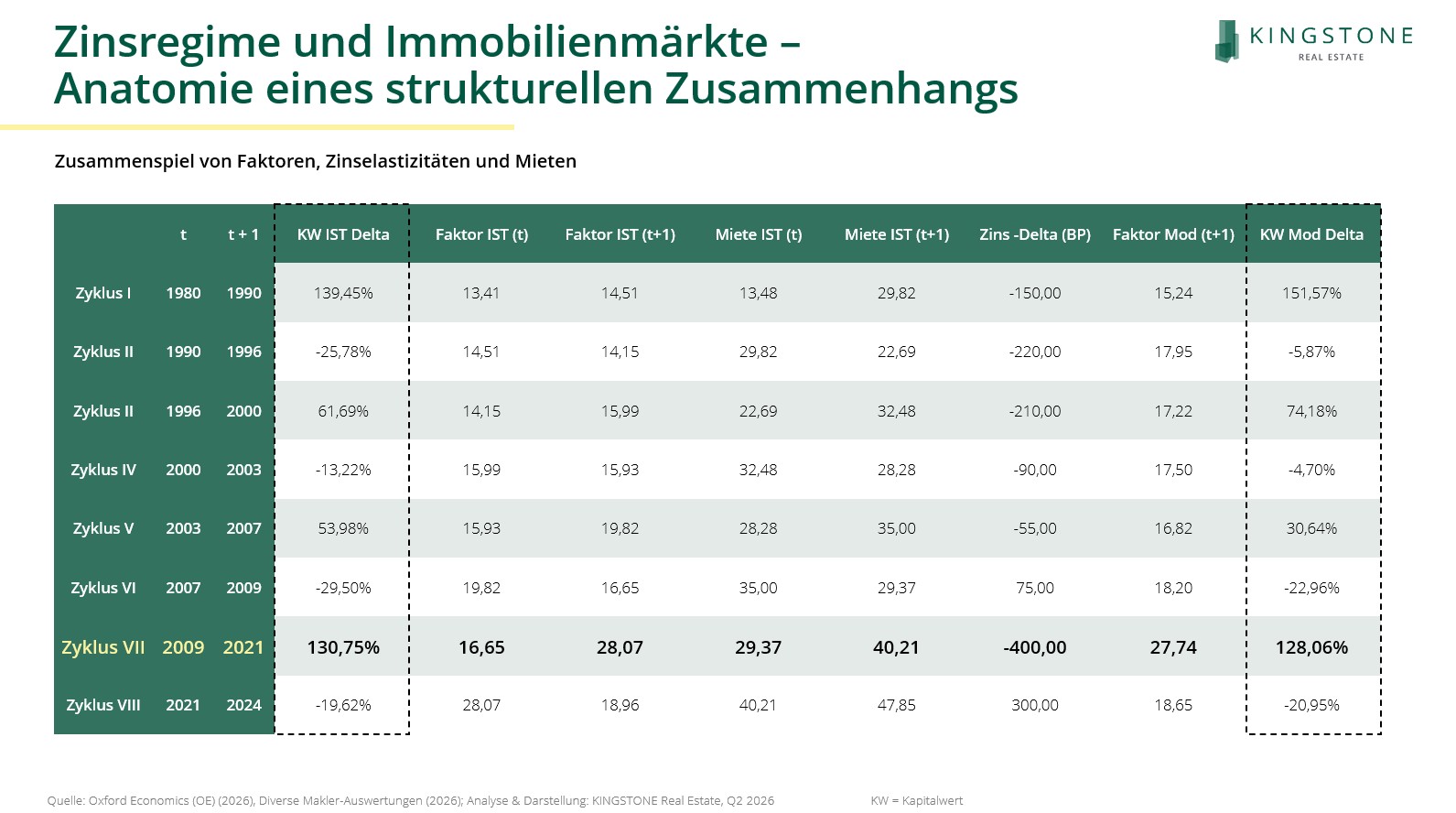
On the basis of historical data, at least eight completed real estate cycles can be identified since 1980; Europe could currently be at the beginning of a ninth cycle. While the early cycles were still characterized by falling inflation, European integration and real economic growth, the years 2003 to 2007 marked the beginning of the real “supercycle” of modern real estate markets. Globalisation, high liquidity, low interest rates and expansive lending caused real estate values to rise sharply throughout Europe. The financial crisis of 2008 marked the first systemic real estate crash in Europe – and at the same time the beginning of a new era in which central banks became the dominant factor influencing the capital markets. The subsequent cycle from 2009 to 2021 was particularly impressive. The era of quantitative easing, negative interest rates and historically low financing costs led to an unprecedented revaluation of real estate and other real assets. The increases in value during this phase significantly exceeded many previous cycles and were characterized less by rental growth and more by falling yields and rising multiples. The change in the interest rate regime from 2021 to 2024 abruptly ended this development. Rising inflation forced central banks to raise interest rates the most sharply in decades. As a result, there were significant valuation adjustments throughout Europe and a comprehensive repricing of the real estate markets.
Cycle IX: Beginning of a new market phase?
Against this background, the central question arose: Are we at the beginning of a new, ninth real estate cycle since 2025? The historical analysis showed a close correlation between capital market interest rates, net initial yields and real estate values. The decisive factor is not only whether interest rates rise or fall, but also from what level they start. The key finding of the webinar is therefore that if you want to understand real estate markets, you need to understand interest rate cycles. Inflation, monetary policy and long-term interest rates form the framework in which real estate valuations develop – and will be decisive in determining how pronounced and dynamic a possible Cycle IX can develop in the coming years.