GARBE Industrial, one of the leading developers, providers and managers of logistics, industrial and commercial real estate in Germany and Europe, has investigated which European regions could particularly benefit from the increasing demand for military logistics. The white paper shows that cities in Belgium and the Netherlands are among the biggest beneficiaries. In Germany, parts of northwestern Germany in particular offer above-average conditions for defence-related logistics properties.
“The demand for real estate in the defense sector can basically be divided into two clusters: the mobility-driven demand of military logistics and the production-related demand. Both follow different spatial patterns. Our white paper now available examines military mobility and shows which locations could become particularly important from it,” says Tobias Kassner, Head of Research at GARBE Industrial.
There is a certain overlap with the industrial and logistics sector in general. However, the focus in the defence sector is primarily on security, proximity, connectivity, flexibility, resilience and high-performance infrastructure networks. As a result, the increase in demand is likely to be concentrated in particular on locations located in the vicinity of important European import points and infrastructure corridors with efficient multimodal connections.
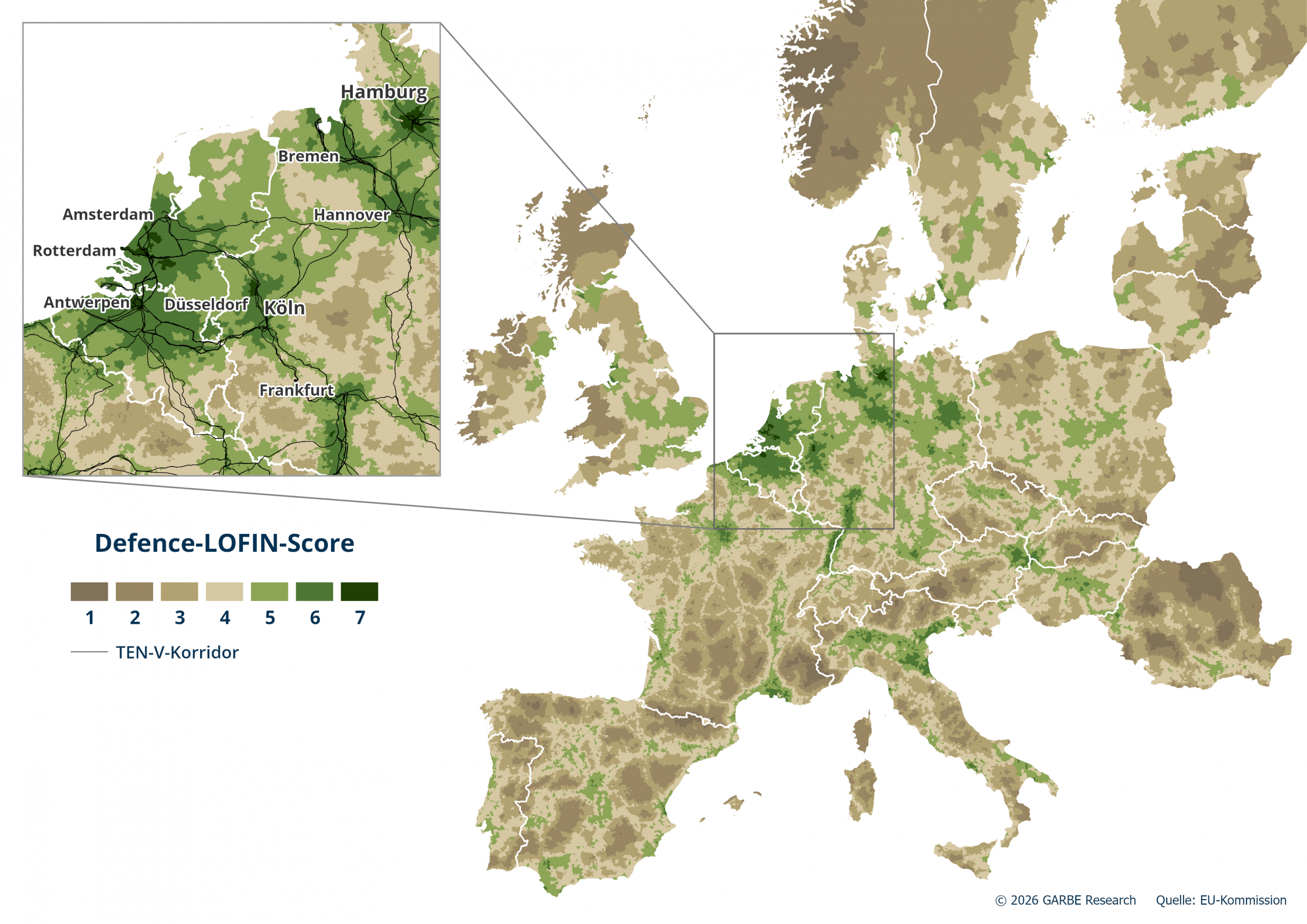
To determine the strategic military corridors most relevant for industrial and logistics properties, the GARBE Industrial research team used five weighted key figures that link operational, infrastructural, regulatory and developmental factors. The proximity to the trans-European transport network (TEN-T), multimodal transport connections, motorway connections, off-road suitability and the efficiency of cross-border customs processes are taken into account. From these five parameters, the Defence Logistics Affinity Score (Defence LOFIN) developed by GARBE Industrial was calculated, which evaluates the attractiveness of logistics locations at the municipal level (Local Administrative Units, LAU) for military logistics uses.*
Only a few sites meet the decisive criteriaThe result: Only six percent of the total land mass in the 25 European countries examined achieve a LOFIN value of more than five points (maximum value: seven). The Netherlands and Belgium have the highest proportions, with around two-thirds of their land mass above this value. Germany reaches 22 percent and Italy eleven percent. This makes them the only one of the five largest European logistics markets with a double-digit share.
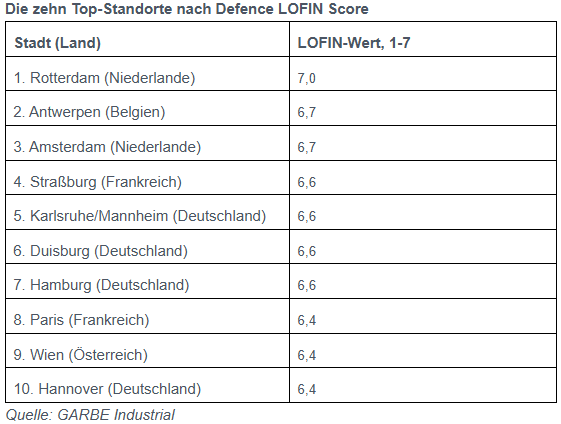
As an important hub for freight transport to and within Europe, the Benelux markets achieve high scores in all five parameters. The regions consistently achieve LOFIN scores of over 6.7 points, underlining their role as a critical corridor for military mobility.
The study also reveals the importance of the seaports along the coast between Hamburg and Le Havre as well as other strategically important port locations. The largest seaports in the Benelux region, Rotterdam and Antwerp, including their immediate hinterland, perform best. However, other port locations such as Hamburg, Bremerhaven, Le Havre and Calais also achieved LOFIN values of over six points. In addition, several smaller but strategically important seaports in Central and Eastern Europe are among the highlighted locations, including Klaipėda in Lithuania and Constanţa in Romania.
The best-rated locations in Germany include Karlsruhe/Mannheim, Duisburg and Hamburg with a LOFIN value of 6.6 points each, and Hanover with 6.4 points. All four locations are central hubs that bundle multimodal connections and high-performance infrastructure corridors. Karlsruhe/Mannheim benefits in particular from its location on a central European TEN-T corridor and from its function as a west-east and north-south hub between the Benelux and North Sea ports, southern Germany and France. “The combination of the Rhine connection, high-performance rail and dense motorway links creates precisely the redundancy and resilience that is essential for military mobility,” explains Kassner.
Rising defence spending drives demand for spaceThe procurement of defence equipment in Europe is expected to increase by almost 152 billion euros to 704 billion euros by 2030. In an earlier study, GARBE Industrial predicted that for every billion euros in defense investments, there will be an additional demand of 245,000 to 490,000 square meters of industrial and logistics space. This results in a potential increase in demand of 37 to 75 million square meters within the next five years. Since many of the properties are built for own use (“built-to-own”), only about a fifth of this volume is likely to be available for the institutional real estate investment market. This corresponds to an additional demand potential of 7.5 to 14.9 million square meters.
“The European rearmament creates considerable demand potential for industrial and logistics properties. In order to tap into this potential, precise knowledge of the main traffic routes and military mobility patterns is crucial,” says Kassner. “Strategic investments and project developments should focus primarily on locations along the highly valued corridors. The combination of multimodal transport connections, motorway access, proximity to seaports and other access points offers the best opportunities to benefit from the emerging demand in the future.”
The white paper can be downloaded here: https://www.garbe-industrial.de/wp-content/uploads/2026/07/Defence_Whitepaper_de.pdf
* About the Defence LOFIN Score: The Logistics Affinity Score (LOFIN) is a data-based analysis model developed by GARBE Industrial to assess the attractiveness of municipalities for logistics use. The index is based on uniform evaluation criteria that can be applied across countries and enables an objective comparison of locations in Europe. It serves as a macro filter tool, creates transparency and supports data-based investment decisions. For the present analysis, the evaluation parameters were specifically adapted to the requirements of military logistics.