DIP partner Aengevelt Immobilien is continuing its investigations into the positive effects of green offices, which it began a year ago. These analyses are now also confirmed by the latest research results just published by the Max Planck Institute for Human Development: Natural elements in the office significantly increase work productivity and stress resistance. As trendsetters, high-tech companies such as Apple and Amazon, among others, are making targeted use of the biophilia effect in their headquarters. In order to integrate the experience of nature into everyday office life, office architecture has numerous options at its disposal.
The “biophilia effect”.
After a year and a half of inconclusive negotiations in sober Geneva conference rooms, the two chief negotiators of the United States and the Soviet Union were able to achieve a breakthrough in the disarmament negotiations for the first time when they went for a walk in the woods on July 16, 1982. Since 2003, the standard manual “Universal Principles of Design” has recommended using the “biophilia effect” in building design to increase creativity, performance and well-being. The fact that experiencing nature has been proven to have significant influences on cognitive performance and work productivity is also proven by 54 international studies recently evaluated by scientists at the Max Planck Institute for Human Development.
It has been shown that experiencing nature can contribute to the reduction of stress as well as increase resilience to stress-triggering factors. Experiencing nature specifically improves, among other things, attention, memory, speed and quality in solving tasks as well as well-being. An interplay of physiological reactions (such as pulse rate, blood pressure, cortisol and amylase levels), psychological capacities (such as self-regulation, cognitive resources and action skills) and social effects (joint activities) is responsible for the effects on productivity. In complex everyday office life, experiencing nature can thus contribute to stress management, productivity and performance increases.
To trigger measurable effects, nature experiences lasting several minutes are sufficient (the average experience of nature lasted 28 minutes in the experiments, starting with 1.5 minutes), whereby virtual nature experience (for example through photos, videos, VR glasses, bird calls) can also have positive effects. There are several options available in office architecture for initiating productivity effects.
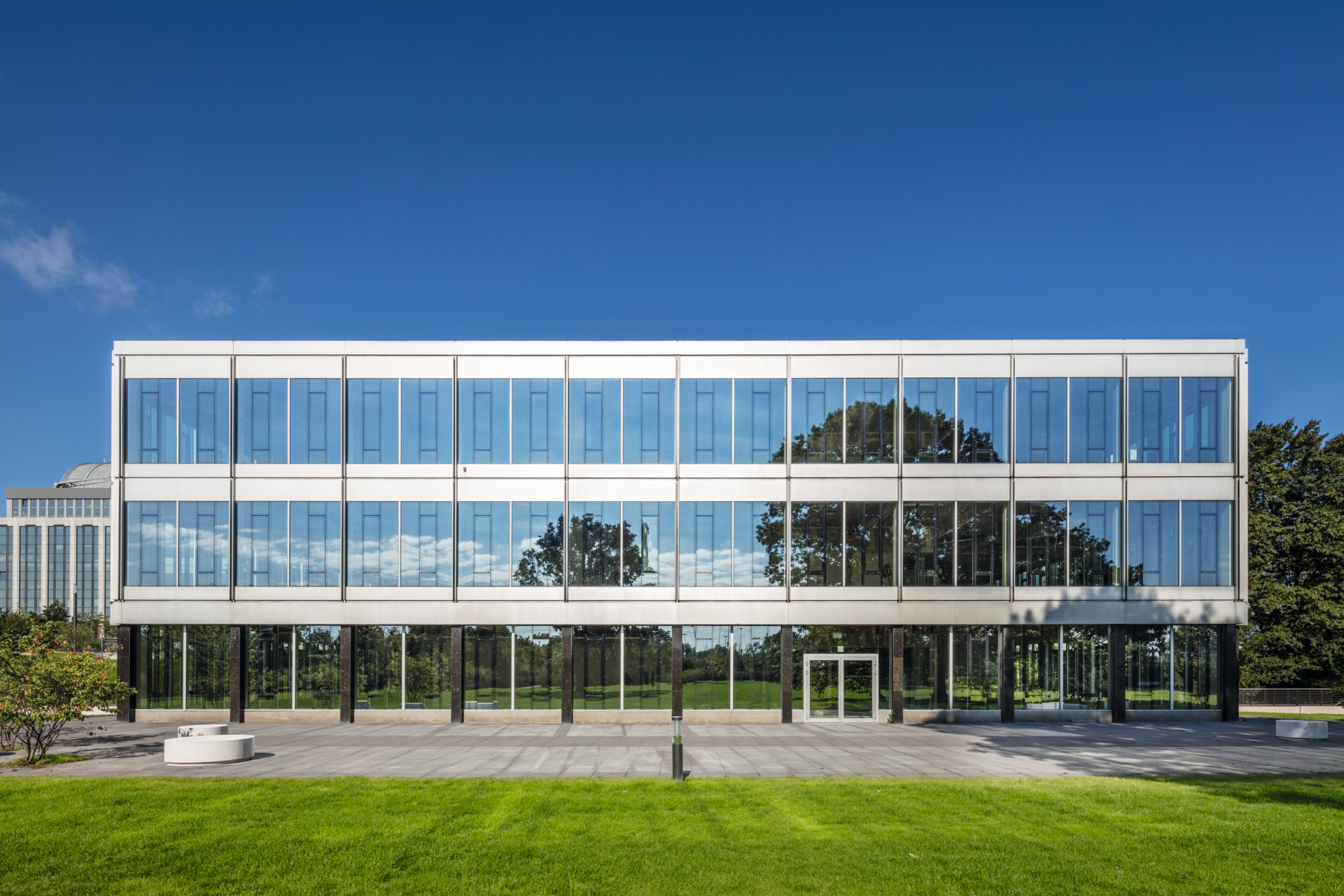
This includes embedding office buildings in a green environment that allows views and short stays and walks during work breaks. The headquarters of John Deere from 1964 or Apple Park from 2017 are among the most spectacular examples. The concept of business parks has long been standard in North America, while in Germany this term is mostly applied to conventional commercial areas without sophisticated greening. Singapore’s “Green Plan” envisages greening the entire business district of the metropolis.
The greening of office buildings, for example through appropriate outdoor areas, courtyards, roof gardens or vertical façade greening, is an effective option. This not only creates spaces for experiencing nature, but also improves ecological and climate balances.
In addition, green and water areas can be created within larger office buildings, which enable an experience of nature and contribute to improving the microclimate. The extensive interior greening of Singapore’s Jewel Changi Airport is one of the reasons why this airport has repeatedly been named the best in the world – against the well-known background that airports are among the stress-producing properties.
Office greening can already be implemented in a space-saving way with plant boxes and plant walls, but can also reach the dimension of a mini-jungle, as in an extensive way, for example, at Amazon’s headquarters “The Spheres” in Seattle.
Dr. Wulff Aengevelt, Managing Partner of Aengevelt Immobilien: “Green in construction is more than just a gimmick. Research in this area has long since shown that natural elements in office environments measurably increase productivity. The headquarters of leading high-tech corporations and banks and insurance companies were the first to implement this findings in a targeted manner and thus became trendsetters. Since there are numerous implementation options for intelligently integrating the experience of nature into office architecture, there is great potential to enhance office properties with green elements in a socially relevant way that creates added value in a way that is appropriate to the situation.”