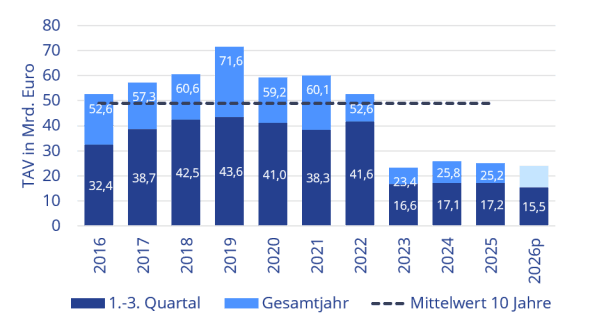
The increased pressure on interest rates over the last three months has finally ensured that 2026 will not be the year of the hoped-for upturn in the property investment market. According to Colliers, property worth 21.6 billion euros was traded in Germany in the first nine months. This meant that the transaction volume in the investment market (residential and commercial) was 9 per cent below the previous year’s figure. The institutional residential segment – comprising properties with ten or more residential units – accounted for around €6.1 billion, which is 7 per cent less than in the same period last year. Commercial property generated €15.5 billion in turnover, around 10 per cent less than in the corresponding period of 2025.
After eleven quarters of stable transaction volumes, each totalling around 6 billion euros, the three-month figure fell below the 4.5 billion euro mark for the second consecutive quarter, reaching just 4.4 billion euros in the third quarter. The number of transactions, at 226, was also below the quarterly average, which has stood at 265 since the drastic market correction in mid-2023. The average deal size remains just below the €20 million mark. Overall, for the first time since the market stabilised in mid-2023, there is again a noticeable slowdown in transaction activity.
Interest rates and financing conditions have tightened significantly over the summer
Geopolitical tensions and the associated uncertainties regarding inflation, government spending and capital market returns are currently making it more difficult to assess long-term investment decisions. The consequences are longer decision-making processes and higher requirements in terms of returns and risk premiums.
Michael R. Baumann, Head of Capital Markets Germany at Colliers, commented on the implications: “Purchase prices for assets already in the transaction process are being recalculated. This is causing further delays to deal closures. At the same time, we are observing that, particularly amongst institutional property owners, there is a growing realisation that they must accept price reductions and value adjustments in order to carry out necessary portfolio restructuring to generate liquidity. Some lending banks are prepared to accept haircuts. The market generally has sufficient investable capital. The key bottleneck at present remains the pricing negotiations between buyers and sellers.” Baumann sees this as a key prerequisite for strengthening the willingness to invest among currently active buyer groups. Prospective foreign buyers, in particular, often adopt a wait-and-see approach given that purchase prices remain high by international standards.
Michael R. Baumann
Image source: Colliers
Prime yields reflect the changed financing environment
In fact, the trend towards rising prime yields continued, driven by increased price sensitivity and higher financing costs. This also applies to all seven investment centres. With the exception of Munich and Hamburg, where well-capitalised investors are acquiring trophy assets at multiples in excess of 20 times, yields for core properties in prime locations across the remaining top seven cities now stand at over 5 per cent. Outside the prime segment, even higher yield premiums are to be expected across all location and risk categories.
Francesca Boucard, Head of Market Intelligence & Foresight at Colliers, emphasises the importance of price corrections for a recovery in the property market: “The environment of extremely low interest rates is likely to remain a thing of the past for the foreseeable future. For investors, this means that property is once again competing more strongly with alternative forms of investment for capital. When making investment decisions, therefore, greater emphasis is being placed on a property’s long-term profitability, rental security and adaptability, rather than purely on expectations of capital appreciation.”
Francesca Boucard
Image source: Colliers
Few major deals; market activity centred on three key areas
Baumann confirms: “Investor interest is currently focused on three key areas. These include, on the one hand, smaller core properties in the range of between 10 and 60 million euros, which can largely be financed with equity. On the other hand, there is demand for properties with long-term lettings or those with short-term appreciation potential, where the development potential is reflected in a realistic purchase price. In particular, office properties with potential for conversion and comparatively low capital values can be successfully placed.”
Transactions of 100 million euros or more, on the other hand, are rare. In the past three months, too, only six deals in this size category were recorded. The three largest purchases were each made for around 150 million euros. These include, amongst others, the acquisition by the Spanish asset manager Colonial SFL of a stake in a fund held by Generali, which comprises the two prime Berlin office properties LindenCorso and Atrium on Friedrichstraße. With the sale of the Munich property ARTrium to its prospective interim occupier, Kreissparkasse München, for around 100 million euros, another major office property in the state’s seven investment centres has been sold. Given the limited number of major deals, the Top 7’s share of the transaction volume recorded since the start of the year – at 38 per cent – remains well below the long-term average of 50 per cent.
The situation is similar with regard to portfolio transactions. The 22 per cent market share is largely driven by block sales of several large industrial and logistics properties, healthcare and social care properties, and the €200 million Power Foods local retail portfolio from the first half of the year.
The decline in transaction volumes is affecting all property sectors in a similar way
Compared with the previous year, the decline in transaction activity affected most property types to a more or less similar extent, so there was little change in their ranking. Office properties took first place with a 26 per cent share of transaction volume, ahead of industrial and logistics properties with 24 per cent. Retail property suffered the sharpest decline in the first nine months of the year, falling by around 6 percentage points, and recorded a market share of 16 per cent at the end of September. Healthcare and social care properties – which, in addition to care homes, also include clinics, outpatient healthcare centres, medical centres and childcare centres – are increasingly establishing themselves as a strategically sought-after property type, with a 10 per cent market share. Investors particularly value the demographic-driven demand dynamics and the segment’s comparatively stable cash flows. The hotel sector is currently attracting more attention from operators than from property investors, with the result that, despite positive developments in the market environment, its market share has fallen to 6 per cent.
Outlook: Setbacks in the recovery process weigh on year-end results
Looking ahead to the final quarter of the year, which tends to make the largest contribution to the full-year results, Baumann is tempering expectations of a significant market recovery. “Market activity remains steady, but given the current conditions, it is concentrated on selected properties and strategies. A noticeable increase in transaction volume is therefore not expected in the short term.”
Boucard, too, does not expect the investment market to return to a path of recovery until some time in 2027: “By then, the gradual economic upturn – driven by a robust export sector and government infrastructure and defence spending, which has been ramped up in recent months – should also have a stimulating effect on the property market.” According to the joint autumn 2026 forecast by leading German economic research institutes, GDP forecasts – following a significant upward revision for 2026 – average 1.3 per cent for 2026 and 1.1 per cent for 2027. As evidence of the resilience of the German economy, this is likely to provide a significant boost to investment appetite. As expected, such a development will only reach the property market after a delay of several months. The conditions for a market recovery are already taking shape today. As soon as financing costs stabilise and the economy gains further momentum, the willingness to invest is also likely to return to the market on a broader scale.
Looking at the year as a whole, given two quarters with lower transaction volumes and buyers’ wait-and-see attitude in the hope of further price falls, it is now realistic to expect a result that is likely to be below the previous year’s figure of 25 billion euros.
A comparison of German investment centres (figures as at the third quarter)
Germany Berlin Düsseldorf Frankfurt Hamburg Cologne Munich Stuttgart
Commercial property transaction volume in € million 2026
15,519 1,168 930 543 1,143 430 1,560 114
Commercial transaction volume in € million 2025
17,162
2,097
470
331
1,431
699
1,435
144
Change compared with the previous year
-10 %
-44 %
+98 %
+64 %
-20 %
-38 %
+9 %
-21 %
Largest investor group
Asset managers (asset/fund managers)
22 per cent
Asset managers (asset/fund managers)
40 %
Asset managers (asset/fund managers)
44%
Private investors / family offices
25%
Asset/fund managers
30%
Property companies
19%
Private investors / family offices
42%
Private investors / family offices
45%
Largest group of sellers
Project developers / property developers
20%
Asset managers (asset/fund managers)
30%
Private investors / family offices
33%
Project developers / property developers
38%
Project developers / property developers
22%
Project developer / property developer
30%
Open-ended property funds / special-purpose funds
29%
Private investors / family offices
35%
Main type of use
Office
26 %
Office
45 %
Office
54 %
Office
58%
Office
42%
Land (commercial)
36 %
Office
50 %
Office
57 %
Prime yield for office
5.15 %
5.20 %
5.15 %
4.90%
5.10%
4.50%
5.00%
Prime yield – retail
5.15%
5.10%
4.95%
4.50%
5.10%
4.10%
5.00%
Prime yield for logistics
5.05%
Source: Colliers
Commercial transaction volume (TAV) in Germany