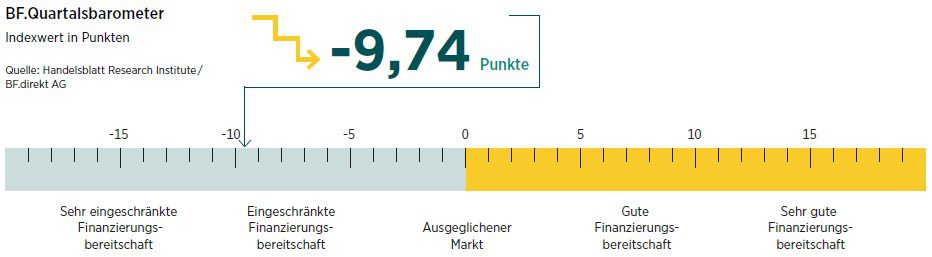
The mood among commercial real estate financiers is subdued in the first quarter of 2026. That’s what the new BF says. Quarterly Barometer, which was redesigned in cooperation with the Handelsblatt Research Institute. The survey took place from March 16 to 20, 2026 and was thus already under the influence of the Iran war. The newly calibrated barometer value of currently -9.74 points signals an overall limited willingness to finance. Almost 27 percent of those surveyed see a deterioration in financing conditions on the market in the past three months, while 68 percent expect a stable development. Only five percent perceive an improvement.
Professor Dr. Steffen Sebastian, Chair of Real Estate Finance at IREBS and Scientific Advisor to the BF. Quarterly Barometer, says: “The results must also be seen against the background of the Iran conflict. The markets have reacted surprisingly calmly so far, but this composure is increasingly fragile. In my opinion, a scenario of stagnating growth and higher inflation at the same time has become more likely. For real estate financing, the problem at the moment is not so much the absolute interest rate level as an interest rate environment that can become unstable again at any time.”
When it comes to new business in the commercial real estate financing sector, almost 73 percent of those surveyed report stagnation, while a good 27 percent report a growing volume of business. A similar picture emerges when assessing the competitive situation: around three-quarters of those surveyed see no change compared to the previous quarter. Of the remaining quarter, however, the majority report an intensifying competitive situation. “We have also been observing for several months that financiers are competing somewhat more strongly with each other again. This is a positive sign for the market, as it signals a higher willingness to finance and dampens margins,” says Francesco Fedele, CEO of BF.direkt AG.
Private equity most in demand among alternative financing instruments
According to 41.2 percent of respondents, the demand for alternative financing instruments compared to the classic bank loan has increased compared to the fourth quarter of 2025. The greatest demand is in the area of real estate private equity, for example in the form of equity provided by joint venture partners.
When asked how the ratio of non-performing loans (NPLs) had developed compared to the previous quarter, 32 percent said that the ratio had decreased, while only 18 percent reported an increase. For 41 percent, the rate remained the same, the others did not provide any information. Fabio Carrozza, Chief Sales Officer of BF.direkt AG, comments: “On the one hand, the trend towards declining NPL ratios is an indication of a better situation on the financing market, and on the other hand, this also reflects the starting level we have now reached.”
Margins have enormous ranges
For the financing of existing properties, the average margin across all mentions is 169 basis points (bp). “There is a wide range between the individual institutions and types of use; the individual stocks range between 110 and 400 bp. A differentiated view of the asset classes shows clear differences,” says Dr. Sven Jung, Director Economic Analysis & Financial Planning at the Handelsblatt Research Institute. For example, residential real estate has the lowest margin at an average of 144 bp, while financing for office buildings is at the upper end with an average of 181 bp. The average loan-to-value for portfolio financing is 63.52 percent across all types of use.
In the financing of project developments, the average margin is 262 bp, with individual stocks ranging from 110 to 800 bp. In the area of project development, the institutions charge the highest margin for residential real estate with an average of 309 bp. At the lower end of the range are logistics halls with 201 bp. The average loan-to-cost for project developments reaches 71.32 percent.
Methodology
The BF. Quarterly Barometer is compiled by the Handelsblatt Research Institute on behalf of BF.direkt AG, a specialist in the financing of real assets. Scientific advisor to the BF. Quarterly Barometer is Prof. Dr. Steffen Sebastian, holder of the Chair of Real Estate Finance at IREBS. The index comprehensively reflects the mood and business climate of real estate financiers in Germany.
In order to determine the BF. Quarterly Barometer, 33 experts are currently surveyed quarterly, all of whom are directly entrusted with lending to real estate companies. The panel consists of representatives from various banks and alternative financiers. The value of the BF. The Quarterly Barometer is composed of statements on the following aspects: assessment of current financing conditions, development of new business, average loan volume of individual transactions, leading department in credit decisions, development of the NPL ratio, importance of alternative financing options and development of the competitive situation.