Action day on Wallrafplatz meets with great interest. The research results show that measures must be planned according to location and goals
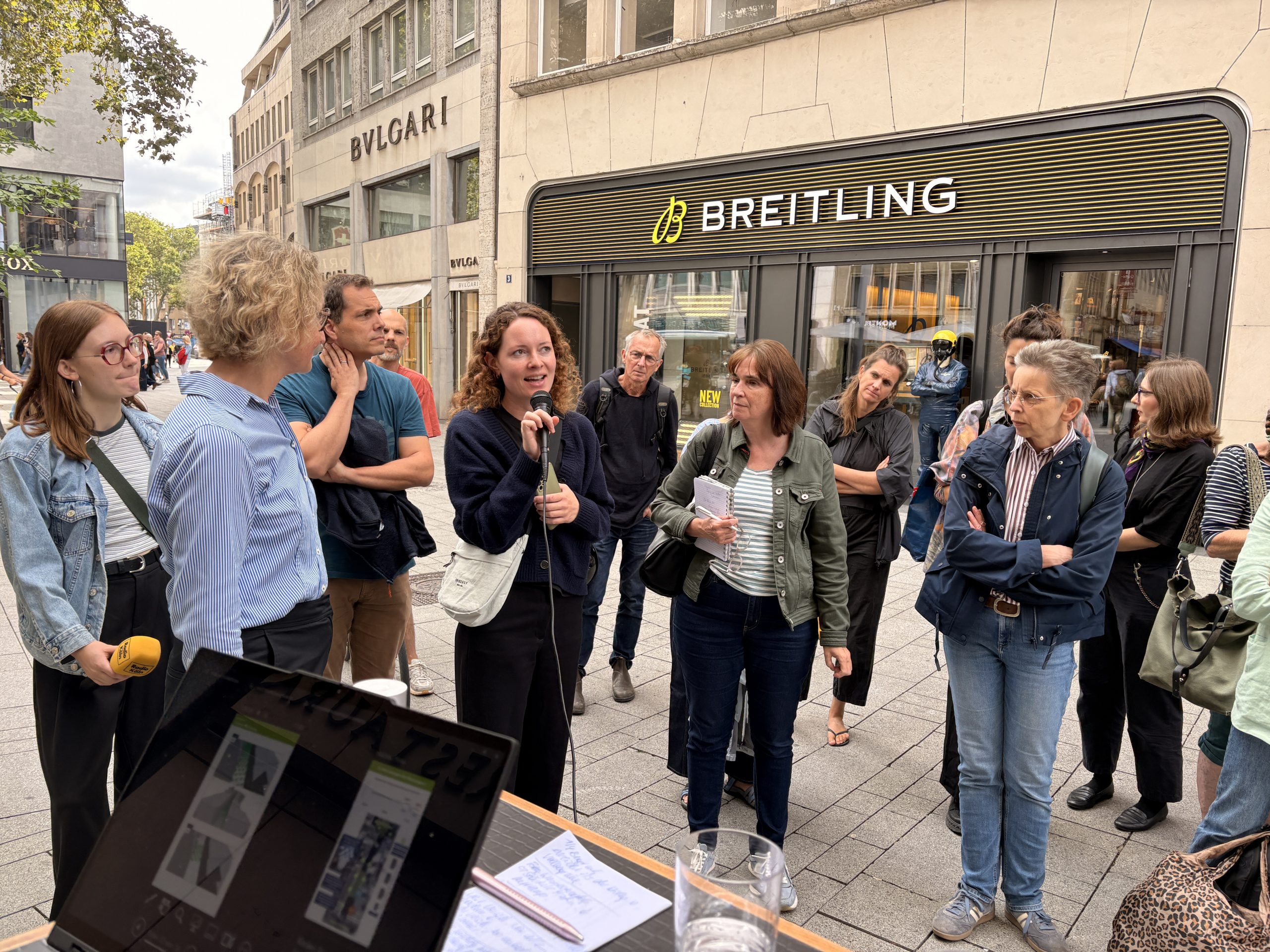
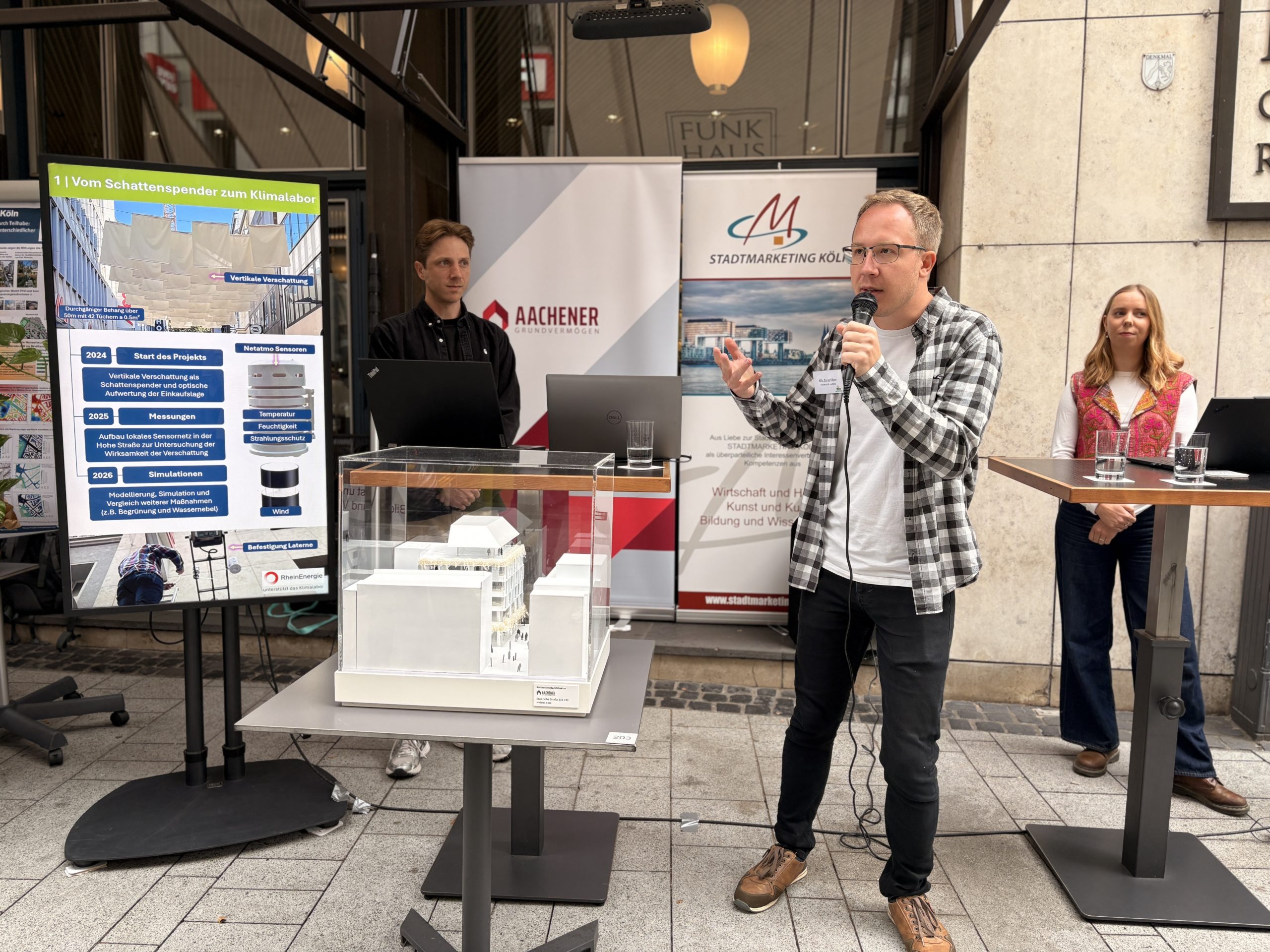
The action day of the cooperation project “Climate Lab Cologne” on August 21, 2026 on Wallrafplatz has met with great interest. Under the patronage of Cologne’s Lord Mayor Torsten Burmester, represented on the day of action by Mayor Derya Karadag, Aachener Grundvermögen, Stadtmarketing Köln and the University of Cologne presented current measurement results and simulations for climate adaptation in inner-city retail locations. The focus was on the question of how city centres can be made sustainable as attractive places for trade, spending time and meeting in the face of increasing heat. After the presentation of the scientific results by the project partners, visitors were able to follow live sensor data, thermal imaging and results of the 3D microclimate simulation at interactive stations and experience the effect of different surfaces and climate adaptation measures by means of vivid experiments in the “Cool City Lab” of the University of Cologne and the TH Köln. The evaluation of pedestrian frequencies by hystreet.com, the PropTech company of Aachener Grundvermögen, shows a clearly negative correlation between rising temperatures and the number of people in the city center.
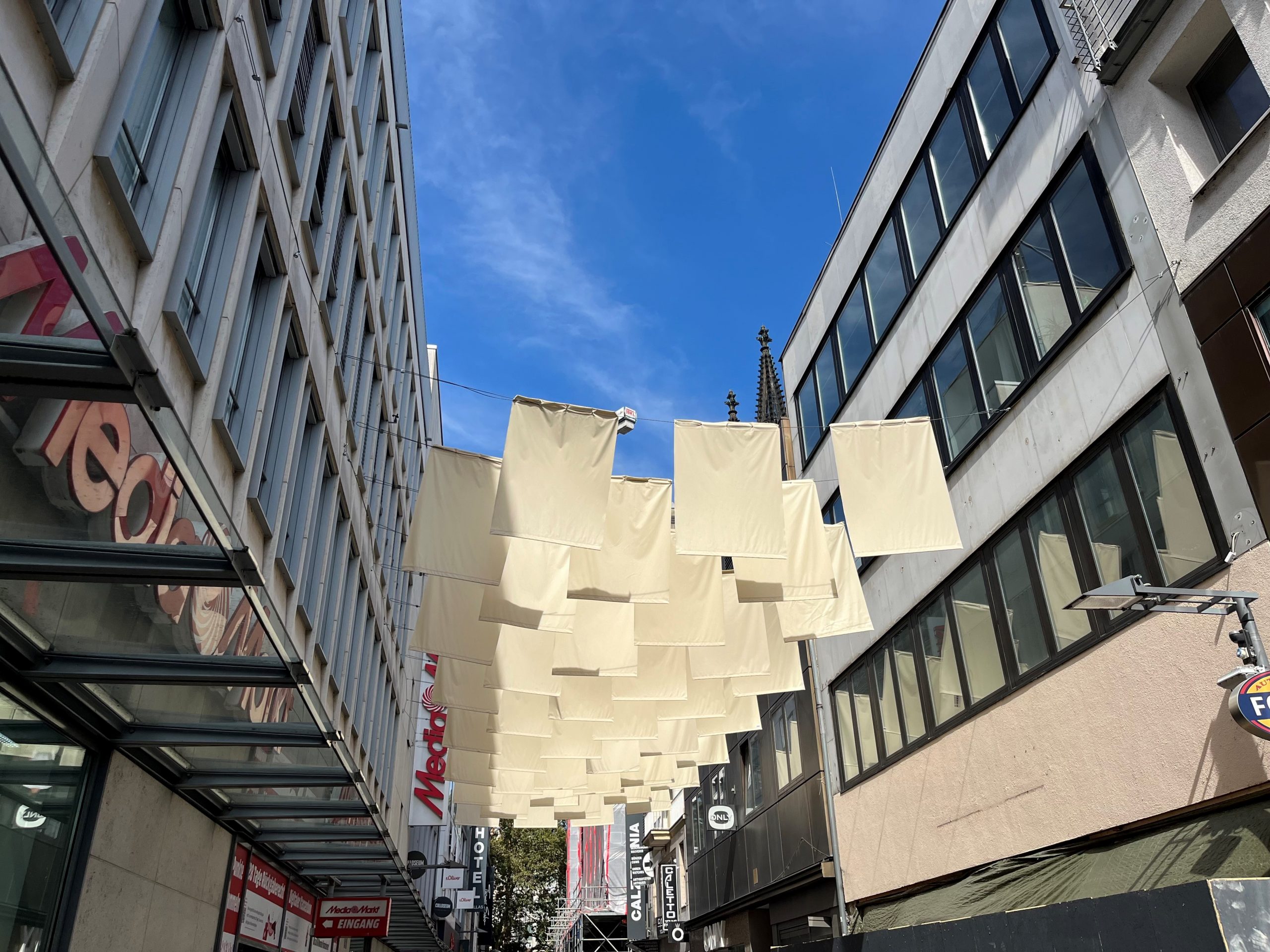
The Climate Lab Cologne-City Centre was created from a shading measure initiated by Aachener Grundvermögen and Stadtmarketing Köln e.V. in Hohe Straße in 2024. Since 2025, the measure has been scientifically monitored in cooperation with the University of Cologne. More than 40 climate sensors record local measurements of air temperature, humidity, wind and CO2. The first measurement results in 2025 already showed a two to three degree lower air temperature on hot afternoons in the areas shaded by the vertical fabric elements. On windless hot days, the air temperature dropped by up to five degrees, and the perceived temperature for passers-by decreased by up to 11 degrees in individual hours.
In 2026, Lauren Gülker used the sensor data to further calibrate a high-resolution 3D microclimate model. In her master’s thesis, she examined a total of six climate adaptation scenarios for Hohe Straße. The results show: façade greening reduces thermal stress over a particularly large area and permanently, water misting lowers the air temperature the most, while shading has a local effect and during radiation-intensive hours. The climate laboratory thus provides a valid data basis for location- and goal-specific decisions.
Lauren Gülker’s results make it clear that climate adaptation measures must be planned on a site- and target-based basis. Depending on the local situation and objectives, the focus may be on lowering the air temperature or, as in Hohe Straße, reducing the thermal stress on people.
“The future of our city centres also depends on whether people enjoy spending time there. It is therefore important to measure the impact of climate adaptation measures in a scientifically reliable way. The initial results show that shading can noticeably lower the perceived temperature and at the same time is comparatively cost-effective and can be implemented at short notice,” says Dr. Frank Wenzel, Managing Director of Aachener Grundvermögen, explaining the company’s commitment.
This is also reflected in the planned project development of today’s Media Markt building of Aachener Grundvermögen on Hohe Straße. The property, which has so far focused on retail, is to be converted into a modern, high-quality multi-use property in timber hybrid construction with a vertically green façade and intensively landscaped inner courtyard.
“Lauren Gülker’s results show how important it is to measure climate adaptation at a specific location and to make it visible. The combination of sensor data, pedestrian frequencies and simulation creates a reliable basis for taking appropriate measures for each location.
“, summarizes Raymond Wollenberg, initiator of the Climate Lab Cologne-Innenstadt and ESG manager at Aachener Grundvermögen.
In view of the increasing heat stress and the growing importance of effective climate adaptation strategies for urban areas, the Mayor of Cologne, Torsten Burmester, has taken over the patronage of the “Climate Lab Cologne”, which is unique in Germany. 80 percent of the textile shading measure was funded by the Cologne City Disposal Fund as part of the federal program “Sustainable Inner Cities and Centers”. The costs for the annual re-suspension and the sensor technology on Hohe Straße are borne by Aachener Grundvermögen. The scientific director is Dr. Nils Eingrüber from the Institute of Geography at the University of Cologne and Prof. Dr. Ulrich Löhnert from the Institute of Geophysics and Meteorology. The research work is part of the project AKT@HoMe the University of Cologne and the TH Köln, which is funded by the RheinEnergie Stiftung Jugend Beruf Wissenschaft.
Based on the findings of the climate laboratory on Hohe Straße, a transferable model for other inner-city areas and retail locations in Germany is to be developed.