Half-year results 2026 of DIP – Deutsche Immobilien-Partner.
The continuous analysis of 15 selected German office markets – including Berlin, Bremen, Düsseldorf, Essen, Frankfurt am Main, Freiburg, Hamburg, Hanover, Karlsruhe, Cologne, Leipzig, Magdeburg, Munich, Nuremberg and Stuttgart – enables DIP – Deutsche Immobilien-Partner to make a well-founded cross-sectional comparison. Not only can regional differences between north, south, west and east be identified, but structural characteristics can also be analysed depending on the market size of the individual cities.
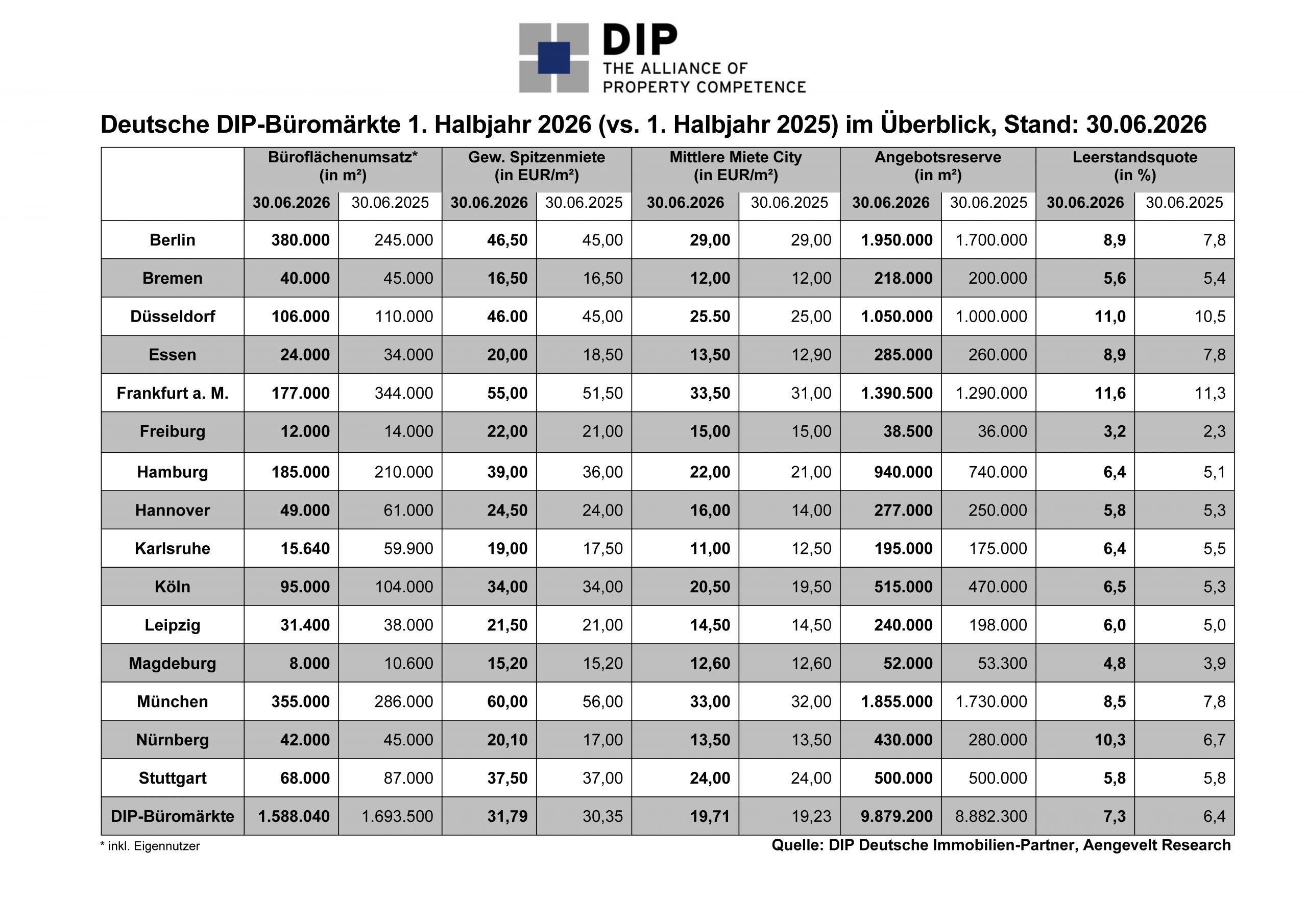
According to the evaluations by DIP – Deutsche Immobilien-Partner, there was an increase in take-up in only two of the 15 office markets examined. Overall, there is a slight decline in market activity compared to the first half of 2025.
- In the first half of 2026, total office space take-up (including owner-occupiers) amounted to around 1.59 million m². This means that the result is around 6.2% below the previous year’s result (1.69 million m²). The slight recovery phase that could still be observed in 2025 has thus come to an end.
- Office vacancy in the DIP stores has increased by around 11.2% year-on-year to currently around 9.88 million m². The vacancy rate thus grew from 6.4% at the end of June 2025 to 7.3% currently.
- At the same time, however, the average weighted prime rent in the German office markets analysed increased by EUR 1.44/m² or 4.7% year-on-year to around EUR 31.79/m² (H1 2025: approx. EUR 30.35/m²). The median rent in the city rose by 2.5% to EUR 19.71/m².
The cautiously optimistic mood, which had been responsible for a slight recovery in market activity in the previous year (+11% compared with 2024), has given way to a largely wait-and-see attitude in the previous six months. Due to the war in Iran and the resulting increases in oil, gas and raw material prices, as well as the hesitant onset of an economic recovery, many office tenants are still refraining from new leases or even capacity expansions. More flexible forms of work (New Work) and the use of the home office are causing some employers to even reduce their office space. These factors were responsible for the fact that the office markets in the vast majority of DIP locations were weaker:
- Rising take-up was only recorded in Berlin (+55%) and Munich (+24%).
- With a decline of only 4%, the Düsseldorf office market was still reasonably stable.
- Sales declined at all other DIP locations, with declines of up to 49% in Frankfurt am Main and as much as 74% in Karlsruhe. However, both cases can be explained by cut-off date effects, which had caused unusually high sales at these locations in 2025.
- There were slight decreases in Nuremberg (-7%), Cologne (-9%), Bremen (-11%), Hamburg (-12%) and Freiburg/Breisgau (-14%).
Leipzig (-17%), Hanover (-20%), Stuttgart (-22%), Magdeburg (-25%) and Essen (-29%) suffered more significant revenue losses.
Office market in the “Big Seven”: Uneven development.
- In the group of the “Big Seven” (Berlin, Düsseldorf, Frankfurt/M., Hamburg, Cologne, Munich, Stuttgart), different developments were observed when Frankfurt achieved sharp declines and Berlin and Munich achieved high growth rates. Overall, office space take-up in the “Big Seven” remained stable at 1.37 million m². (previous year: 1.39 million m²). This corresponds to a slight decrease of 1.4%. The share of the “Big Seven” in the total DIP office markets analysed has therefore increased to 86% (previous year: 82%).
- There were clear movements among the frontrunners. With a 55% increase in take-up to around 380,000 m² of rented office space, Berlin advanced to become the city with the highest turnover in a national comparison. Munich, which has been the leading location for many years, follows in second place with around 355,000 m² (+24%). Frankfurt was unable to maintain its top position from the previous year, which had come about as a result of a series of major transactions, and fell back to fourth place with 177,000 m² (-49%), as Hamburg was able to move up to third place with 185,000 m² despite a slight decline in take-up of 12%.
- Düsseldorf achieved 106,000 m² (-4 %), Cologne 95,000 m² (-9 %) and Stuttgart 68,000 m² (-22 %).
- Overall, there is thus a focus of demand on the absolute top locations, from which the federal capital in particular benefited, but also the Bavarian capital.
Other DIP office markets with weaker momentum.
- In the eight other DIP office markets outside the “Big Seven”, office space take-up fell by a total of 28% to 222,000 m² (previous year: 307,500 m²).
- Sales declines were recorded at all DIP locations outside the “Big Seven”.
- The weak economy has thus disproportionately affected the smaller and medium-sized locations.
Vacancies continue to grow – supply reserves are rising in all markets.
- The total amount of office space available at short notice in the 15 DIP locations increased by 996,900 m² (+11%) to around 9.9 million m² over the course of the year. This means that the trend already observed in the previous year has continued, albeit at a slower pace (2025 compared to 2024: +20%).
- Accordingly, the average vacancy rate increased from 6.4% to 7.3% within a year.
- In the “Big Seven”, the increase in the supply reserve totalled around 0.77 million m², which corresponds to an increase of around 10%. This means that the available space volume there is now around 8.20 million m². The vacancy rate in the “Big Seven” rose from 7.7% to 8.4%.
- A similar trend can be seen in the medium-sized locations: In all cities analyzed, the supply reserve also increased here. Overall, the vacancy rate in these cities increased by around 226,400 m² or 16% to currently around 1.68 million m².
Prime and city rents continue to rise – despite growing supply reserves
The average weighted prime rent in the 15 DIP office markets analysed increased by 4.7% year-on-year and reached around EUR 31.79/m² at the end of the first half of 2026 (June 2025: approx. EUR 30.35/m²). The driver of this development is the “flight to quality” – the demand for high-quality, ESG-compliant and New Work-suitable office space, for which supply remains limited, while outdated space is affected by growing vacancies. At EUR 60.00/m², Munich remains the most expensive office market in Germany and also has the highest price increase at 7.1%. This is followed by Frankfurt with EUR 55.00/m² (+6.8%); in third and fourth place are Berlin (EUR 46.50/m²; +3.3%) and Düsseldorf (EUR 46.00/m²; +2.2%).
The average rent level for office space in central locations also increased: In the city locations of the markets analysed, average rents rose by 2.5% year-on-year to EUR 19.71/m².