GARBE Industrial, one of the leading developers, providers and managers of logistics, industrial and commercial property in Germany and Europe, has investigated where the European defence industry’s production hubs are located and where new capacity is being created. The focus is on the opportunities this presents for investors in industrial and logistics property. The white paper shows that European defence production is concentrated in a small number of closely interconnected industrial centres. The largest established centres are located in Germany and the UK. At the same time, Central and Eastern Europe – particularly Poland – is emerging as one of the most important growth corridors for the European defence industry.
“The various sectors of the defence industry place very different demands on industrial and logistics space. The manufacture of military vehicles requires different sites and properties to, for example, the development of new technologies or the production of ammunition. Our white paper highlights these differences and helps investors and project developers to assess long-term demand potential in a targeted manner,” says Tobias Kassner, Head of Research and a member of the Executive Board at GARBE Industrial.
For the analysis, GARBE Industrial examined more than 3,600 defence companies in 25 European countries. The research team distinguishes between four areas of defence production:
- Manufacture and integration of military systems such as tanks and aircraft
- Maintenance and servicing
- Development and testing of key technologies
- Ammunition production
For investors in traditional industrial and logistics property, the first two areas are particularly relevant, as they generate demand for production and storage space, workshops and spare parts warehouses. The development of key technologies, on the other hand, often requires specialised research facilities, whilst munitions production usually relies on highly secure, remote sites.
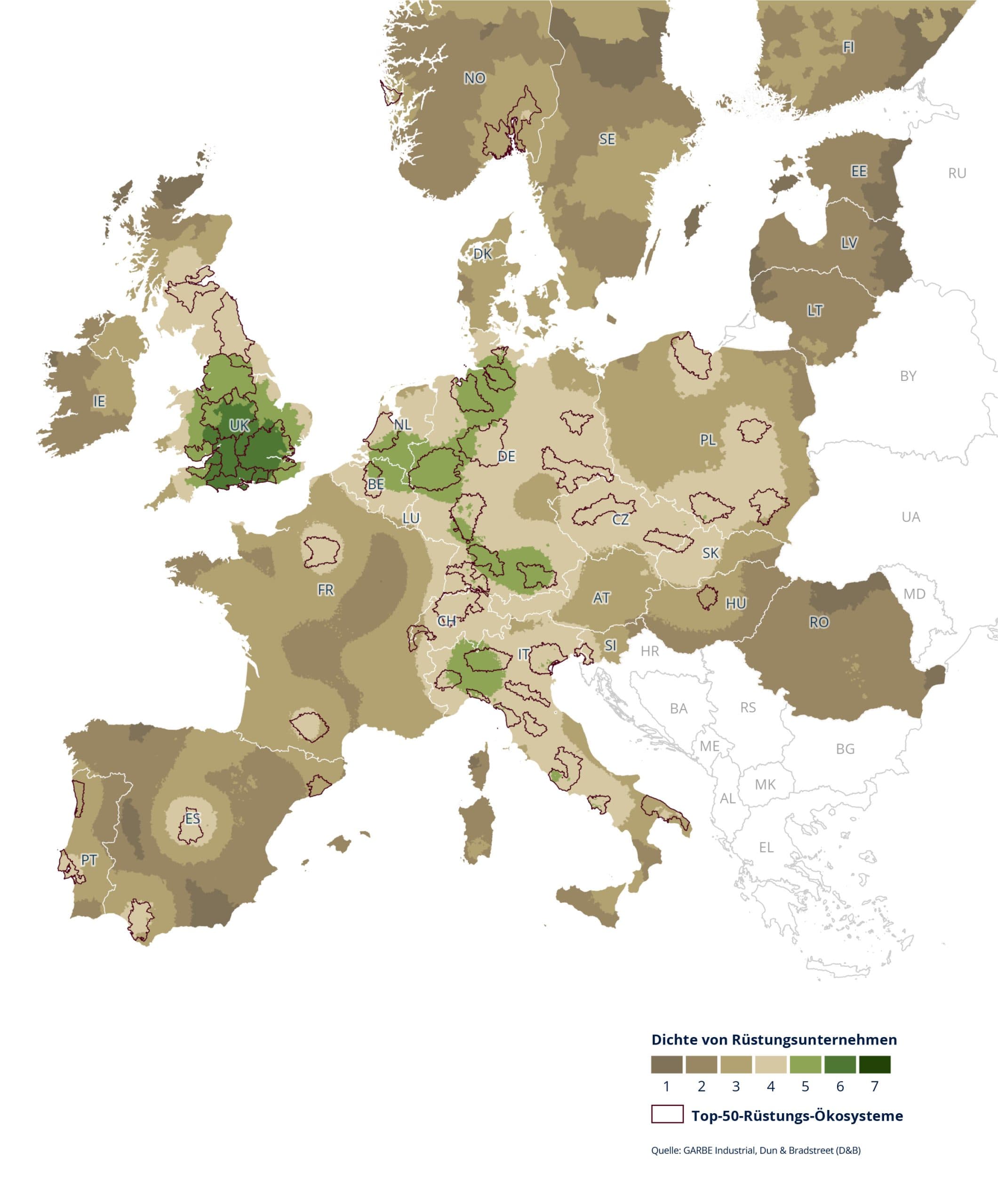
Europe’s largest defence industry hubs are in the UK and Germany
Most defence companies are based in the UK and Germany. In the UK, GARBE Industrial has identified 1,484 companies, and in Germany 639. Particularly large production centres are located in the north-south corridor of England around Birmingham, London and Liverpool/Manchester, as well as in Germany in the Rhine-Ruhr region and in the Munich/Augsburg and Stuttgart/Ulm regions. North-western Italy, around Turin, is also one of the major defence industry hubs. In all the markets compared, the manufacture and integration of military systems is by far the largest of the four production sectors.
“The concentration in these industrial regions is closely linked to the presence of major defence contractors. Companies such as BAE Systems in England, Rheinmetall in Germany and Leonardo in north-west Italy benefit from well-established supply networks, a skilled workforce and a well-developed infrastructure. At the same time, they attract other companies, thereby strengthening the regional production clusters,” explains Tobias Kassner.
Regional priorities vary significantly depending on the defence sector. Whilst the production of military land systems, such as tanks, is primarily based in Germany and Central and Eastern Europe, military aircraft manufacturing is concentrated in established aviation centres such as southern England and Toulouse. The construction of naval vessels is heavily tied to coastal locations with shipyards and port infrastructure. Maintenance and repair facilities, on the other hand, are more widely distributed and are often located near military bases, airports or ports.
Germany leads the way in new production projects
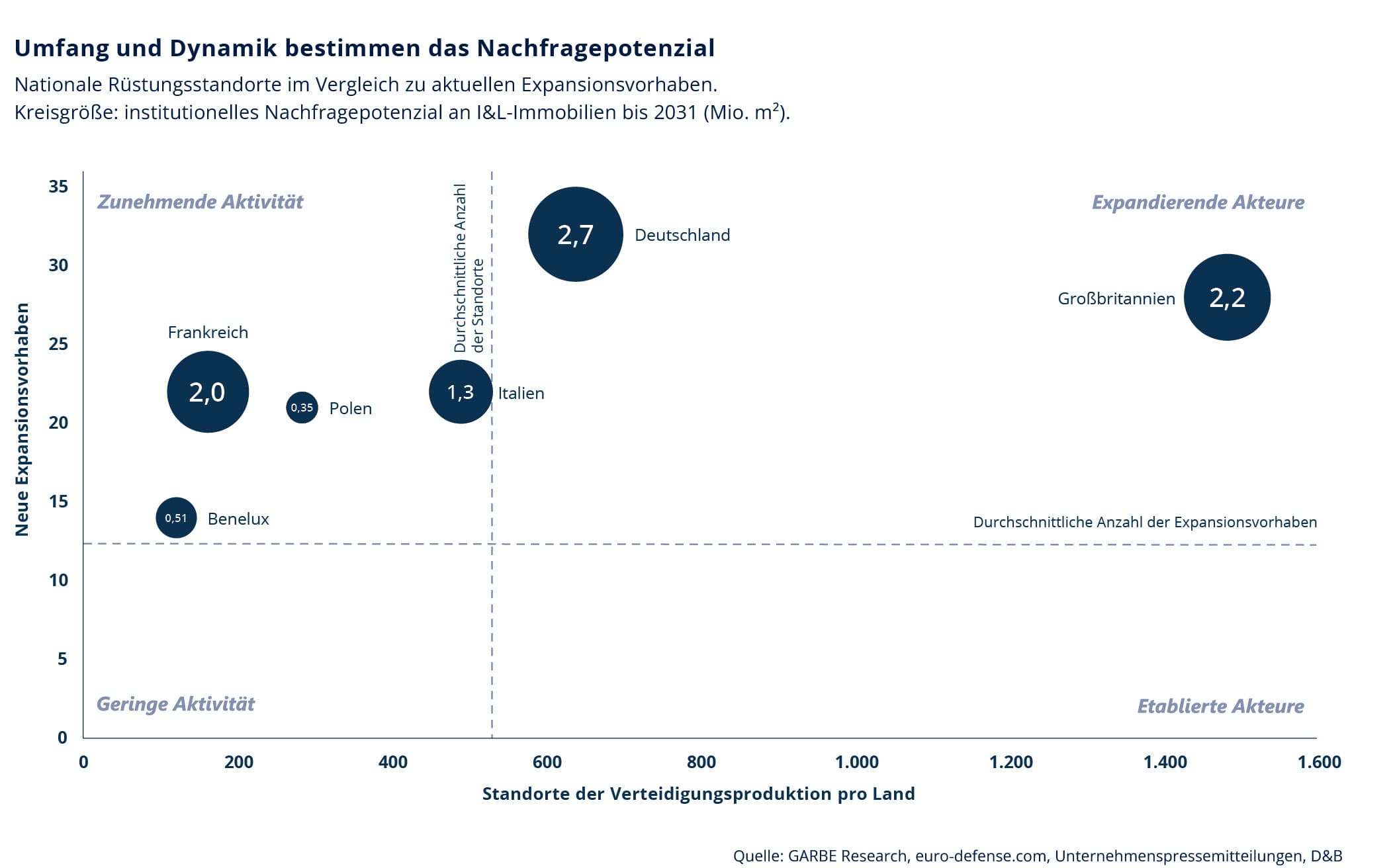
Germany and the UK are also leading the way in the expansion of defence production. Of a total of 256 new construction, expansion and conversion projects recorded since 2022 – including planned and announced projects – 32 (12.5 per cent) are in Germany and 28 (10.9 per cent) in the UK. At the same time, almost a third of the new projects are located on Europe’s eastern and northern flanks in the CEE region, where countries such as Poland and the Baltic states are expanding their domestic defence industries. Growth in Central and Eastern Europe is driven in particular by rising defence spending, proximity to NATO’s military supply corridors and investment by major European defence companies. What is particularly noteworthy is that this growth is driven almost exclusively by new construction projects, whilst extensions or conversions play a negligible role.
Of the 256 projects, 100 involve new builds, 107 involve extensions to existing sites and 49 involve the conversion of existing industrial facilities. “New buildings are more often constructed outside established defence industry hubs, where sufficient development land is available. In existing industrial centres, on the other hand, companies are primarily expanding their production capacities or converting existing factories for defence manufacturing. Former automotive industry sites in particular can benefit from existing facilities, skilled workers and supplier networks,” explains Kassner.
Greatest potential for demand for space in Germany
For the property sector, the long-term potential for demand for space is a key factor, alongside the number and type of development projects. The research team at GARBE Industrial identifies Germany as having the greatest institutional potential for demand for industrial and logistics space by 2031, at 2.7 million square metres. This is followed by the United Kingdom with 2.2 million square metres and France with 2.0 million square metres.
“The additional demand for industrial and logistics space will be concentrated in a few European defence hubs. The best opportunities for investors lie in regions where established production and supply networks are continuing to grow and where additional space will be required in the long term. It is crucial to identify these locations at an early stage and to position oneself there strategically with the appropriate types of property,” says Kassner.
The white paper can be downloaded here: Download Centre