With 970 MW, Frankfurt remains the largest market in continental Europe
The European data center market is undergoing a profound structural change. While demand for digital infrastructure is at record levels, massive investments in AI infrastructure and limited power capacity in established markets are leading to a fundamental shift in the choice of location for new data centers. This is a key finding of JLL’s latest EMEA Data Center Report. According to the report, hyperscalers planned between 2026 and 2028 are located on average 175 kilometers away from major data center hubs – compared to just 46 kilometers for projects completed between 2022 and 2025.
“We are seeing a fundamental change in the way data center infrastructure is planned,” explains Martina Williams, Head of Work Dynamics EMEA at JLL. “Historically, operators have built as close to large population centers as possible. With the growing AI training infrastructure, a different logic is now being followed: the decisive factor is increasingly where sufficient power can be secured – not simply where there is demand.”
Greenfield projects are increasing significantly
The composition of the European supply is shifting from industrial areas to greenfield locations. Between 2022 and 2025, almost 80 percent of the new capacities were realized on established industrial sites or on the outskirts of cities. In the pipeline for 2026 to 2028, greenfield sites already account for 39 percent – an increase of almost five times.
The world’s four largest hyperscale cloud providers are expected to invest $725 billion in 2026, 77 percent more than the $410 billion in 2025. The vast majority goes into AI computing and data center infrastructure. The German market is also of strategic importance here. For example, AWS opened its European Sovereign Cloud in Brandenburg in January 2026, supported by an investment of 7.8 billion euros.
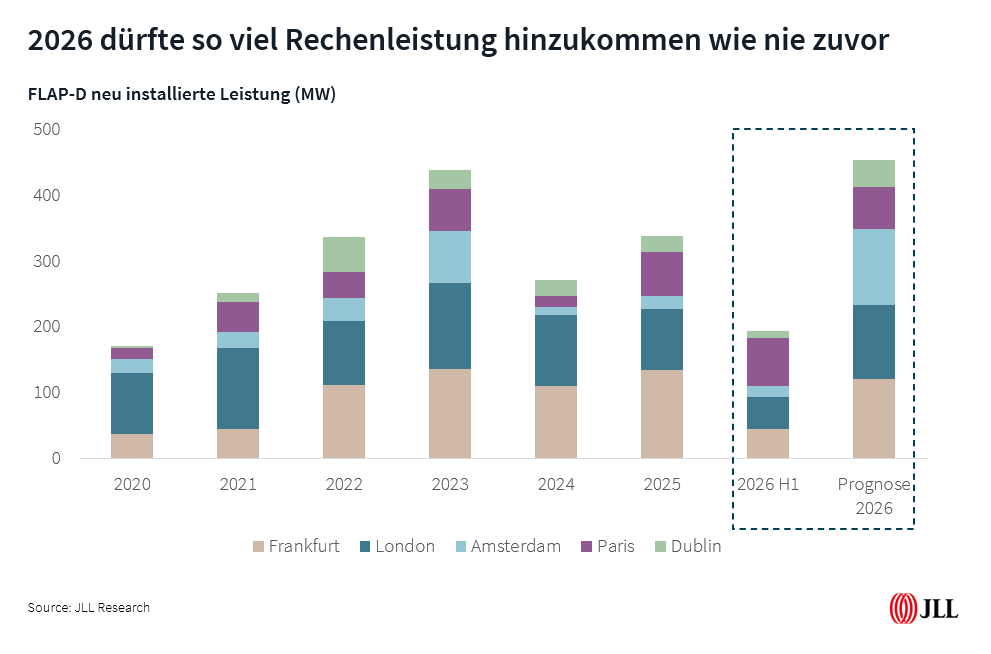
In Germany, Frankfurt remains the largest data center market in continental Europe with an installed capacity of 970 megawatts (MW). This is followed by Paris (614 MW), Amsterdam (611 MW) and Milan (230 MW). Across Europe, London is ahead with 1,277 MW of installed capacity. However, with 311 MW under construction and a further 687 MW planned, Frankfurt has the largest pipeline in Europe. However, grid connections and planning decisions extend the implementation times considerably. According to the grid operators, grid capacities for current applications will not be available until the mid-2030s.
Capacity utilization in Frankfurt has continued to tighten: The vacancy rate is now only 3.1 percent – less than half as much as the average of the five largest data center markets (FLAP-D). In the first half of 2026, 36 MW of new capacity was added, after a record year in 2025 with 128 MW.
Berlin is becoming an alternative location
Berlin has established itself as an attractive alternative location. Capacity has grown to 148 MW, and with a vacancy rate of only 0.9 percent, the market is effectively fully utilized. The pipeline has expanded significantly: 143 MW are under construction and another 379 MW are planned, including large grid-connected campus projects such as the Virtus site in Wustermark.
Frank Weber, Senior Director Client Solutions Datacenter & New Energies at JLL Germany, sees this development as an opportunity for decentralized locations in Germany: “While the industry fixates on congested metropolises, northern and eastern Germany, for example, produces massive electricity surpluses. Wind farms generate more green energy than the region can consume. Surpluses fizzle out unused because of a lack of grid capacity. This is an immense opportunity for the data center industry.”
According to Weber , the often raised objection of a lack of connectivity is increasingly losing relevance: “Latency differences between Frankfurt and Schleswig-Holstein are in the single-digit millisecond range – irrelevant for the vast majority of applications. Cloud architectures have long been designed for geographical distribution. A data center in northern Germany, at least partly powered directly by wind power, has a fundamentally better climate balance.”
Access to the power grid and local acceptance will determine which projects from the pipeline will actually be realized. “Developers who involve municipalities at an early stage, even before projects enter the planning phase, will make the fastest progress.” In the future, access to energy will become a decisive competitive advantage for developers, investors and regions that want to attract AI infrastructure.